

- Solar irrigation brings savings, extra income to Jhenaidah farmers |
- ADB Approves $100m Loan for Affordable Housing in Bangladesh |
- No Respite From Poisonous Air: Radical Cure Urgent |
- Minimising The Energy Shocks In Bangladesh |
Solar irrigation brings savings, extra income to Jhenaidah farmers
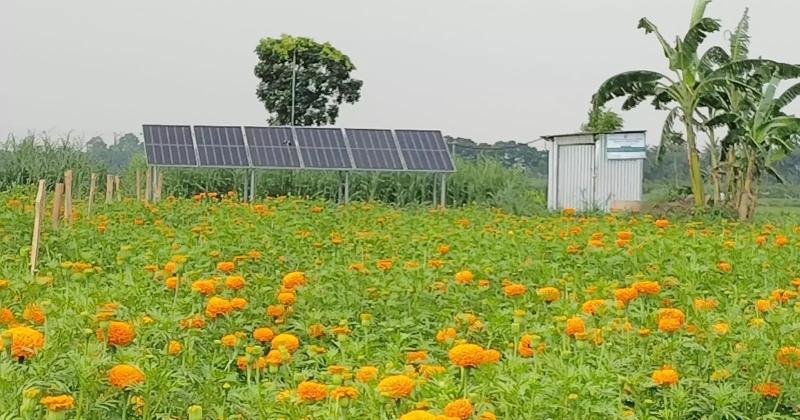
Irrigation pumps have been converted from diesel to solar in Jhenidah.
Amid rising fuel and electricity costs, solar-powered irrigation pumps are helping farmers in Jhenaidah reduce irrigation costs while earning additional income by selling surplus water to other farmers.
According to local sources, 106 solar-powered irrigation pumps have so far been installed in Moheshpur, Kotchandpur and Sadar upazilas of the district. Of these, 32 are located in Moheshpur.
The installations include 34 pumps supported by AID Foundation, seven by the Bangladesh Agricultural Development Corporation (BADC) and 65 by Wave Foundation, while a number of smaller solar irrigation systems have also been installed in different areas.
The Rural Reconstruction Foundation (RRF) is implementing the environment-friendly initiative through its “SMART” project, funded by the World Bank with technical assistance from the Palli Karma-Sahayak Foundation (PKSF).
Solar panels are also being installed at the individual level with support from Infrastructure Development Company Limited (IDCOL).
Solar power takes root among flower growers
Solar-powered irrigation has received a particularly positive response among flower growers in the border areas of Maheshpur.
Gafur Mia, a flower grower in the area, said he no longer has to worry about fuel or electricity after installing a solar irrigation pump.
“After irrigating my own land, I sell the surplus water to neighbouring farmers, which provides me with additional income,” he said.
Farmer Sadikul Rahman, from the same area, established a solar irrigation project with a combination of project loans and grants.
He now irrigates his own farmland and provides commercial irrigation services to another 15 bighas of land in the surrounding area.
Lower irrigation costs
Habibur Rahman, a farmer in Sadar upazila, installed a solar pump at a cost of Tk 170,000, of which he received a Tk 45,000 cash grant from the SMART project.
The benefits of solar irrigation are also becoming visible in Bongkira village of Sadar upazila.
Anisur Rahman, another farmer, said he installed solar panels on his 10-katha plot with assistance from IDCOL.
Farmers Bablu and Shahidul Islam of the same village said solar power is helping them reduce their own irrigation costs while also allowing them to sell irrigation water to other farmers.
They charge Tk 3,000 per bigha for a whole year, which they said is considerably cheaper than conventional irrigation methods.
More pumps planned
Saurav Kumar Biswas, an assistant engineer (Jhenaidah zone) of BADC, said solar power has become increasingly important for agriculture and everyday use amid difficulties related to diesel and electricity.
“Farmers covered by solar irrigation systems in Jhenaidah have been able to irrigate their land as needed despite the problems with diesel and electricity,” he said.
Saurav said electricity generated by BADC-supported solar systems is being supplied to the national grid after meeting the irrigation needs of farmers.
“Even during the current crisis, owners of solar irrigation systems have remained largely free from such concerns,” he said.
Agriculturist Dr Asit Baran Mondal, senior assistant director at RRF, said irrigation costs have fallen significantly with the introduction of solar pumps.
“Previously, it cost Tk 400 to Tk 500 to irrigate one bigha of land using diesel or conventional electricity per month. With solar pumps, the cost has come down to around Tk 250,” he said.
According to him, the reduction in irrigation costs is helping farmers lower their production expenses while also contributing to environmental protection.
A total of 36 solar irrigation pumps under the RRF are currently operational and plans are underway to install more than 100 additional solar pumps across the district soon, he said.- UNB