

- Why is Iran offering to mediate between Saudi Arabia and the Houthis? |
- Biman suspends Tuesday’s Dhaka-Dammam flight |
- First Phase of Union Parishad Polls Set for January 21 |
- PM Seeks Canadian Support for Energy, Agriculture, Climate Finance |
- Saudi-led coalition intercepts drone, Houthi ballistic missile |
The Fight To Preserve Indigenous Languages
3rd International Indigenous Language Journalism Conference held in Kathmandu
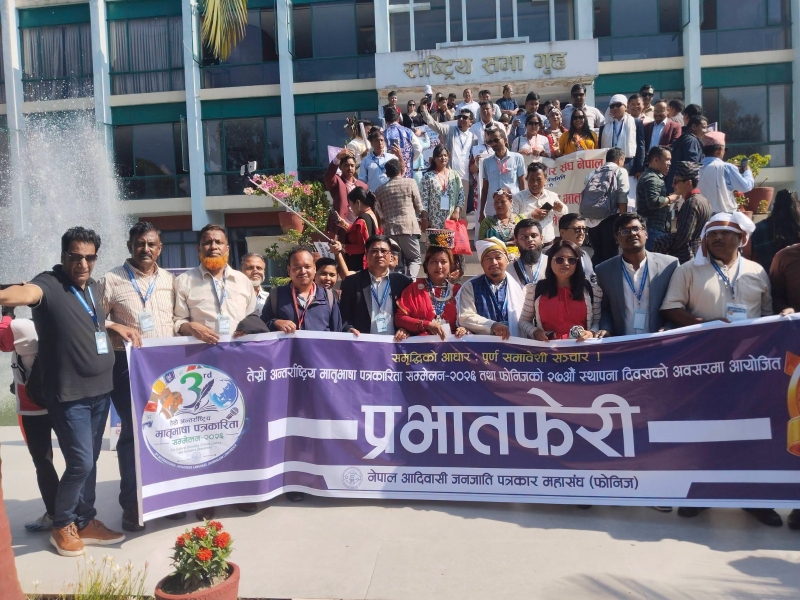
Participants at the 3rd International Indigenous Language Journalism Conference held in Kathmandu, Nepal recently.
Ziaur Rahman back from Nepal
Boishali, a linguistics student from a university in Bihar, travelled to Kathmandu to attend the 3rd International Indigenous Language Journalism Conference. She came with a simple question -- What is the future of her mother tongue?
Her language is spoken mainly within her indigenous community. Like many other indigenous languages in South Asia, it faces growing pressure from dominant languages. These languages are used in education, government, business, mass media and increasingly in digital communication.
Boishali was not alone in her concern. Many participants came to the four-day meet with similar questions. How can their languages survive? Can journalism help keep them alive? And what happens when a language gradually disappears from everyday life?
Held at Rastriya Sabha Griha in Kathmandu, the 4-day conference (August 9-12) brought together indigenous journalists, academics, researchers, media professionals, policymakers, elected representatives and indigenous leaders from Nepal and other countries.
The central theme was -- Indigenous Language Journalism for Cultural Diversity, Climate Justice, and Inclusive Democracy. The message was clear that the mother-tongue journalism is not simply about reporting news in a particular language. It is also about their identity, rights, culture and participation.
Nepal’s Law, Justice and Parliamentary Affairs Minister Sobita Gautam, who inaugurated the conference, spoke about the importance of mother-tongue journalism in preserving linguistic diversity and giving indigenous communities a stronger voice in public life.
The technical sessions took that discussion further. Speakers linked language with cultural identity, traditional knowledge, environmental protection and democratic participation. They argued that when a language disappears, much more than words can be lost. Knowledge, history, customs and ways of understanding nature may also disappear with it.
Nepal’s Education Minister Dasmit Pokharel, President of the Federation of Nepalese Indigenous Nationalities Journalists (FoNIJ) Lucky Chaudhary, President of Newar Journalists Association/National Forum of Newar Journalists Nripendra Lal Shrestha and and Secretary General of the Central Committee of the SAARC Journalist Forum Md. Abdur Rahman also spoke at the opening of the conference.
Dr Pasang Dolma Sherpa, an Indigenous researcher and expert, who attended a plenary session stressed the importance of protecting Indigenous knowledge and customary governance. She called for greater recognition of customary systems and for Indigenous knowledge and cultural practices to be reflected in education.
Other sessions explored climate change, REDD+ (Reducing Emissions from Deforestation and Forest Degradation in Developing Countries, plus conservation, sustainable management of forests, and enhancement of forest carbon stocks.), forest rights, biodiversity, Indigenous agriculture, food security and traditional knowledge. The discussions showed why these issues are closely connected.
According to speakers, indigenous communities often live closest to forests, rivers and other natural resources. They carry generations of knowledge about their environment. Yet their voices are not always heard in mainstream media. This is where mother-tongue journalism can play an important role.
It can take local knowledge to a wider audience. It can document traditions that are at risk of disappearing. And it can allow communities to tell their own stories instead of having others speak for them.
Sunita Dangol, Deputy Mayor of Kathmandu Metropolitan City, linked mother-tongue journalism with linguistic and cultural rights, freedom of expression and inclusive democracy.
The conference therefore moved beyond the question of language alone. It examined who has the right to speak, whose knowledge is recognised and whose stories reach the public.
The four-day event adopted “the Kathmandu Declaration,” which called for stronger policy support for mother-tongue media. It urged governments to develop policies and financial mechanisms to strengthen Indigenous media and recognise mother-tongue journalism as an important tool for social justice, cultural preservation and climate resilience.
But outside the conference hall, the reality is much harder.
Across South Asia, many Indigenous communities still struggle for legal recognition and political representation. Their media organisations often have limited resources. Small community-based newsrooms find it difficult to compete with large mainstream media outlets.
There is another challenge -- indigenous journalists reporting on land, forests, mining, environmental damage or climate change can face pressure. Reporting from the frontline is not always easy or safe. The conference brought these realities into the discussion.
On the opening day, a documentary by a young Bangladeshi university lecturer presented the struggles of a journalist who refused to compromise with his principles. The film left the audience in silence. It was a powerful reminder that journalism is not only about language. It is also about courage, identity and the right to be heard.
For Boishali and many others at the conference, the future of their mother tongues may depend partly on whether they can create spaces where those languages continue to be spoken, written, reported and heard.
The Kathmandu conference offered one such space. But keeping a language alive will require much more than a four-day conference. It will require supportive policies, resources, education, technology and, above all, communities determined to keep their languages alive.