

- MPO-listed teachers’ eligibility for local polls rests with EC: Shahe Alam |
- How Ganges Treaty 1996 Missed Guarantee, Arbitration Clauses |
- Saudi Arabia, Houthis trade strikes over Bab al-Mande |
- Iraq seizes drone-launching pad used targeting Saudi oil pipeline |
- Elena Rybakina beats Aryna Sabalenka to win the US Open title |
Govt takes steps to expand kidney dialysis services at district, upazila level
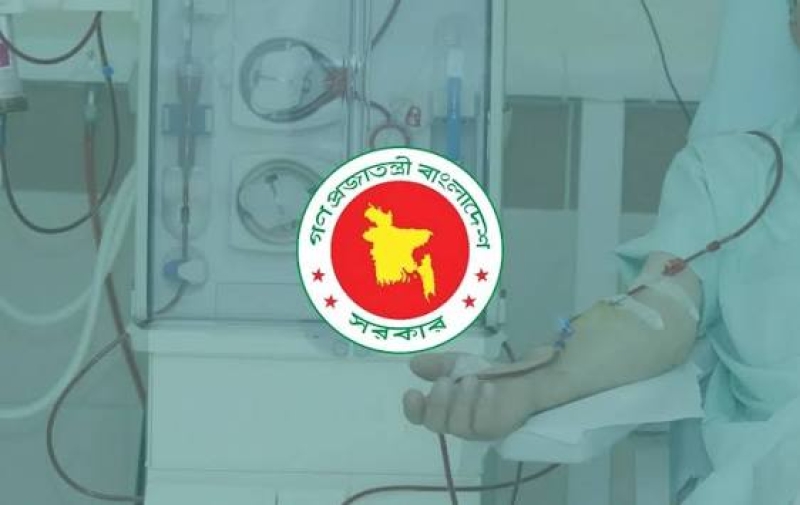
The government is set to introduce dialysis services for kidney patients at all district and upazila levels across the country soon.
Under the plan a three-month training programme is underway for 5,000 nurses and medical technologists on dialysis care, Director General of the Directorate of Nursing and Midwifery Dil Afroza told BSS.
The government has also decided to create 2,500 new posts for nurses and medical technologists, she said.
She said a three-month training programme on kidney dialysis is going on. Ninety nurses are taking training at National Kidney Foundation, 20 in Pabna and 10 in Rajshahi.
Such training programme will begin on a larger scale in several other places including Sylhet, within a few days, she said adding that more nurses would be recruited to ensure dialysis services for kidney patients across the country within the quickest possible time.
Health and Family Welfare Minister Sardar Md Sakhawat Husain said 50-bed kidney dialysis centres would be established in every medical college hospital and 10-bed dialysis centres in every district sadar hospital.
Meanwhile, applications have already been collected from nurses working at public medical college hospitals, specialised hospitals and district sadar hospitals for participating in the training under 2026-27 fiscal year programme.
A decision in this regard had been taken at a meeting of the Health Services Division with Prime Minister Tarique Rahman in the chair on August 12.
The meeting was organised by the Coordination Cell responsible for implementing commitments and proposed programmes of members of parliament.
Following the decisions, the Prime Minister’s Office (PMO) sent the minutes of the meeting, in the form of a Record of Notes, to the Secretary of the Health Services Division on August 24 for taking necessary steps.
Earlier, at a meeting held during the Prime Minister’s visit to the Ministry of Health and Family Welfare on July 20, a decision was taken to establish 10-bed kidney dialysis centres in every district of the country.
According to data from the Kidney Awareness Monitoring and Prevention Society (KAMPS), around 3.8 crore people in Bangladesh are suffering from kidney disease. Around 40,000 patients are dependent on dialysis.
However, dialysis services are largely concentrated in Dhaka and other major cities, leaving many patients in remote areas deprived of access to treatment.
Against this backdrop, the government is planning to expand dialysis services to hospitals at district and upazila levels.
According to the Bangladesh Renal Association, there are around 146 dialysis centres in the country, with 65 to 70 percent in Dhaka. As a result, the availability of such services at the grassroots level remains inadequate.
According to officials, a decision has also been taken to prepare an action plan to establish dialysis facilities at the upazila level three years after the district-level centres become fully operational.
The training will be conducted by the National Institute of Kidney Diseases and Urology (NIKDU) and the National Kidney Foundation.
The meeting also decided to create probationary or entry-level doctors posts to their respective upazilas to address the shortage of physicians at the grassroots level.
If suitable doctors are not available in any upazila, doctors from a neighbouring upazila or district will be posted there.
The meeting also decided to ensure the automatic posting of professors, associate professors, assistant professors, lecturers and consultants, prepared a project to upgrade all upazila health complexes to 151 beds and establish a 600-bed general hospital in Mirpur, reports BSS.