

- Potential For Stronger Saudi Investment Considerable: Ambassador |
- Padma Barrage To Restore River Ecosystem In SW Bangladesh |
- The Urge To Contain Super AI, Today’s Frankenstein |
- Dhaka’s Invisible Inferno: 31 Risky Heat Days In Monsoon |
- Glacier Collapse, Himalayan Tsunami In Nepal: Climate Lesson |
US hopes Dhaka-Delhi can work together on Hasina issue
The United States has expressed its hope that Bangladesh and India can work together to find a solution regarding former Prime Minister Sheikh Hasina noting that it remains a major irritant in Dhaka-Delhi relations.
When a journalist mentioned Hasina’s intention to return to Bangladesh by December and wanted to know US position, a senior official at the US Department of State told the South Asian journalists that they have not taken a formal position on this.
“We understand that it remains a major irritant in the India-Bangladesh relationship, and so we hope that they can work together to find a resolution,” the official said.
The official said Washington had not specifically weighed in on what should happen with Hasina, while encouraging better relations between India and Bangladesh.
"But we have not weighed in specifically on what we think should happen with Hasina. But I will just say in general, we hope to see better – better – we encourage better relationships between both sides. And that’s what we support,"
Asked about the lifting of the ban on the activities of Awami League, the official said the issue was for the Bangladeshi government to decide. "That’s for the Bangladeshi government to decide."
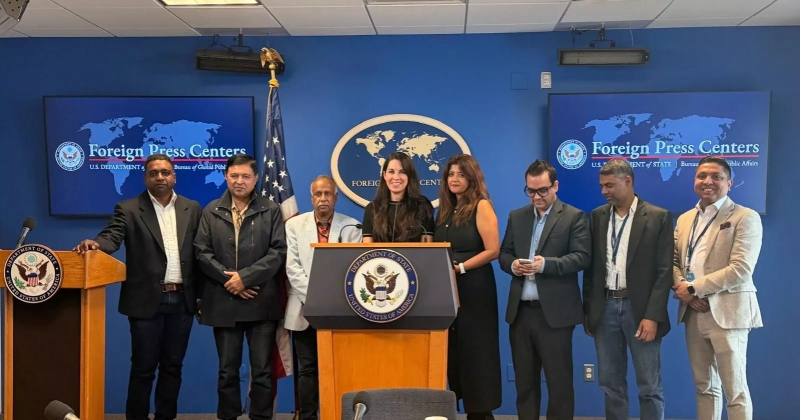
The US State Department official outlined the Trump administration's position at an "on-background" briefing in New York on Wednesday.
The briefing, titled "US Policy in Support of a Stable, Prosperous and Sovereign South Asia," was held at the New York Foreign Press Center.
Journalists from Bangladesh, India, Nepal, and Sri Lanka attended it.
The official also described the current Bangladesh-US relationship as “very strong”, saying Washington was focused on working with the elected government to advance goals aimed at making Bangladesh “stronger and more secure, and more prosperous.”
"We will not weigh in on for the domestic political ongoing discussions inside of Bangladesh, but I will say is that our relationship with Bangladesh, our relationship with the BNP, is in a very, very healthy place," the US official said.
"We continue to work with the elected government, and that’s who we’re focusing on, advancing the goals that are going to make Bangladesh stronger and more secure, and more prosperous, as well as the United States. And so I think we’re not going to weigh in on political domestic ongoing discussions, but our relationship right now with the U.S. and Bangladesh is very strong," the official added.
Counterterrorism Efforts
On Bangladesh-related counterterrorism concerns, the official said al-Qaida was a terrorist organisation and Washington would work with any country on counterterrorism efforts, but declined to comment specifically on a recent UN Security Council sanctions monitoring report because the official had not seen its details.
"I don’t know the details of that report, but I can just say in general al-Qaida is a terrorist organization, and we will work with any country to make sure we help them on counterterrorism," the official said.
The United States is not asking Bangladesh to choose between major powers but wants to provide alternatives, particularly in sensitive sectors such as critical infrastructure and telecommunications, the senior US State Department official said.
“We’re not saying you have to pick this or that, but we want to be able to present them with alternatives that we think are safer and better for their resiliency and better for their sovereignty,” the official said at an on-background briefing on US policy in South Asia.
The official said Bangladesh is in a difficult geopolitical position and Washington understands that countries cannot always be forced to choose between major powers.
“However, there are key areas that we do feel they need to make a choice, and those are things like critical infrastructure. These are things like telecom. These are sensitive parts of their system,” the official said.
The United States, the official said, wants to help Bangladesh uphold its sovereignty and protect its systems by presenting alternatives in such sensitive sectors.
The official said Chinese companies, which Washington views as backed by the Chinese Communist Party, can sometimes be difficult to compete with because of their pricing.
“That’s where we have resources, like the DFC and others, and working with our like-minded friends to make sure we can push alternatives,” the official said.
US-India Cooperation in Indian Ocean
The official also outlined growing US-India cooperation in the Indian Ocean, saying Washington and New Delhi were looking at ways to pool resources and work together in countries including Sri Lanka, the Maldives and Mauritius.
The cooperation would focus on maritime security, combating illegal fishing, human trafficking and narcotics trafficking, as well as strategic and digital infrastructure.
The official said the United States and India had overlapping interests despite their respective “America First” and “India first” policies.
“We both have a strategic interest, and that’s where — and this is something the Secretary — I think you were at his press conference when we were in New Delhi. But America has an America First policy, India has an India first policy, but that doesn’t mean our interests do not align quite a lot,” the official said.
The official said Washington and New Delhi were also looking at ports and next-generation digital infrastructure, including 6G standards.
Trump-Tarique Contact
Asked about possible future meetings between US President Donald Trump and Bangladesh Prime Minister Tarique Rahman, the official deferred to the White House on the president’s schedule.
The official, however, noted that Trump had met Foreign Minister Rahman briefly during the week, while US Secretary of State Marco Rubio had also met him in Manila during an ASEAN-related engagement.
“Those touchpoints have been happening, and I can’t tell you what’s on the schedule coming up, but I imagine there’ll be more opportunities for them to meet,” the official said.