

Saturday, October 3, 2026
News update
- 8 More Die With Measles Symptoms in Bangladesh |
- Hasina wasn't brought to India by its Air Force or Army: Dinesh Trivedi |
- Bangladesh Scales Up Disaster Preparedness Amid Rising Risks |
- Tarique Calls for Deeper Cooperation in Bay of Bengal |
- Dhaka Third Most Polluted City in World on Saturday |
Saudi Arabia Prepares Major Offensive Against Houthis
GreenWatch Desk:
Conflicts
2026-10-03, 8:07pm
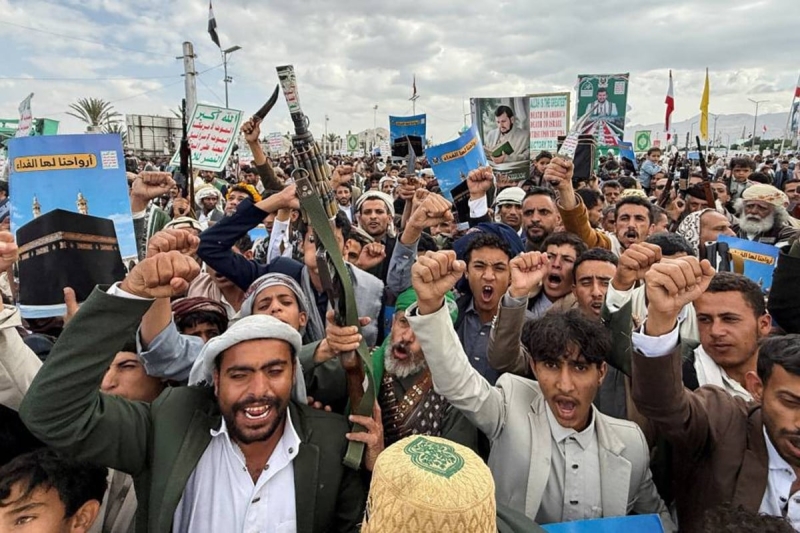
Saudi Arabia is preparing for a possible major military operation against Iran-backed Houthi forces in Yemen, with Riyadh considering several plans to regain control of the Bab al-Mandab Strait and its surrounding areas.
The potential operation could begin within the next few weeks, according to six people familiar with the plans. Saudi-backed Yemeni forces would carry out the main ground offensive, supported by Saudi airstrikes.
Saudi allies are not expected to participate directly in combat operations. The United States is already providing intelligence support for Saudi military operations in Yemen, while several regional and European countries are providing mainly defensive military assistance, according to officials familiar with the matter.
### Two possible plans
Gulf and Yemeni officials said Saudi authorities are considering two possible plans.
Under the first option, a limited operation would target the Bab al-Mandab Strait and nearby areas. The second would be broader, involving coordinated attacks in Yemen's al-Bayda, Marib, Taiz and al-Jawf provinces.
More than 100,000 Yemeni fighters could potentially be deployed, depending on the scale of the operation, according to officials familiar with the plans.
The timing of any operation remains uncertain. The possible timelines provided by people familiar with the plans range from as early as next week to after the US midterm elections in early November.
Saudi and Yemeni governments, the Houthis and the US military did not immediately respond to requests for comment.
### Why Bab al-Mandab matters
The Bab al-Mandab Strait is the southern gateway to the Red Sea and one of the world's key maritime trade routes linking Europe and Asia.
Its strategic importance has increased amid the ongoing conflict involving Iran and the disruption of shipping through the Strait of Hormuz. Any further deterioration around Bab al-Mandab could have significant implications for international shipping and regional trade.
The Houthis have recently advanced along the coast and taken control of areas near the strait, raising concerns in Riyadh. Officials familiar with the plans said reversing that advance and restoring control of the coastal area are among the main objectives being considered for a possible Saudi operation.
A Western diplomat and a Gulf official said Riyadh believes new peace talks with the Houthis would be difficult while the group controls the strait, as that gives them significant strategic leverage.
### Riyadh seeks to avoid another 2015-style war
Saudi Arabia became directly involved in Yemen's civil war in 2015, leading an Arab coalition that supported the internationally recognised Yemeni government after the Houthis seized the capital, Sanaa.
A ceasefire between the two sides took effect in 2022 and largely held for a period. However, tensions have increased this year amid the wider regional conflict involving Iran. The Houthis have also launched missile and drone attacks targeting Saudi-linked shipping and oil infrastructure.
Former US ambassador Michael Ratney, who has studied Saudi affairs, said the potential Saudi operation could be more limited than the campaign launched in 2015.
Saudi Arabia may seek both to contain the Houthis and restore the previous situation along the Bab al-Mandab coast, rather than attempt to completely defeat the group, he said.
### US, Turkey and Pakistan
The United States remains Saudi Arabia's key military partner. A Western diplomat said Washington is providing military advisers and intelligence related to targeting in support of Saudi air operations.
However, the extent of US involvement remains unclear. Previous reporting indicated that Saudi Crown Prince Mohammed bin Salman had sought additional direct US military support, including airstrikes, but that request was not accepted by President Donald Trump.
Turkey and Pakistan, which signed a joint defence agreement with Saudi Arabia last month, are also providing military equipment to Riyadh, according to Pakistani and regional officials.
A Pakistani government official said Pakistan had sent air-defence systems, light artillery, drones and counter-drone equipment to the Saudi-backed Yemeni government's port of Aden in four cargo flights last month.
Pakistani military advisers are also in Yemen assisting Saudi officials and local Yemeni forces, according to Pakistani, Gulf and Western officials. Turkish-made drones previously purchased by Saudi Arabia have also been deployed over Yemen, they said.
### Pakistan will not send troops to Yemen
One of Riyadh's key concerns is protecting its oil facilities and critical infrastructure from possible Houthi drone and missile attacks during any new operation.
Regional officials said Saudi Arabia has sought additional defensive capabilities from several allies.
A Pakistani official said Pakistan has deployed between 30,000 and 40,000 troops to Saudi Arabia to help protect the country's borders and counter drone and missile threats. The troops were sent in several deployments beginning last year, with additional deployments following the recent escalation.
However, Islamabad has made no decision to send Pakistani troops into Yemen for direct combat operations, the official said.
Pakistan's and Turkey's defence ministries did not immediately respond to requests for comment on their military assistance.
France has also announced defensive measures and troop deployments to help protect Yanbu, a Red Sea port city in Saudi Arabia.
### How prepared are anti-Houthi forces?
Saudi Arabia would have to rely on several fragmented and loosely coordinated armed groups in Yemen to conduct any ground offensive. Saudi Arabia and the United Arab Emirates have provided weapons and training to various such groups during different stages of Yemen's civil war.
Questions remain over whether these forces are sufficiently prepared to conduct a prolonged and large-scale offensive against the Houthis.
Yemen analyst Mohammed al-Basha said many anti-Houthi forces remain insufficiently organised or prepared for a sustained campaign capable of forcing back the well-organised Houthi forces. The local forces are also facing pressure as the Houthis increase their activity on several fronts.
Divisions among anti-Houthi forces deepened last winter when UAE-backed southern fighters seized territory in the east and announced plans for a separate state, leading to clashes with Saudi-backed forces. The southern forces were eventually defeated after several rounds of fighting.
### Success depends on local forces
Saudi political analyst Ali Shihabi said the outcome of any potential operation would depend heavily on the capabilities of Yemen's ground forces.
He said the priority of these forces had previously been to defend their positions and maintain stability across different fronts, but they are now preparing to move towards offensive operations.
The effectiveness of any Saudi-led campaign against the Houthis would therefore depend substantially on the ability of local Yemeni forces to carry out sustained ground operations.
Any new Saudi campaign against the Houthis would come amid the wider regional conflict involving Iran and Israel, the disruption around the Strait of Hormuz and growing risks to commercial shipping in the Red Sea.
The Houthis have also assumed greater strategic importance for Iran following the weakening of Hezbollah's military capabilities in Lebanon in recent years. A new Saudi-led campaign could therefore add another significant flashpoint to an already volatile regional security environment.