

- Bangladesh, US sign strategic civil nuclear cooperation agreement |
- Bangladesh Unveils Five-Year Plan to Tackle Pollution |
- Potential For Stronger Saudi Investment Considerable: Ambassador |
- Padma Barrage To Restore River Ecosystem In SW Bangladesh |
- The Urge To Contain Super AI, Today’s Frankenstein |
India must provide Bangladesh's due share of freshwater: Faridul Islam
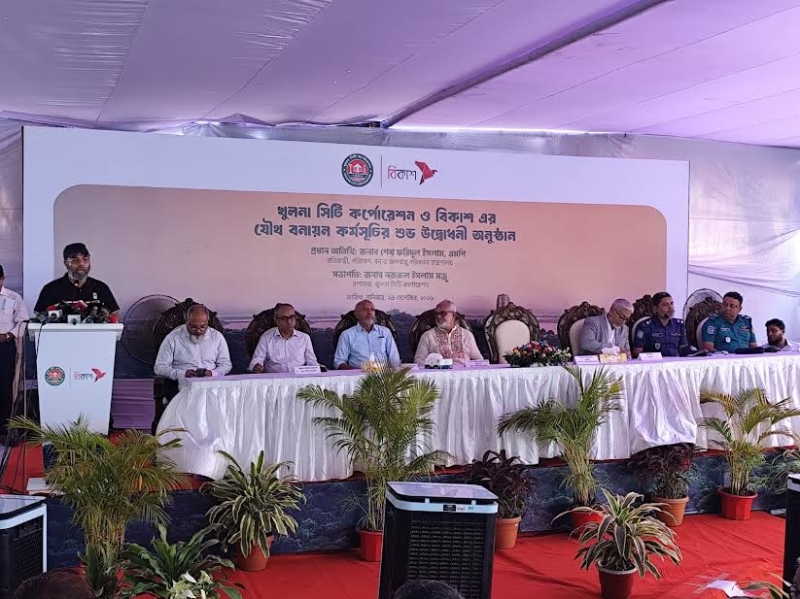
State Minister for Environment, Forest and Climate Change Shaikh Faridul Islam today said rivers and canals in the country’s southwestern region are silting up due to the adverse impact of the Farakka Barrage.
He said for the lack of upstream water flow in the rivers, siltation is taking place there, coming from downstream sources, leading to the filling up many canals and wetlands as well as about 54 rivers.
“Salinity levels are also rising simultaneously. To protect the Sundarbans and the region's biodiversity, India must provide Bangladesh with its due share of freshwater,” he said.
The state minister made the remarks while speaking as the chief guest at the inauguration of a joint afforestation programme by Khulna City Corporation (KCC) and bKash Limited at Solar Park in Khulna’s Sonadanga Residential Area.
He said the freshwater crisis cannot be resolved merely through talks or diplomatic statements, so effective initiatives must be undertaken with India to this end.
Faridul said he also clearly raised this issue during a recent meeting with the Indian High Commissioner. Without the inflow of freshwater from upstream, the natural growth of Sundarbans vegetation — including the Sundari tree — would be hindered at the confluence of saline seawater and freshwater.
He said if the natural balance is disrupted by human or national intervention, protecting the Sundarbans would become difficult.
Strict measures are also required to control pollution from 'Red Category' industrial establishments located near the Sundarbans, he said. The government has planned to plant 25 crore trees across the country, he mentioned.
So far, he said, about 3.5 crore trees have been planted. An additional two crore Keora saplings and seeds are ready for planting in coastal areas during the coming months of December and January, he said.
He said the target is to plant 5.5 crore trees between February of this year and February of next year.
The state minister said about 120,000 palm trees have been planted this year in Jashore, Magura, Narail, Khulna, and Satkhira to mitigate the impact of lightning strikes.
He noted that increasing the number of tall trees — such as palms and coconut —could help reduce the risk associated with lightning.
He mentioned that the government is implementing nature-based programmes such as canal excavation, tree plantation, solar power initiatives, waste management, and the introduction of electric buses.
The objectives of these initiatives extend beyond environmental protection; they also aim to restore rivers and canals, boost fisheries resources, and minimise damage caused by natural disasters, he said.
Highlighting plans to involve educational institutions in curbing plastic and polythene pollution, he said initiatives are underway to make every educational institution in the country free from single-use plastics and polythene.
Discussions regarding this matter have already been held with several institutions, including Jahangirnagar University and the Bangladesh University of Engineering and Technology (BUET), Faridul said.
Commending the Khulna City Corporation’s (KCC) tree plantation and beautification efforts, the state minister remarked that making the city green, clean, and livable is a collective responsibility.
An initiative for tree plantation and maintenance in Khulna city has been undertaken with the support of bKash, including arrangements for the care of the trees over a three-year period, he said.
Presided over by KCC Administrator Nazrul Islam Manju, the event was addressed, among others, by KCC Chief Executive Officer Rajib Ahmed, Khulna WASA Chairman Mohammad Moniruzzaman Moni, Khulna Divisional Forest Officer Md Imran Ahmed, KMP Deputy Police Commissioner (South) Md Rezaur Rahman, and Khulna Range DIG Office Superintendent of Police (Administration & Finance) Md Sajjadur Rahman Russel, reports BSS.