

- Apratim Murder Suspects Confessed, Says Home Minister |
- Dhaka's air decorded unhealthy for sensitive groups Sunday morning |
- Meet Earth’s newest wild cat species, the first named in over a century |
- Bus torched in Mymensingh early Sunday |
- Anthropic, OpenAI, SpaceXAI, Google deal on AI slowdown illegal? |
25 Workers killed in Sikkim Teesta Tunnel Disaster
Eight Disasters Hit Himalayan Hydro Projects in Six Weeks
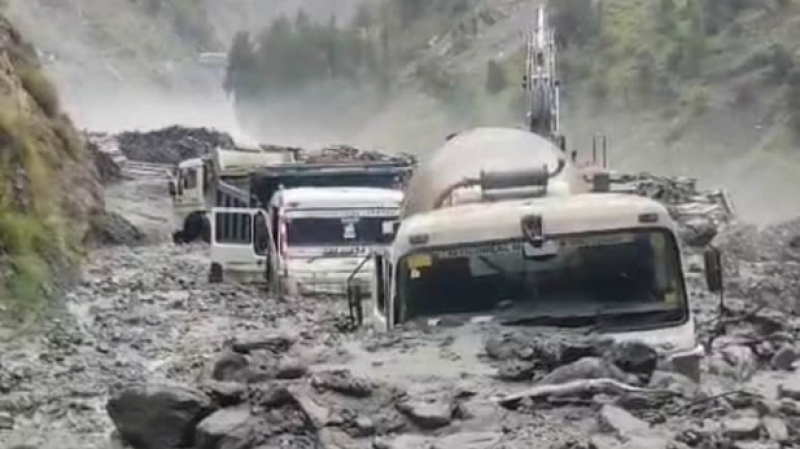
Flash flood in Chenab valley on July 06, 2026 buried several vehicles at Kwar HEP site in Kishtwar. Source NDTV via SANDRP
By SANDRP on August 3, 2026 - Over the past one and a half months of the 2026 monsoon season (since June 24), at least eight (& counting) major accidents and disasters have affected hydropower and dam projects across the Himalayan region. In addition, two recurring landslide lakes have emerged as significant hazards that are either linked to HEP construction activities or have the potential to impact downstream hydropower infrastructure. Notably, these incidents span the Teesta, Brahmaputra, Chenab, Ravi, Beas, Sutlej and Yamuna basins underlining that almost no major Himalayan river basin remains untouched by recurring hydro-related disasters.
The deadliest incident occurred at NHPC’s Teesta Stage-VI HEP in Sikkim, where a methane explosion inside an under-construction tunnel killed 25 workers. Before this, a flash flood near NEEPCO’s Panyor Lower (Ranganadi) HEP colony in Arunachal Pradesh claimed at least five lives, injured several others and exposed serious shortcomings in rainfall monitoring, flood forecasting and emergency response.
While flash floods in the Chenab and Ravi basins disrupted construction at the Kwar, Ratle and damaged Chanju-III HEPs, the landslides at the Chamera-III HEP and the under-construction Lakhwar Dam in the Yamuna basin exposed the vulnerability of workers and project infrastructure. Meanwhile, the expanding landslide lake on Jiva nullah in the Beas basin and the recurring artificial lake at Lippa in the Sutlej basin have renewed fears of sudden downstream flooding.
The repeated occurrence of these incidents across different river basins points to systemic problems including gaps in project planning, geological, hydrological & environmental appraisal, monitoring, SOPs, management plans, independent assessments, accountability norms and regulation. Some common issues include inadequate geological investigations, poor cumulative impact assessment, unsafe muck disposal, weak hazard monitoring, limited disaster preparedness and poor public disclosure after accidents. Climate change is making matters worse by increasing the frequency of cloudbursts, extreme rainfall and flash floods. Worker safety is another major concern as most of the victims are migrant workers employed in hazardous conditions often with inadequate safety measures and emergency protection.
These disasters are becoming more frequent and severe and should serve as multiple wake-up calls for governments, developers, local communities, workers and regulators. Every major accident should be independently investigated, with the findings placed in the public domain and accountability fixed. Future projects need basin-wide cumulative impact assessments, stronger geological and climate-risk appraisal, continuous monitoring, clearly defined and legally mandatory SOPs and management plans, better worker safety, effective early warning systems and transparent disaster management. We are lacking in each of these aspects. Without these reforms, such disasters are likely to become more frequent, possibly more damaging, causing greater human, ecological and economic losses across the Himalaya.
Sikkim: 25 Workers Killed in NHPC Teesta-VI HEP Tunnel Disaster NHPC’s Teesta Stage-VI tunnel disaster has become one of the deadliest accidents in India’s hydropower construction sector and another stark reminder of the multiple hazards associated with large infrastructure development in the fragile Himalayan region.
Beyond the tragic loss of 25 lives, the latest disaster highlights the urgent need for stronger geological investigations, continuous hazard monitoring, real-time gas detection, robust ventilation systems, independent safety audits and specialised underground rescue preparedness at major tunnelling projects.
June 2026: Flash Flood Disaster at NEEPCO’s HEP Site A severe flash flood spell in the Poosa–Yazali area of Keyi Panyor district, Arunachal Pradesh on June 24, 2026, has significantly affected NEEPCO’s 43 colony located near the Panyor Lower Hydroelectric Project (PLHEP) site, close to the reservoir of the HEP. The disaster occurred around 6 in the morning, heavy spell creating a cloud burst like situation. The flood appears to have originated in a Pai (Possa) stream passing through Possa village and joining the Panyor river from the southern side, about 2 km upstream of the PLHEP dam.
Preliminary reports recorded five missing persons, 17 injured people, including three critically injured persons shifted to Gyati Taka District Hospital, Ziro and one confirmed female fatality. Authorities also evacuated five persons from the affected area. The episode raises serious questions about disaster preparedness and risk management in one of India’s most climatically and geologically fragile regions. The available evidence suggests significant gaps in forecasting, monitoring, preparedness, communication and mitigation.
SANDRP Flags Monitoring Gaps in Arunachal Flash Flood Disaster A report by SANDRP has attributed the severe impacts of the recent flash flood at the 600 MW Kameng Hydroelectric Project (Panyor Lower HEP) colony in Keyi Panyor district, Arunachal Pradesh, to major gaps in rainfall monitoring, flood forecasting and disaster communication. The report notes that the Central Water Commission (CWC) has only one monitoring station on the 150-km-long Panyor River, located about 40 km upstream of the project, which failed to capture the highly localised cloudburst and flash flood.
It also highlights the absence of a basin-wide early warning system, delayed public communication by district authorities, and a lack of transparency from NEEPCO regarding the incident. SANDRP further raises concerns over the project’s location in a naturally flood-prone area, the collapse of an under-construction retaining wall, and calls for an independent investigation into the engineering, ecological and disaster management aspects of the incident, with the findings made public.
July 2026: Workers Injured by Rockfall near Chamera-III Dam Site A rockfall at the dam site of the 231 MW Chamera-III Hydro Project narrowly averted a major tragedy on July 24, 2026. The incident occurred close to the dam construction area around 6 PM near Kharamukh on the Pathankot–Bharmour NH in Chamba district, Himachal Pradesh. Around 25 workers were present at the site when a section of the hill slope suddenly collapsed, sending large boulders and debris crashing onto the project site amid a massive cloud of dust. Panic spread across the construction area as workers rushed to safer locations. While most escaped in time, three workers sustained minor injuries after being struck by falling stones.
July 2026: Flood Damages Chanju-III HEP Again in Ravi Basin The increasing incidents of disasters and violations have also raised serious questions about HPPCL’s project planning, construction practices, environmental compliance and disaster preparedness. Before proceeding with its construction, the project should undergo a comprehensive review covering geological stability, cumulative disaster risks, environmental compliance and worker safety through an independent expert assessment.
July 2026: Flood Threat from Landslide Lake in Sainj Valley The repeated landslides in July 2026 around the artificial lake formed on Jiva nullah near Niri village in Sainj Vally in 2023, have enlarged the impounded water body and renewed fears of downstream flooding. While the administration has intensified monitoring through SDRF inspections, local communities continue to seek proactive interventions before another episode of heavy rainfall triggers a major disaster.
July 2026: Recurring Artificial Lake Floods Lippa in Sutlej Basin The recurring formation of an artificial lake at Lippa in Sutlej basin highlights the increasingly dangerous interaction between extreme rainfall, the fragile Himalayan landscape and hydropower project. While the immediate trigger has been intense monsoon-induced flash floods, the repeated impoundment of water points to deeper issues of inadequate drainage, poor muck disposal and the cumulative impacts of hydropower development in the basin.
Unless these underlying causes are addressed through comprehensive management, scientific muck disposal, restoration of natural drainage channels and continuous monitoring of vulnerable mountain streams, Lippa is likely to remain exposed to recurring artificial lakes, placing homes, public infrastructure and local livelihoods at risk every monsoon.
July 2026: Chenab Flood Damages Ratle HEP Coffer Dam in J&K The reoccurring disasters have once again highlighted the growing vulnerability of HEP construction sites across the Chenab basin. They also underscore the need for a cumulative risk assessment and an independent review of disaster preparedness at HEP sites in Himalayan region. This particular disaster needs an independent assessment to understand the role of upstream Kwar Project water releases, SOPs and preparedness of the Ratle project to possible high inflows and how the floods were tackled.
July 2026: Flash Flood Disaster at Kwar HEP Site in Chenab Valley Though, the Kishtwar District Disaster Management Plan (DDMP) 2024-25 acknowledges the potential flood and landslide risks of hydro projects, however it appears to rely primarily on CVPPL’s Disaster Management Plan (DMP). According to the DDMP the CVPPL has its DMP ready to tackle with any disaster like situation. However, the CVPPL has yet to issue an official press release detailing the overall impact of the disaster on the project and its infrastructure.
Fragile Chenab Basin Under Pressure Irshada Mir highlights the growing ecological threats facing the Chenab Basin due to expanding riverbed mining, quarrying, stone crushing, hydropower projects and road construction in one of the Himalayas’ most fragile landscapes. He argues for basin-wide cumulative impact assessments instead of project-wise clearances, warning that fragile geology, landslides, seismic activity and climate change have made the basin increasingly vulnerable. The article concludes that stronger enforcement, scientific monitoring and ecosystem-based river management are essential for the Chenab Basin’s long-term ecological security.
July 2026: Two Landslide Incidents at Lakhwar Dam in Three Days The under-construction Lakhwar dam site on the Yamuna river in Dehradun district of Uttarakhand witnessed two landslide incidents within three days in July 2026. Although there was no loss of life, both incidents damaged construction machinery, exposed the risks faced by workers, and revived concerns about slope stability, construction practices and the suitability of building such a large dam in the fragile Himalayan region.
HYDRO POWER PROJECTS
India’s rarest heron faces a silent end as new dam ignores its home Once a dam in the Lohit river basin is built, it could alter the water’s turbidity and flow, and lead to the local extinction of white-bellied herons. The bird was first scientifically described in 1878, based on specimens from the Teesta region. The species does not occur there today. In fact, it has been ‘critically endangered’ since 2007. The white-bellied heron (Ardea insignis)is among the world’s most elusive birds, nesting along fast-flowing rivers lined with old growth forests. “India has a population of six to nine individuals distributed in three rivers: Noa-Dehing River, Lohit River and its tributary Lahm River”, says Yumlam Benjamin Bida of ATREE (Bangalore).
DAMS
Two die, two missing at Polavaram Dam site Two persons died at the Polavaram Project on July 27. Four workers entered the seepage area (where canal was being dug for dewatering) in Gap 2 area to secure crane hooks to an excavator when operator Takasi Nageswara Rao (50) slipped into deep water. Mechanical engineer Koduri Ravikanth (30), a native of Vizag district, tried to rescue him but was swept away, Polavaram SI P Appa Rao said. Search operations on for others.
Four days back, when the canal was being dug, the Poclain machine sank in it. On July 27, the Poclain driver tried to find the machine, and it began to sink. Ravikanth tried to hold him and drag him out and save him from the canal, but both went under the water and lost their lives.