

- 11-Party Alliance Begins Dhaka-Chattogram Long March |
- Dhaka's air quality turns ‘moderate’ |
- Musk launches steering-wheel-free taxi service |
- Hindu community celebrate Janmashtami |
- Global Food Prices Reach Highest Level Since 2022: FAO |
Rescue Spacecraft Approaches NASA Telescope but Cannot Save It
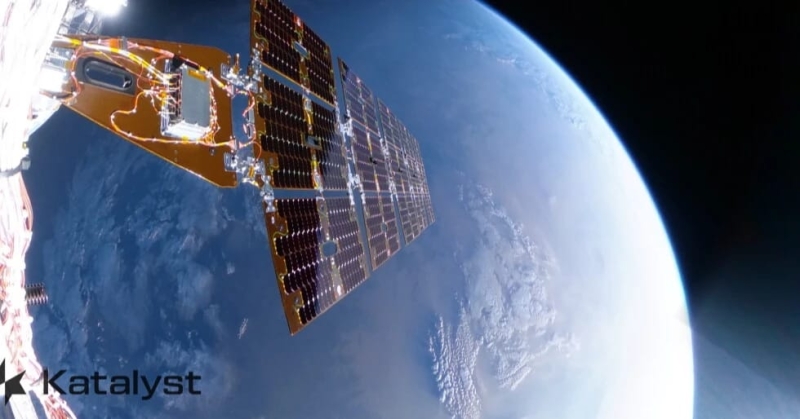
A privately operated spacecraft designed to rescue NASA's aging Swift Observatory successfully approached the troubled telescope and photographed it, despite the rescue mission having been abandoned two weeks earlier.
However, the robotic spacecraft was forced to retreat after running low on fuel, according to Katalyst Space Technologies, the company behind the attempted rescue.
"We got so close, but so far," Katalyst CEO Ghonhee Lee said this week.
Katalyst's Link spacecraft came within about 15 kilometres (9 miles) of Swift on Tuesday. During the approach, its instruments gathered valuable information about the aging observatory for NASA.
Although the rescue attempt was officially cancelled in August because of problems with Link, Katalyst decided to continue the approach as a training exercise for future satellite-maintenance missions.
Shortly after being launched toward Swift in July, Link began spinning uncontrollably. Mission controllers eventually reduced its rotation and regained control, but the effort consumed a significant portion of its limited fuel.
As a result, Link no longer had enough fuel to move Swift into a higher and more stable orbit that could have allowed the telescope to continue its scientific work.
Lee attributed Link's difficulties partly to the speed with which the mission had to be developed. The spacecraft was prepared in only nine months, forcing engineers to use available components rather than wait for their preferred equipment.
NASA spent $30 million on the rescue attempt, which was designed from the outset as a fast-paced experimental mission. NASA and Katalyst both viewed it as an opportunity to test new technology, although they were concerned that a collision could create dangerous clouds of space debris.
NASA Administrator Jared Isaacman said after Sunday's launch of the Roman Space Telescope that the unsuccessful outcome was disappointing but still provided valuable experience.
He said NASA should continue pursuing challenging missions because lessons learned from failures can improve future efforts.
Isaacman also said extending the operational life of expensive spacecraft is worthwhile when doing so costs less than building replacements. The Roman Space Telescope, for example, was designed to be refuelled despite being intended to operate roughly 1 million miles (1.6 million kilometres) from Earth.
Lee said Link probably does not have enough fuel for another close approach to Swift. Nevertheless, the spacecraft can continue testing its three approximately 1-metre robotic arms and gathering useful information before eventually falling back into Earth's atmosphere and burning up in the coming weeks.
Swift was launched in 2004 and still has some time left in orbit, although its remaining lifetime depends partly on solar activity. Strong solar storms in recent years have caused its orbit to decay much faster than anticipated.
By Friday, Swift was orbiting about 208 miles (335 kilometres) above Earth, less than half the altitude at which it began studying some of the universe's most powerful explosions.
NASA expects Swift to re-enter the atmosphere sometime between October and the end of the year. The agency restarted observations with the telescope last week after suspending them earlier this year to preserve its limited power supply.
Solar activity has also caused the orbit of the Hubble Space Telescope to gradually decline. Katalyst is working on a newer spacecraft that could eventually raise Hubble into a higher and more durable orbit.
Lee said Hubble is still expected to remain operational for several more years, meaning any potential servicing mission is not an immediate necessity.
According to Lee, repairing and maintaining aging telescopes and other satellites was once considered a highly specialised idea. He believes such missions will become increasingly common as space agencies and companies seek ways to extend the useful lives of valuable spacecraft.
The report was later corrected to clarify that Link's close approach to Swift occurred on Tuesday rather than the previous weekend, following updated information provided by Katalyst Space Technologies.