

- Dry Monsoon in South Asia: Looming Fears of Agricultural Loss |
- Flood-ravaged Nepal calls for climate justice |
- If Long March Solved Energy Crisis, We’d Organise It: PM |
- Freedom of speech should not cross limits of civility: PM |
- Bangladesh Condemns Israeli Settlement Plan in West Bank |
Bangladesh, Algeria holds talks on energy cooperation
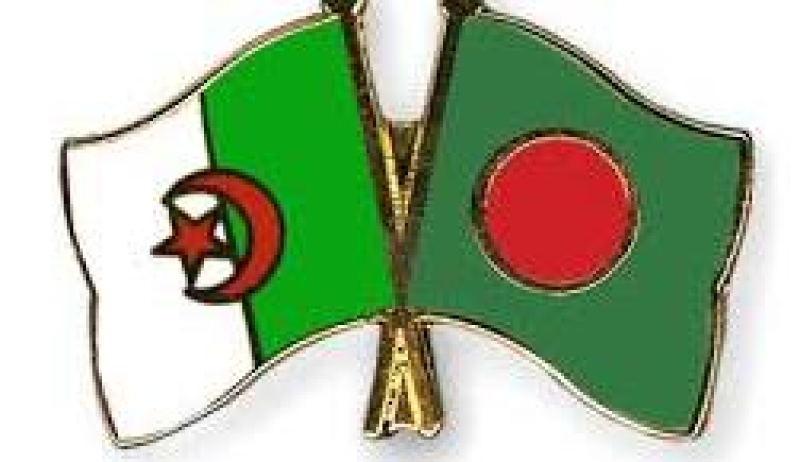
Bangladesh and Algeria crosses flags pin
By Imtiaz Ahmed and Samia Tabassum
Bangladesh and Algeria have held their first-ever high-level bilateral talks on energy cooperation, putting stress on short- and long-term partnership in energy supply, investment and technical collaboration.
The landmark zoom meeting, held at Bangladesh’s initiative on Thursday morning (Bangladesh time), brought together senior government officials and state energy entities from both countries for substantive discussions on crude oil, LNG and gas cooperation, supply arrangements and investment opportunities.
Power, Energy and Mineral Resources Minister of Bangladesh Iqbal Hassan Mahmood and Algerian Energy and Mineral Resources Minister Mohamed Arkab led respective sides at the zoom meeting on energy cooperation.
Energy and Mineral Resources Division Secretary of Bangladesh Md Ziaul Haque, Chairman of the Bangladesh Oil, Gas and Mineral Corporation (Petrobangla) Md Abdul Mannan, Bangladesh Ambassador to Algeria Md. Najmul Huda, Director General of African Wing of the Ministry of Foreign Affairs ATM Abdur Rouf Mondol, among other, joined the zoom meeting
Meanwhile Bangladesh has emphasised growing engagement with African nations, recognising the continent's potential in the changing global scenario under the leadership of Prime Minister Tarique Rahman, said Power, Energy and Mineral Resources Minister of Bangladesh Iqbal Hassan Mahmood
As tensions in the middle-east increased over the USA-Israel imposed war on Iran and control of the Strait of Hormuz and Qatar’s production capacity loss of LNG by Iran war, Bangladesh had to procure energy products including LNG at high prices during the last six months.
According to Reuters, Iranian attacks have knocked out 17% of Qatar's liquefied natural gas (LNG) export capacity, causing an estimated $20 billion in lost annual revenue and threatening supplies to Europe and Asia.
During the meeting, the Bangladesh side outlined the country’s growing energy demand and underscored its strategic priority of diversifying crude oil and gas imports beyond the Middle East to ensure long-term energy security.
Bangladesh expressed strong interest in establishing a government-to-government energy cooperation framework with Algeria and invited an Algerian technical delegation to visit Dhaka at the earliest opportunity to begin formal negotiations.
The working groups of both countries will hold a series of meetings on energy cooperation next week.
Either the Bangladesh delegation will visit Algeria or the Algerian delegation will visit Bangladesh to sign an MOU soon and long-term deal to work on the energy sector.
Algeria remains a major global energy supplier in 2026, driven heavily by its hydrocarbon wealth while expanding renewable capacity to meet domestic and European demand.
The African country holds a reserve of roughly 12.2 billion barrels of crude oil (3rd in Africa) and about 2.5 trillion cubic meters of natural gas (10th largest globally)
Algeria produces close to 1 million barrels of oil daily and supplies roughly 18% of European Union gas imports.
Algeria also highlighted its LNG export capability and ongoing development of upstream and downstream gas infrastructure, while expressing strong interest in attracting foreign investment across the energy value chain.
The Algeria delegation welcomed Bangladesh’s proposal for closer cooperation and assured that the draft MoU would be reviewed and feedback provided at the earliest opportunity.
Both sides described the discussions as frank, constructive and forward-looking, acknowledging significant untapped potential in bilateral energy cooperation.
The two countries agreed to maintain sustained technical-level engagement to translate the strategic dialogue into concrete outcomes, reflecting Bangladesh’s pursuit of diversified and reliable energy sources and Algerian’s ambition to expand export markets and attract international investment.
Xinhua adds: As tensions in the Strait of Hormuz disrupt global liquefied natural gas (LNG) shipments, Algeria is strengthening its position as a reliable gas supplier for Europe, offering pipeline exports that bypass vulnerable sea routes.
European officials, including Italian Prime Minister Giorgia Meloni and Spanish Foreign Minister Jose Manuel Albares, have recently visited Algiers, with both sides describing Algeria as a "reliable and consistent" partner.
Unlike seaborne LNG that must pass through the volatile Strait of Hormuz, a key route for global LNG shipments, Algerian gas reaches Europe directly via pipelines, avoiding maritime disruptions.
According to European data, Algeria currently supplies about 14 percent of the EU's gas imports.
In 2025, Algeria delivered between 39-40 billion cubic meters (bcm) to the EU, accounting for around 13-14 percent of total imports. Most of this is transported via pipelines, primarily TransMed to Italy and Medgaz to Spain, along with some LNG shipments, according to Euronews.
Algerian economic expert Mourad Kouachi told Xinhua that Europe's growing reliance on Algerian gas is "not temporary, but part of a lasting strategy driven by supply security concerns, especially as tensions around key routes like the Strait of Hormuz continue."
"Algeria's location, stability, and track record as a reliable supplier make it a natural choice," Kouachi said.
Ranking among the top 10 gas reserves globally and having partnered with major companies including Sinopec, Eni, Chevron and ExxonMobil, Algeria has strong potential to meet rising demand, he noted.
However, challenges remain for Algeria. The country currently produces about 100 bcm of gas annually, half used locally and half exported. Domestic demand is growing by 3-4 percent each year, leaving limited spare pipeline capacity.
To increase gas output, Algerian Energy and Mines Minister Mohamed Arkab said in October 2025 that the country plans to invest 60 billion U.S. dollars in energy projects between 2025 and 2029.
Kouachi said Algeria has about 4.5 trillion cubic meters of reserves but needs major investment to fully develop them.
Algeria's European and Chinese partners would both be essential in financing and development, he noted, adding that Chinese companies, including Sinopec, are already active in Algeria's oil, gas and renewable energy projects.
Beyond gas, Algeria is also advancing green hydrogen initiatives, including the SoutH2 Corridor pipeline expected to carry up to 4 million tons of green hydrogen to Europe annually.
The country has launched solar projects of more than 3,200 megawatts and plans to expand renewable energy as part of its energy transition.