

- Cultivation of Black Baby watermelons on a rooftop in Kalapara |
- Low pressure area on Bay; Maritime ports to hoist cautionary signal 3 |
- Nandini killing: Man sentenced to death in Lalmonirhat |
- Four of a Rangpur family killed for objecting to Yaba taking: Police |
- Bangladesh Rise to Highest-Ever Sixth in Test Rankings |
Experts Urge Bangladesh to Scrap Unfair Energy Deals
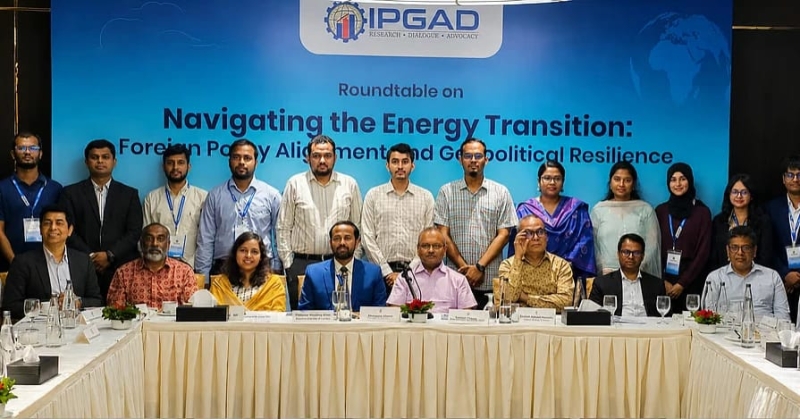
Experts at a policy roundtable on Sunday called for the cancellation or renegotiation of unfair energy agreements, greater use of domestic resources and reduced dependence on imported fuel to address Bangladesh’s energy crisis.
They also stressed expanding renewable energy, strengthening energy sovereignty and ensuring greater transparency and accountability in the sector.
The recommendations came at a roundtable titled “Navigating the Energy Transition: Foreign Policy Alignment and Geopolitical Resilience” at Hotel InterContinental Dhaka. The Institute of Policy, Governance and Advocacy for Development (IPGAD) organised the event, moderated by its Executive Director Mostafa Hossain.
Professor Mushtaq Khan, an economist at SOAS University of London, said Bangladesh’s energy crisis should be viewed from both short-term supply constraints and longer-term structural and production-related problems.
He pointed to what he described as serious flaws in the power sector, saying electricity generation capacity increased fourfold on paper during the previous government, while actual costs increased 11 times and capacity payments rose 20 times.
“This is not normal. Many power plants were approved simply out of greed for capacity payments or plant rents, even though there was no arrangement for fuel supply,” he said.
Discussing the legal challenges surrounding 25-year sovereign agreements, Khan warned that Bangladesh could face difficulties if it sought to resolve disputes over unpaid bills through conventional international arbitration.
Referring to the Adani power agreement, he suggested that Bangladesh should explore legal avenues to establish whether corruption or irregularities had occurred when the agreement was signed.
He also called for alternative arrangements and strategic negotiations in case of any threat to suspend electricity supplies.
“This is not an ordinary bureaucratic task; it is literally a fight to save the country,” Khan said, urging the prime minister to directly oversee energy crisis management.
Lawmaker Mansura Alam highlighted the need for policy reforms and a stronger shift towards renewable energy.
She said the energy transition was not only an environmental issue but also closely linked to the economy.
“Our power sector is now at a very important crossroads. So far, our only goal was to increase generation capacity. But the challenge now is completely different. We must think about how to ensure sustainable, affordable and environmentally friendly energy production,” she said.
Alam said Bangladesh aims to generate 20% of its electricity from renewable sources by 2030 and 30% by 2040. However, she noted that the current share remains around 5%.
Energy journalist and Energy & Power editor Molla Amzad Hossain identified a lack of policy continuity as one of the major reasons behind the current crisis.
He recalled that after the 1973 Arab-Israeli war, Bangabandhu Sheikh Mujibur Rahman purchased five gas fields for £4.5 million, describing the decision as far-sighted.
Hossain criticised successive governments for failing to adequately explore domestic gas resources, particularly in Bhola.
He said Petrobangla had around 4 trillion cubic feet (TCF) of reserves in domestic gas fields but was producing only 600–700 million cubic feet per day, while Chevron was producing around 900 million cubic feet daily from reserves of about 1.1 TCF.
“This is our utter failure,” he said.
Hossain also alleged that large amounts of public money had been wasted on quick-rental power plants and LNG imports.
He called for greater use of energy-efficient appliances, including inverter air conditioners and BLDC fans, to reduce electricity consumption.