

- Potential For Stronger Saudi Investment Considerable: Ambassador |
- Padma Barrage To Restore River Ecosystem In SW Bangladesh |
- The Urge To Contain Super AI, Today’s Frankenstein |
- Dhaka’s Invisible Inferno: 31 Risky Heat Days In Monsoon |
- Glacier Collapse, Himalayan Tsunami In Nepal: Climate Lesson |
Where Climate Resilience Is An Everyday Struggle
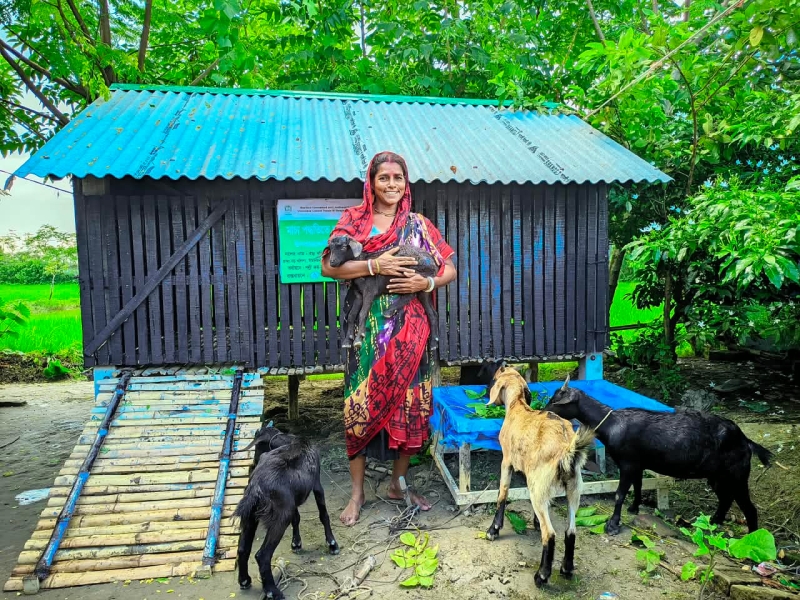
Goat rearing on raised grounds protecting the animal from recurring tides in the Coastal areas of Bangladesh
By Ziaur Rahman
For people living along Bangladesh’s vulnerable southwestern coast, climate change is no longer something discussed only at international conferences. It is visible in the water around their homes, the salt in their fields, the repeated disasters brought by cyclones and the growing difficulty of finding safe drinking water.
Bangladesh contributes less than 0.5 per cent of global greenhouse-gas emissions, according to its latest national climate commitment. Yet the country is among the world's most climate-vulnerable nations and faces recurring floods, cyclones, tidal surges, sea-level rise, salinity intrusion and loss of livelihoods. Coastal people of the country are already paying a heavy price for it. Across the southwest, families are adapting their homes, water supplies and livelihoods to survive a changing climate.
For coastal families, the cost is not measured only in tonnes of carbon emitted or economic statistics. It is measured in costs of houses rebuilt after storms, farmland lost to salinity, livestock kept above floodwater and the growing effort required simply to secure drinking water.
People are not passively observing the climate to change.
Across the coast, families are finding practical ways to reduce their risks—from raising houses and livestock above floodwater to harvesting rainwater, growing vegetables and ginger in small spaces, and turning increasingly saline water into an opportunity for crab farming.
For Kalpona Shornokar of South Kainmari in Mongla, the struggle has been painfully personal. She lives with her husband and two children beside the Pashur River. She has lost her homestead three times to cyclonic storms. The first major blow came when Cyclone Sidr struck in 2007. Other storms followed, bringing new destruction.
Each time, Kalpona and her husband rebuilt their home with whatever they could afford—bamboo, golpata and other locally available materials. But the fragile structures offered little protection against cyclones, tidal surges and saline water.
Now in her sixties, Kalpona hopes those days are behind her. She has received a climate-resilient house through a local NGO. Unlike her previous homes, the new structure stands on a raised earthen mound, helping reduce the risk from tidal surges, waterlogging, heavy rain and flooding. For Kalpona, the house means more than a stronger roof.
It means that she can think about her family's future without constantly worrying about rebuilding the house after every storm. Her family still depends mainly on fishing in the Pashur River and rearing goats. They also grow vegetables whenever possible to supplement their food and income. A safer home, therefore, has become the foundation for a safer livelihood.
Shanai Bibi of Gawrokathi in Chalna has the same feeling. She too has received a climate-resilient house and says she now feels more confident to facing storms, floods and tidal surges. She believes the house will protect her family during disasters and could even provide temporary shelter to neighbours in an emergency. For families like theirs, resilience begins at home.
From climate vulnerability to adaptation
The houses provided to Kalpona and Shanai are part of the Resilient Homestead and Livelihood Support to the Vulnerable Coastal People of Bangladesh (RHL) project being implemented by the Palli Karma-Sahayak Foundation (PKSF), with support from the Green Climate Fund.
The project covers 20 upazilas across seven coastal districts—Khulna, Bagerhat, Satkhira, Barguna, Patuakhali, Bhola and Cox's Bazar. The GCF approved $42.2 million in grant financing for the $50-million project, which is expected to increase the resilience of about a million people.
PKSF’s two partner organizations -- Nabolok Parishad and Ad-Din Welfare Centre -- are implementing the projects in the country’s southwestern coastal region of Khulna.
The houses are built on raised plinths with stronger construction to reduce risks from floods, cyclones and tidal surges. They can also include rainwater harvesting, safe sanitation, solar power and improved cooking facilities.
When a homestead becomes a small farm
A climate-resilient home is not simply a stronger structure. As salinity makes traditional farming increasingly difficult, coastal families are finding new ways to use the small plots of land around their homes.
Families are making maximum use of limited land. Vegetable gardens provide food and, when there is a surplus, additional income. Sweet potato, pumpkin, okra and spinach can be grown around the homestead. Fruit trees such as coconut, guava, lemon, sofeda, amra and neem add food, shade and income. In this way, the homestead itself becomes a small production centre.
This is particularly important where salinity and waterlogging make conventional agriculture increasingly difficult.
“This is not just a climate-resilient home; it has also become a hub for vegetable cultivation, ginger farming, goat rearing and fruit-tree planting, which provides financial support to the families,” said Fazlul Hoque, Director of Ad-Din Welfare Centre.
Growing ginger without farmland
Ginger cultivation in sacks is another example of adaptation on a small scale. Families fill sacks with suitable soil and organic manure and place them around their homes or in other available spaces. Because the sacks are movable, they can be shifted to higher ground when flooding or waterlogging threatens. For households with little cultivable land, the method turns otherwise unused space into productive space.
A small number of sacks may not transform a family's economy. But together with vegetables, fruit trees and livestock, such activities can diversify household income and reduce dependence on a single climate-sensitive livelihood.
Keeping goats above the water
In low-lying coastal areas, goat sheds become wet and muddy during the rainy season. Standing water also creates unhealthy conditions for the animals. Raised platforms provide a simple adaptation. They keep goats above standing water and mud while improving ventilation and cleanliness.
Kakoli Das and Lipi Khatun of the coastal areas of Dacope and Mongla, previously struggled to rear goats in open or poorly protected spaces. Some of their animals died because of poor housing conditions and attack of diseases. With support from local organisations, they received raised platforms for their goats. The intervention may look modest, but for a poor household, protecting even a few animals can be an important source of savings and income.
Intruding salt is used for productive purposes
Salinity presents perhaps the cruellest example of how coastal livelihoods are changing. As saltwater intrusion makes rice cultivation and some forms of freshwater aquaculture more difficult, farmers are looking for livelihoods in brackish-water environments.
Crab farming has emerged as one such option in parts of Khulna and Bagerhat plus areas around Koyra, Chalna and Dacope. Chandrika Mondal, a young housewife from South Kainmari in Mongla, has turned crab fattening into a source of income. In one cycle of about three months, she earned a net profit of around Tk 13,000.
The activity also creates opportunities for women to participate in feeding, cleaning and monitoring the crabs. For Chandrika and others like her, saline water is no longer only a threat to livelihood. Under the right conditions, it can also become part of a new livelihood strategy.
But perhaps the most basic climate challenge is water.
In many coastal communities, saline intrusion has reduced the availability of freshwater for drinking and household use. Rainwater harvesting therefore becomes more than an environmental adaptation. A resilient house that can harvest and store rainwater gives a family an new source of freshwater when ponds and other surface-water sources become saline or unsafe.
The RHL project is explicitly designed around the interconnected problems of vulnerable settlements, climate-sensitive livelihoods and scarcity of safe drinking water.
A separate GCF-supported programme on climate-induced salinity has also focused on strengthening the adaptive capacity of coastal communities, particularly women, and improving water security and climate-resilient livelihoods.
The adaptation measures are not substitutes for large-scale climate action. They are the first lines of defence. Coastal communities also need stronger embankments, reliable freshwater systems, better roads and communication, effective disaster preparedness, access to finance and technology, and markets for climate-adaptive products.
It is about creating conditions in which people can continue to live safely and earn a decent living as the climate changes.
mzrbd60@gmail.com
(From the print edition – GreenWatch. Please see greenwatchbd.com home page)