

- Potential For Stronger Saudi Investment Considerable: Ambassador |
- Padma Barrage To Restore River Ecosystem In SW Bangladesh |
- The Urge To Contain Super AI, Today’s Frankenstein |
- Dhaka’s Invisible Inferno: 31 Risky Heat Days In Monsoon |
- Glacier Collapse, Himalayan Tsunami In Nepal: Climate Lesson |
Glacier Collapse, Himalayan Tsunami In Nepal: Climate Lesson
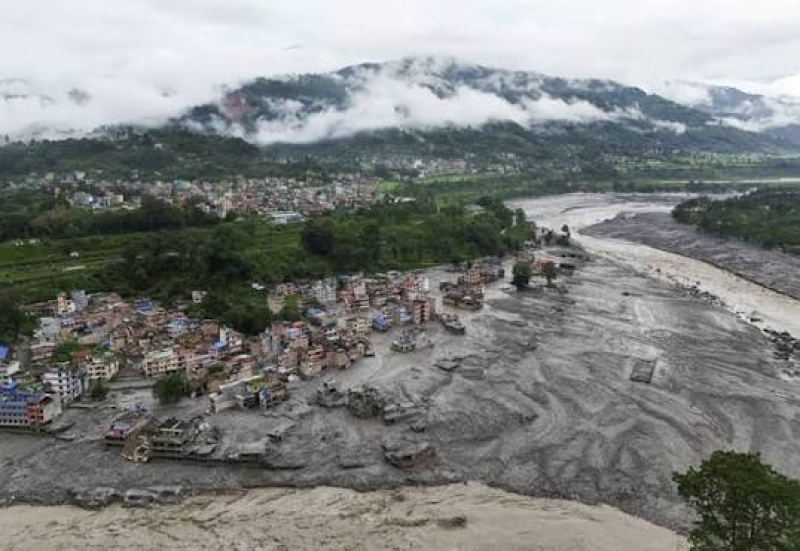
Nepal glacier collapse disaster is believed to be linked to climate change to which the Himalayan nation contributes little.
Mostafa Kamal Majunder
On the morning of August 26, 2026, a deafening roar fractured the silence of the high Himalayas, signalling a humanitarian catastrophe of unimaginable proportions. Near the 23,000-foot peak of Langtang Lirung, a massive section of a high-altitude glacier and its supporting bedrock broke away at approximately 5,200 meters above sea level. The colossal collapse mobilized an estimated 142 million cubic meters of ice, rock, and ancient sediment, plunging 4,000 feet into the valley below. The sheer kinetic impact—equivalent to a magnitude-5.2 earthquake—pulverized the lower glacier and temporarily choked the Lhende Khola river. When that temporary debris dam breached, it unleashed a fast-moving, sediment-heavy wall of water, mud, and rocks that surged down the Bhote Koshi and Trishuli river corridors at average speeds of 188 kilometers per hour. Traveling nearly 100 kilometers downstream, the raging surge caused the Trishuli River to rise by an astonishing nine meters in just 30 minutes. Locally referred to as a "Himalayan tsunami," this trans-boundary mud-debris flood tore through the borderlands of Nepal and the Xizang (Tibet) Autonomous Region of China, permanently reshaping the landscape and claiming thousands of lives in what has become the worst disaster in the Himalayan region in living memory.
The immediate aftermath of the wall of mud was a scene of utter devastation. Satellite imagery captured a terrifying spectacle: entire towns along a 72-kilometer stretch of the river valley were instantly buried under thick layers of gray mud, with a fast-moving torrent washing away everything in its path. Houses, buses, cars, and generations of household belongings were dragged into the current. In Nepal’s affected northern districts of Rasuwa, Nuwakot, and Dhading, local authorities reported that more than 1,400 people had been killed and over 6,150 remained missing. On the Tibetan side of the border, official Chinese government figures listed at least 43 dead and 519 missing. For the survivors, the physical flood has been replaced by an agonizing wave of uncertainty. In the capital city of Kathmandu, the tragedy is personified by Mingma. Her 20-year-old husband, Manoj Tamang, went missing when the mudslide struck the vital trading border town of Rasuwa. Mingma now spends her days pacing the emergency wards and mortuaries of Kathmandu’s hospitals. She walks from reception desks to bulletin walls covered with hundreds of photos of unidentified bodies, carrying a single photograph of Manoj, only to walk back out into the streets in tears. For families like 6 months pregnant Mingma's, the lack of closure extends the trauma indefinitely, transforming an environmental hazard into an enduring psychological prison.
Weeks after the initial surge, the long-term humanitarian crisis is falling heavily on the youngest survivors. The disaster affected more than 84,000 people, including approximately 32,000 children across the northern regions. According to the UN Children’s Fund (UNICEF), around 17,000 children are in urgent need of mental health and psychosocial support. Many of these children witnessed the deaths of parents, siblings, and friends as the water breached their homes. Beyond the immense grief, their secure environments have evaporated; hundreds of schools were damaged or completely flattened, and thousands of families remain displaced in temporary shelters. Furthermore, UNICEF reported that 541 children were separated from their families during the chaotic rush for survival, requiring urgent tracking, protection, and reunification efforts in an environment where basic infrastructure has ceased to exist.
For over a decade, the steep valleys of South Asia have been the epicentre of a massive hydropower boom. The August 26 disaster has turned into a watershed moment for the safety of these mega-infrastructure projects, many of which are heavily backed by international finance corporations and multilateral institutions like the World Bank and the Asian Development Bank (ADB). The Trishuli Basin features dense hydropower development, which bore the full brunt of the Himalayan tsunami. The 214 MW Upper Trishuli-1 project—one of Nepal's largest hydropower plants, which was nearing completion—was heavily damaged by the force of the debris flow. Surface powerhouses, dams, and desanders near the riverbeds were torn apart. Worse still, the disaster turned engineering triumphs into subterranean traps. Hundreds of labourers and engineers were trapped inside the long access tunnels of the Upper Trishuli-1 and the China Exim Bank-funded Trishuli 3A projects when the muddy torrent blocked the entrances with massive boulders and debris.
Critics point out that the multilateral development banks that funded these projects were aware of these hazards. Cumulative impact assessments had previously highlighted the extreme risks of flash floods and glacial hazards in the Trishuli Basin. Yet, funding was pushed through under the label of "Climate and Disaster Resilience" without mandating robust, real-time Early Warning Systems or setting strict limits on building near active riverbeds.
But what caused a stable mountain slope at 5,150 meters to suddenly give way. A comprehensive report released by the World Weather Attribution (WWA) group said that the catastrophe was a compound crisis rather than a standard, isolated extreme weather event. First, high-altitude regions in the Himalayas are experiencing elevation-dependent warming, rising at a rate significantly faster than the global average. This long-term temperature rise thinned the Langtang Lirung glaciers and thawed the deep mountain permafrost that acts as the "glue" holding the rock faces together. Second, the rapid accumulation of liquid meltwater underneath the glacier increased lubrication, reducing the friction holding the mass to the bedrock until it reached a breaking point. Finally, the massive 2015 Nepal earthquake had left structural fractures within the Himalayan rock walls, pre-conditioning the slope to fail under the added stress of modern climate pressures.
The United Nations, alongside its global humanitarian partners, officially launched a $49.6 million emergency flash appeal. The primary objective of this response plan is to deliver immediate, life-saving aid to the 84,000 people left completely destitute. The UN funds are being rushed to provide clean drinking water, water purification systems, emergency healthcare, and temporary classrooms. Most critically, the appeal stresses that families whose homes were entirely erased need durable, insulated shelters within weeks to survive the sub-zero temperatures ahead.
Armed with the scientific backing of the WWA report, Nepal has launched an aggressive diplomatic campaign seeking $20 million from the newly established UN Fund for Responding to Loss and Damage. Foreign Minister Shisir Khanal has stated clearly that Nepal contributes a virtually negligible fraction of global greenhouse gas emissions, yet its people are facing the highly disproportionate, lethal impacts of global warming. The accelerating melting of ancient glaciers and the increasing frequency of cascading mountain disasters are direct consequences of industrial activities thousands of miles away. The Nepalese government is demanding that financial assistance to climate-vulnerable countries be treated as an explicit geopolitical obligation and a matter of legal responsibility, rather than an act of optional charity.
The scale of the destruction has ignited a regional movement demanding a fundamental shift in how mountain environments are treated. Under the collective banner of People for Himalaya, civil society groups across India and Nepal have issued urgent appeals to designate high-altitude and trans-Himalayan zones as strict "no-go zones" for high-risk mega infrastructure. Activists across the Teesta, Brahmaputra, Chenab, and Sutlej basins argue that the rapid expansion of large dams, tunnelling, and unchecked urban growth acts as a force multiplier for natural hazards. Rebuilding infrastructure in the exact same vulnerable valleys, they warn, ensures that future climate anomalies will result in even higher casualties.
Nations like Bangladesh have stepped forward, with organizations like the Bangladesh-Nepal Friendship Society and the Gulshan Society holding vigils in Dhaka, while the Bangladeshi government provided US$1 million to support immediate relief and recovery operations. However, with the UN preliminary assessments estimating building damage alone at $158 million, and total long-term reconstruction costs projected to run into billions of dollars, the road ahead remains long, muddy, and profoundly uncertain. For Mingma, and thousands like her, the cost of global carbon emissions is measured not in dollars, but in the empty spaces left behind in their homes.
(From the print edition GreenWatch. Please also visit greenwatchbd.com homepage.)