

- ADB Approves $100m Loan for Affordable Housing in Bangladesh |
- No Respite From Poisonous Air: Radical Cure Urgent |
- Minimising The Energy Shocks In Bangladesh |
- How Bad Loans, Capital Erosion Pressure Banks In BD |
No Respite From Poisonous Air: Radical Cure Urgent
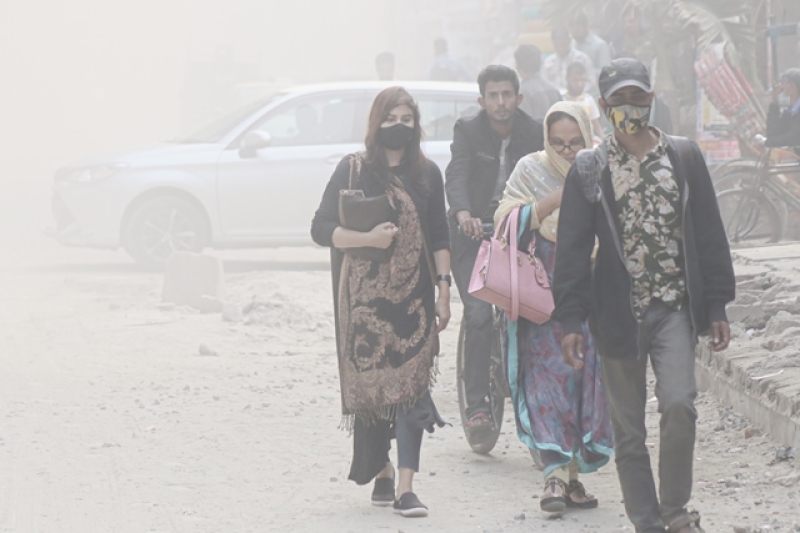
Air pollution in capital Dhaka makes residents helpless.
Special Correspondent
For years, air pollution in Dhaka City has been framed as a seasonal winter affliction. Dwellers of this hyper-dense capital have grown accustomed to the bleak, ash-coloured winter skies between November and March when brick kilns fire up and dust blankets the metropolis. However, recent environmental metrics reveal a far more insidious reality: Dhaka’s air pollution is no longer confined to the dry months. Even during August and September—traditionally the tail end of the cleansing monsoon season—the city’s Air Quality Index (AQI) frequently surges into categories deemed "unhealthy" or "unhealthy for sensitive groups." This off-season pollution has turned out to be a full-blown public health emergency and economic catastrophe.
It shaves years off human lives, drains billions from the national economy, and exposes a regulatory framework that is utterly failing its citizens. To save Dhaka from an irreversible respiratory crisis, the governance structures must pivot towards a radical paradigm shift: stopping pollution strictly at its source.
Historically, the monsoon rains of June through August served as a natural vacuum cleaner for Dhaka’s atmosphere, washing away the deadly particulate matter PM2.5 and PM10. But recent data shows that as soon as the torrential rains pause, even for a day or two in late August, the AQI spikes dramatically. By September, as the transition toward the dry season begins, the natural cleansing mechanism fades entirely. In September, Dhaka regularly registers inside the top ten most polluted major cities on earth. Readings taken during mid-September have shown AQI numbers hovering between 121 and 165, firmly in the "unhealthy" bracket.
This off-season toxicity is largely driven by baseline urban activities that never stop: unfit motor vehicles pumping black carbon, unplanned urban construction leaving heaps of dry earth exposed, and peripheral factories burning materials round the clock, and the air remains heavily laden with gaseous toxins like sulfur dioxide and nitrogen oxides.
Breathing the air in Dhaka during August and September has meant subjecting the human body to a continuous barrage of microscopic poisons. PM2.5 particles are so minute—24 times smaller than the width of a human hair—that they bypass the nasal passages, lodge deep within the lungs, and cross directly into the bloodstream.
The immediate medical manifestations are highly visible in Dhaka’s overcrowded public hospitals. Pediatrics and pulmonology wards see a steady influx of patients suffering from acute bronchitis, severe asthma flare-ups, chronic obstructive pulmonary disease (COPD), and persistent hyper-hypertension. For children, the elderly, and pregnant women, the risks are exponentially worse. Early exposure to these pollutants stunts lung development in Dhaka’s youth, forcing an entire generation to chronic illness. The long-term consequence is premature death.
According to a landmark study by the Energy Policy Institute at the University of Chicago (EPIC), air pollution is the single greatest threat to human health in Bangladesh, outranking smoking, water sanitation issues, and infectious diseases. Its Air Quality Life Index (AQLI) report reveals a horrifying metric: the average resident of Dhaka City loses 7.7 years of life expectancy solely due to ambient particulate pollution. This silent killer claims approximately 68,703 premature lives annually in Dhaka alone.
The crisis in Dhaka is as much an economic catastrophe as it is a medical one. When millions of citizens are chronically ill or breathing toxic air, the financial foundations of the state crumble. A recent study led by researchers at Jahangirnagar University estimated that PM2.5 pollution costs the Bangladeshi economy a staggering $23 billion annually, which constitutes roughly 5 percent of the country's Gross Domestic Product (GDP). This economic drain manifests primarily through two distinct channels.
First, the city suffers a massive loss of labour productivity and work hours. When workers suffer from chronic respiratory illness, migraines, or cardiovascular fatigue brought on by poor air quality, their daily output collapses. Parents are routinely forced to take unpaid leaves of absence from offices, garment factories, and commercial enterprises to care for children hospitalised with respiratory tract infections.
Second, households face escalating healthcare costs. The financial burden on individual families is catastrophic, forcing them to allocate large portions of their disposable income to "extra healthcare"—purchasing inhalers, nebulisers, air purifiers, and continuous regimens of antibiotics and steroid medications. For the urban poor, a single major respiratory hospitalization can wipe out a life's savings, plunging them deeper into poverty.
Responsibility for monitoring and curbing this environmental degradation falls squarely upon the Department of Environment (DoE) under the Ministry of Environment, Forest and Climate Change. However, the institutional response has been marked by staggering inadequacy. While the DoE occasionally conducts mobile court drives against polluting brick kilns or issues nominal fines to owners of black-smoke-belching trucks, these actions are functionally performative. Most entities pay the fine and immediately resume polluting.
Furthermore, enforcement corruption and systemic loopholes allow corrupt actors to bypass environmental clearance certifications, enabling vehicles failing basic emission checks to secure fitness certificates. Lack of automated oversight substantially gives polluters a free pass.
The era of soft regulation, occasional street-sprinkling, and toothless advisory warnings must come to an end. Dhaka cannot build enough hospitals to treat its way out of this dilemma; the city must execute a radical strategy aimed at stopping pollution at its source across all major polluting sectors.
In the transport sector, a radical source-control solution requires an absolute, non-negotiable blanket ban on all commercial vehicles older than 15 years operating within city limits. Simultaneously, the government must spearhead an aggressive transition of mass transit, mandating that public fleets convert entirely to electric or compressed natural gas (CNG) engines to permanently pull smoking vehicles off the streets.
For the construction sector, the city must enforce mandatory, heavily penalised dust-containment protocols. Any private or public mega-infrastructure project that fails to completely enclose its site and deploy automated water-misting systems to suppress dust particles should face immediate project suspension and the revocation of building permits.
The government must enforce a total, permanent shutdown of all traditional fixed-chimney kilns within a 50-kilometer radius of Dhaka. This must be paired with aggressive state subsidies and policy mandates that redirect the market entirely toward the manufacturing and use of eco-friendly, non-fired block bricks.
Finally, peripheral industrial zones must no longer be allowed to pay nominal fines as a license for un-filtered waste dumping and toxic air emissions. Factories must be legally mandated to install Continuous Emission Monitoring Systems (CEMS) wired directly to a centralized, tamper-proof DoE database, for penalisation when emissions exceed safe thresholds.
Dhaka's air crisis is a test of governance and collective survival. The alarming pollution trends in monsoon months prove that the capital is running out of clean days. Clean air is not a luxury or a secondary developmental goal; it is a foundational human right.
Defensive measures against air pollution
Residents can actively reduce the immediate impacts of Dhaka's air pollution on their health by adopting a series of logical defensive protocols.
1. When commuting or walking near major roads residents must consistently wear standard surgical masks or cloth face coverings tightly fitted N95 or KN95 respirators to block fine particulate matter.
2. Check real-time air quality mobile applications or regional monitoring websites before planning outdoor activities. On days when the index crosses into the "unhealthy" bracket, individuals should minimise strenuous outdoor exercise or heavy manual work, to prevent deep inhalation of toxins.
3. Since fine outdoor particles easily penetrate doors and windows, placing air purifiers equipped with True HEPA filters in high-occupancy rooms—especially bedrooms—helps maintain a safe indoor sanctuary.
4. Avoid opening windows during high-traffic commuter hours or when nearby construction dust is airborne. Instead, ventilate living spaces during early morning hours if the ambient air appears clearer.
5. Create Green Barriers with Indoor Plants: Broad-leafed indoor plants like Peace Lilies, Snake Plants, and Money Plants can help absorb minor amounts of gaseous pollutants and improve indoor humidity.
6. Maintain Respiratory Hygiene and Nutrition: Rinsing the nasal passages and throat with clean water after returning home from the streets helps clear trapped larger particles.
(From the print edition - GreenWatch. Please also see greenwatchbd.com home page)