

Saturday, September 19, 2026
News update
- ‘Violence will only defer a problem’: UN Assembly President |
- Ninth Pay Scale Gazette Issued, Higher Salaries From July |
- 11-Party Alliance Begins Dhaka-Rangpur Long March |
- Iran claims it hit an oil tanker in the Strait of Hormuz |
- Dhaka Air Quality Unhealthy for Sensitive Groups Saturday |
Black Smoke, Flames Seen Near Riyadh Airport After Alert
World News
2026-09-19, 8:18pm
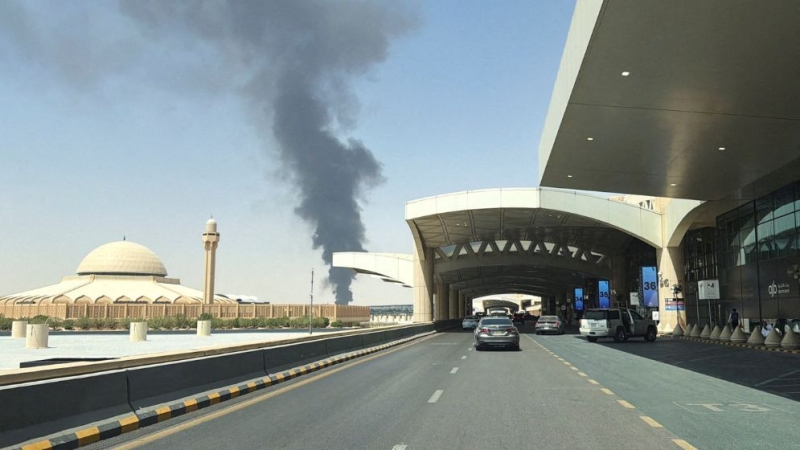
Large plume of black smoke rises from the fuel storage area at King Khalid International Airport, in Riyadh, Saudi Arabia, 19 September 2026. Picture taken with a mobile phone.
Black smoke and flames rose near Riyadh's King Khalid International Airport on Saturday, with flights reportedly cancelled and delayed hours after Saudi authorities issued an air raid alert.
Firefighters were seen attempting to extinguish flames near what appeared to be fuel storage tanks at the airport, according to footage and reports from the scene.
Flight tracking website FlightRadar24 reported major disruption at the airport, placing it under its highest disruption index.
The disruption followed an overnight air raid alert issued by Saudi authorities, the first such warning for Riyadh since fighting in neighbouring Yemen intensified.
Residents reported hearing explosions in parts of the Saudi capital after the early morning alert. One resident said black smoke and fire could be seen in the direction of the airport.
Saudi civil defence later issued an all-clear after the alert. Saudi authorities had warned residents of a potential hostile aerial threat and urged them to remain indoors.
Houthi offensive
Yemen's Houthis have launched a major offensive this month, seizing large areas of territory and putting the internationally recognised Yemeni government, backed by Saudi Arabia, under increasing pressure.
Saudi Arabia has carried out airstrikes on Houthi-held areas but has failed to halt the group's advance. Riyadh has also sought assistance from the United States.
The renewed fighting has brought the conflict closer to the Saudi capital and added to instability in a region already affected by the wider Middle East war.
The Houthis have also expanded their presence along Yemen's Red Sea coast, raising concerns over the strategic Bab al-Mandab Strait, a major maritime route.
The United Nations said the renewed fighting had displaced more than 112,000 people, while nearly 3,000 others had crossed the sea to Djibouti.
The conflict in Yemen began in 2014 after the Houthis seized control of the capital, Sanaa, and other areas. Saudi Arabia led a military intervention in March 2015.
A fragile truce reached in 2022 collapsed in July as fighting resumed.
The latest escalation has also affected maritime trade, with Saudi oil exports through the Bab al-Mandab Strait declining since July, according to maritime tracking data.