

- Bangladesh, US sign strategic civil nuclear cooperation agreement |
- Bangladesh Unveils Five-Year Plan to Tackle Pollution |
- Potential For Stronger Saudi Investment Considerable: Ambassador |
- Padma Barrage To Restore River Ecosystem In SW Bangladesh |
- The Urge To Contain Super AI, Today’s Frankenstein |
Padma Barrage To Restore River Ecosystem In SW Bangladesh
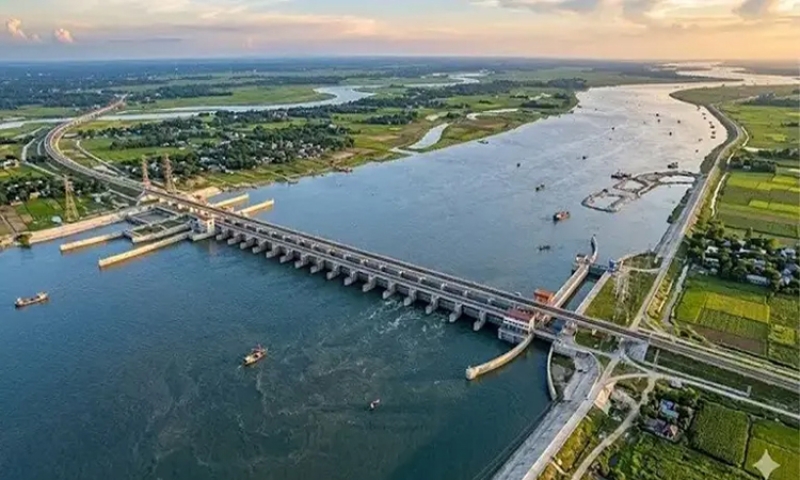
Padma Barrage model prepared by Bangladesh Water Development Board engineers.
Abul Quasem Haider
The soil of Pangsha did not merely crack; it flaked away like old, sun-baked skin. For over five decades, the farmers of Rajbari and the vast southwestern reaches of Bangladesh had watched the horizon with a mixture of desperate hope and mounting grief. The Padma, once a roaring titan that dictated the rhythm of life, had been reduced to an exhausted trickle during the scorching dry seasons. Downstream, the consequences were devastating: the Sundarbans choked on invading salinity, fields in Kushtia turned to dust, and the vibrant fish populations of the Ganges dependent areas simply vanished into memory.
The roots of this quiet tragedy reached back to the 1970s, when the construction of the Farakka Barrage upstream fundamentally altered the geography of the region. As the waters were diverted, a slow-motion ecological catastrophe crept across twenty-four districts. Major river systems—the Hisna, Matha Bhanga, Gorai-Madhumati, Chandana-Barashia, Baral, and Ichamati—gradually lost their currents, transforming from vibrant trade and agricultural veins into stagnant, mud-choked channels. For sixty-five years, the concept of a domestic barrage to counteract this devastation was tossed through the corridors of power, buried under mounds of bureaucratic feasibility studies, and repeatedly sidelined by geopolitical anxieties and reported objections from neighbouring India.
Falling water levels in the Bangladesh part of the Ganges has compelled engineers of the Ganges-Kobadak Irrigation Project, the country’s largest, to lower the levels pumps that lift water from the river to irrigation canals, as water of the river are being increasingly diverted not just at the Farakka Barrage but also five other such structures commissioned all along the river in India. The river has come down to ten percent of its historical flow at the Farakka point, veteran water engineers say.
Yet, on May 13, 2026, the heavy air inside the Executive Committee of the National Economic Council (ECNEC) conference room in Dhaka shifted. Chaired by Prime Minister Tarique Rahman, the meeting concluded not with the usual deferrals, but with a historic, definitive stroke of a pen. The government formally approved the first phase of the long-delayed Padma Barrage Project, authorizing an initial allocation of Tk 34,497.25 crore out of a projected total cost of Tk 50,443.64 crore. Conceived under the close, personal supervision of the Minister of Water Resources, Shahid Uddin Chowdhury Annie, the ambitious plan signaled a bold departure from decades of diplomatic paralysis.
"This is an entirely domestic initiative," Minister Annie stated firmly, addressing the longstanding apprehensions regarding external approval. "It is our own blueprint, engineered for the survival and economic rejuvenation of our people. There is no requirement for foreign consultation when the primary objective is safeguarding our own sovereign territory from desertification."
The Padma Barrage project to mitigate dry-season water crises and revive dried-up river systems. The mega project, scheduled for implementation between 2026 and 2033, aims to improve water management and boost agricultural and fisheries production across the northern and the northwestern regions of Bangladesh.
The engineering blueprint developed by the Bangladesh Water Development Board (BWDB) is designed to transform the regional landscape. Spanning 2.1 kilometers across the Padma River in the Pangsha area of Rajbari, the proposed barrage is engineered not to block the river's flow, but to intelligently manage it. The massive concrete structure will feature 78 high-capacity spillways and 18 specialized sluice gates to precisely regulate water levels, alongside a modern navigation lock to restore lost commercial shipping routes. Crucially, the design includes two dedicated fish passes—specialized aquatic corridors allowing native species to bypass the concrete barriers safely to spawn, ensuring that the infrastructure does not inadvertently disrupt the river's fragile ecosystem.
The primary mechanism of the project relies on monsoonal capture. During the heavy summer rains, when the Padma swells with an abundance of water, the barrage will close its gates to trap and store up to 2.9 billion cubic meters of water. When the dry season arrives and the natural flow drops drastically, the reservoir will systematically release a steady supply of approximately 800 cusecs into the dying distributaries.
By breathing life back into the Hisna, Gorai, and Ichamati, the project aims to secure consistent irrigation for roughly 1.9 million hectares of agricultural land stretching across Pabna, Jessore, Khulna, and Barisal. Economists and agricultural scientists project that this stable water supply will boost national agricultural yields by 100,000 tons of paddy annually, while revitalizing inland fisheries to yield an additional 2.34 million tons of fish. In total, the direct socioeconomic benefits to the local population are estimated to reach an impressive Tk 8,000 crore every year.
Despite the optimistic projections, the sheer scale of the undertaking has sparked intense debate among economic analysts, environmental scientists, and policymakers regarding execution and long-term sustainability. The government’s decision to fund the monumental project entirely through the national treasury has drawn both praise for its display of sovereign independence and caution from financial experts.
Economic analysts argue that relying solely on state funds could place an unnecessary burden on the national budget, potentially squeezing out resources for other vital public sectors. Financial commentators suggest a more balanced approach:
• Diversified Financing: Securing low-interest development loans from global institutions like the World Bank or the International Monetary Fund (IMF) could spread the financial risk.
• Technological Oversight: Partnering with international financial bodies would introduce stringent multi-tiered oversight, ensuring the project avoids the delays and structural flaws that often plague large-scale public works.
• Global Expertise: International collaboration would guarantee the integration of advanced global engineering standards and specialized marine technology, safeguarding the project's long-term durability.
Environmentalists, while welcoming the intervention, stress that a physical barrage is only half the solution. They emphasize that the second phase of the project—focused on the extensive dredging and ecological restoration of the Chandana-Barashia, Baral, and Ichamati riverbeds—must be executed with absolute precision. Without continuous, aggressive desiltation, the newly managed waters will simply pool into clogged channels, failing to reach the distant, parched fields of the southwest.
Furthermore, the geopolitical dimensions of water management continue to hover over the project. While the administration's bold unilateral stance has energized national pride, veteran hydrologists point out that the Ganges-Brahmaputra basin is inherently interconnected. They note that while a domestic barrage can successfully store monsoon surpluses, it cannot generate water out of nothing if upstream flows dry up entirely. Consequently, they argue that long-term environmental security will eventually require sophisticated, data-driven diplomacy alongside concrete infrastructure.
As the initial construction phase kicks off, slated to run through 2033, the atmosphere along the banks of the Padma is charged with a renewed sense of purpose. The scepticism that accumulated over sixty-five years of broken promises is gradually giving way to tangible momentum. The recent announcement that the administration will simultaneously implement the comprehensive Teesta Master Plan has further solidified expectations that a fundamental shift in national water resource management is underway.
For the farming and fishing communities of Rajbari, Kushtia, and beyond, the project represents far more than an ambitious engineering feat or a collection of impressive macroeconomic statistics. It represents the return of their livelihood. The concrete foundations soon to be laid into the riverbed carry the weight of a historic ambition: to finally halt the creeping sands of aridity, push back the advancing salt tides of the south, and ensure that the historic waters of the Padma continue to sustain the nation for generations to come.
(Abul Quasem Haider: Founding Chairman Eastern University, Islamic Finance and Investment PLC, Australian International School and Abul Quasem Haider Mohila College, Sandwip, Chattagram, Former Senate Member, University of Dhaka and Former Vice President FBCCI. E-mail-qhaider@youthgroupbd.com Mobile: 01552367883.)
(From the print edition – GreenWatch. Please also see greenwatchbd.com home page)