

- Woman killed, 4 of her family missing in Meghna boat capsize |
- State can never be strong keeping citizens powerless: PM at UNGA |
- Trump welcomes Xi in Washington as US-China trade truce extended |
- Prevention at heart of govt’s healthcare reform: PM |
- Death toll rises to 11 following typhoon-induced downpours in Japan |
Tarique Rahman on world stage, voicing Bangladesh’s aspirations
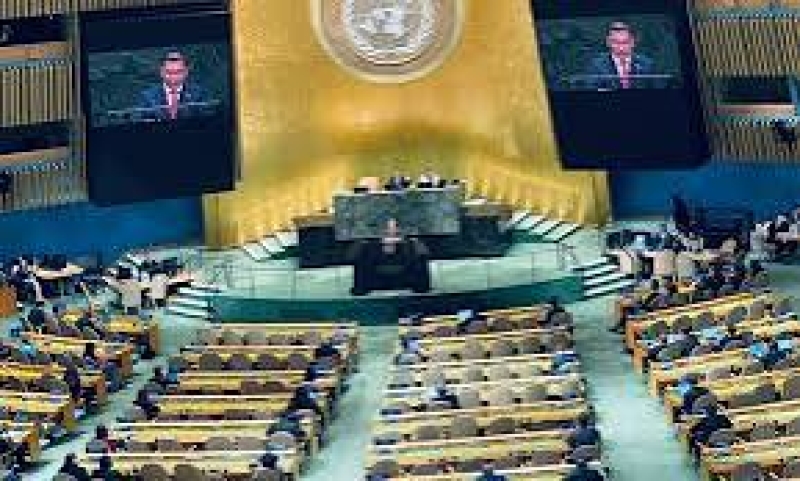
The vast General Assembly Hall of the United Nations was filled with world leaders as Prime Minister Tarique Rahman walked to the podium in a black suit and red tie, smiling and acknowledging greetings from the audience.
As he took the floor at the 81st session of the United Nations General Assembly, the hall broke into applause.
For a moment, the attention of Bangladesh and the wider international community turned to the Bangladeshi leader standing at the podium of the world’s premier multilateral forum.
It was more than a speech by a head of government. From the global stage, Tarique Rahman presented Bangladesh’s aspirations, concerns and expectations, while placing the country’s message before the international community at a time when conflicts, displacement and humanitarian crises continue to challenge the world.
At the outset, the prime minister paid tribute to the martyrs of Bangladesh’s Liberation War and to those killed and injured during the July-August 2024 mass uprising, recalling the sacrifices that shaped the country’s journey.
He then turned to the challenges confronting the world. In a world witnessing conflicts, displacement and humanitarian suffering, Tarique Rahman called for dialogue, diplomacy and mutual cooperation to resolve disputes.
He said international relations should be based on equality, fairness, mutual interests, respect and dignity, stressing the importance of the United Nations in building an understanding-based global community that respects the independence and sovereignty of all nations.
He also reaffirmed Bangladesh’s support for UN initiatives aimed at establishing global humanity and world peace.
The prime minister’s message on peace was closely linked to Bangladesh’s longstanding position on disarmament, non-proliferation and arms control. He said military expenditure at the cost of development budgets remains an obstacle to lasting peace.
The issue of Palestine also found a prominent place in his address as he reaffirmed Bangladesh’s unwavering support for the legitimate demands of the Palestinian people, including their right to self-determination and an independent State of Palestine.
Referring to more than 1.2 million forcibly displaced Rohingyas sheltered in Bangladesh for more than nine years, the prime minister said the origin of the crisis lies in Myanmar and that its solution must also be found there.
“The only solution to this problem is the safe return of the displaced Rohingya population to their homeland, Myanmar,” he said, calling for firm and effective international support for their repatriation.
He also urged the international community to continue life-saving humanitarian assistance until their safe return becomes possible, warning that failure to ensure justice could turn the prolonged crisis into an even greater humanitarian catastrophe.
Migration was another issue through which Bangladesh placed its concerns before the global community.
As one of the major labour-sending countries, Bangladesh reiterated its commitment to regular, safe and orderly migration and called for stronger international cooperation to protect the rights, dignity and welfare of migrants.
Tarique Rahman also highlighted Bangladesh’s role in global peace efforts, noting the country’s commitment to multilateralism and its role in the UN Peacebuilding Commission.
He recalled the contributions of Bangladeshi peacekeepers serving in UN missions around the world and highlighted the participation of women in peacebuilding in line with the Women, Peace and Security agenda.
Climate change, another major concern for Bangladesh, also featured in his address. Despite contributing little to global emissions, Bangladesh remains highly vulnerable to climate change and therefore called for stronger international action on climate justice, climate finance and adaptation support.
Beyond the immediate global challenges, the address also carried a strong message about Bangladesh’s own aspirations.
The prime minister spoke of building a prosperous, self-reliant and welfare-oriented democratic Bangladesh through recovery, restoration and reconstruction, with emphasis on youth employment, women’s empowerment, education, innovation and social protection.
He outlined initiatives aimed at creating opportunities for young people, supporting women and expanding access to education and skills, while also stressing the need to prepare Bangladesh for a rapidly changing world shaped by technology and artificial intelligence.
Yet the significance of the day extended beyond the contents of the speech itself.
Tarique Rahman’s appearance at the UN General Assembly marked a distinctive chapter in Bangladesh’s political history, as he became the third member of his family to address the world body.
His father, Shaheed President Ziaur Rahman, addressed the UN General Assembly in 1980, focusing on issues including self-reliance, agricultural and rural development, South Asian cooperation and a more equitable international economic order.
His mother, former Prime Minister Khaleda Zia, addressed the General Assembly in 1993, raising issues including the Farakka water-sharing question, the repatriation of Myanmar refugees, poverty alleviation, education and regional cooperation.
More than three decades later, Tarique Rahman stood at the same global podium as Prime Minister of Bangladesh.
The moment thus brought together family history and the contemporary aspirations of Bangladesh at the United Nations.
But beyond that legacy, the prime minister’s presence on the world stage offered Bangladesh an opportunity to articulate its position on some of the most pressing issues confronting humanity — peace and conflict, Palestine, the Rohingya crisis, migration, climate change and multilateral cooperation.
From the floor of the General Assembly Hall, Bangladesh placed its message before the international community: dialogue over confrontation, diplomacy over conflict, cooperation over division and human dignity as a shared global responsibility, reports BSS.