

- Bangladesh Faces Volatile Monsoon With Resilient Response |
- Tarique Put Bangladesh’s Interests First at UN: Mahdi |
- Crackdown on extortionists, criminals to be intensified : Home Minister |
- Trump says top tech firms have signed accord to 'self-police' AI dev |
BERC Sets Solar Power Purchase Price at Up to Tk7.11
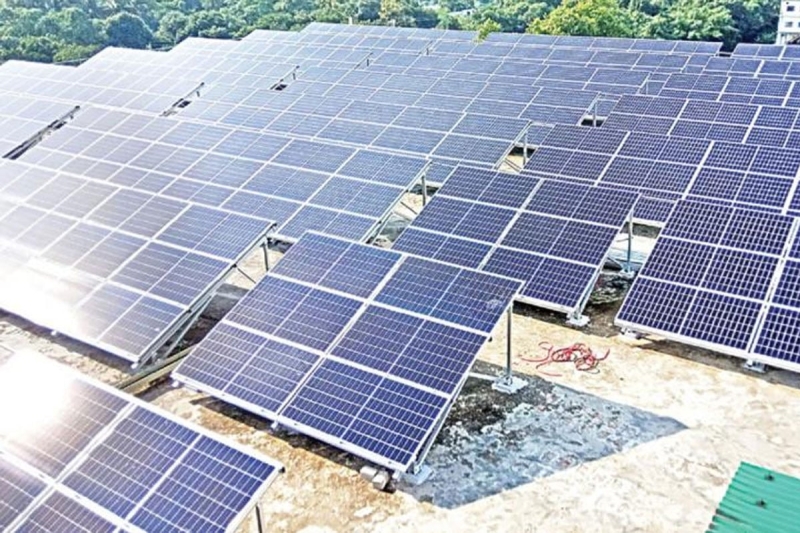
The Bangladesh Energy Regulatory Commission (BERC) has set the price at which public-sector power utilities can purchase electricity from privately owned renewable-energy-based commercial power plants.
Under the new tariff, solar-generated electricity will cost Tk6.98 per unit at the 33-kilovolt (kV) connection level and Tk7.11 per unit at 132 kV.
The commission has also fixed charges for using transmission and distribution networks to deliver electricity from renewable-energy-based commercial power plants to consumers.
The new rates will take effect from October, according to a BERC notice.
Under the framework, the Bangladesh Power Development Board (BPDB) will act as the single buyer for electricity purchased by public-sector utilities from commercial solar power plants. The purchase price will be Tk6.98 per unit at 33 kV and Tk7.11 per unit at 132 kV.
Commercial power plants, also known as merchant power plants (MPPs), can also sell electricity directly to large consumers. In such cases, producers and buyers can negotiate the electricity price themselves. However, additional charges will apply if government-owned transmission or distribution networks are used.
These network-use charges are known as the Open Access Tariff (OAT). Depending on the connection arrangement between the power plant and the consumer, the total charge will range from Tk1.22 to Tk1.9097 per unit.
BERC has set different charges for three types of connection arrangements.
If the power plant is connected directly to the national grid while the consumer is connected through a government distribution utility, the charge will vary according to the transmission voltage. The total charge will be Tk1.5989 per unit at 230 kV, Tk1.6025 at 132 kV and Tk1.6097 at 33 kV.
These charges include transmission, distribution, energy accounting and billing-settlement costs. The transmission charge will be 37.89 paisa per unit at 230 kV, 38.25 paisa at 132 kV and 38.97 paisa at 33 kV.
A distribution charge of Tk1.17 per unit will apply at the receiving end, while another 5 paisa per unit will be charged for energy accounting and billing settlement.
If the power plant and consumer are connected to different distribution utilities at the two ends of the transmission system, an additional 30-paisa distribution charge will apply at the supply end.
In that case, the total charge will rise to Tk1.8989 per unit at 230 kV, Tk1.9025 at 132 kV and Tk1.9097 at 33 kV.
However, the additional 30-paisa charge will not apply if both the power plant and consumer are connected to the same distribution utility. Distribution losses at the supply end will also not be imposed in such cases.
For this purpose, all rural electricity cooperatives will be treated as a single distribution entity under the Bangladesh Rural Electrification Board.
If the power plant and consumer are connected to the same distribution utility and the transmission network is not used, the total network charge will be Tk1.22 per unit.
Transmission and distribution losses will also be taken into account when electricity is supplied. For transmission losses, the actual monthly average rate published by Power Grid Bangladesh will be used. For distribution losses, the rate achieved at the relevant voltage level during the latest completed financial year will apply.
BERC has also specified distribution charges for individual utilities. The rate is 70 paisa per unit for BPDB, Tk1.43 for the Bangladesh Rural Electrification Board, 85 paisa for Dhaka Power Distribution Company, and 99 paisa for Dhaka Electric Supply Company.
The rate has been set at 87 paisa per unit for West Zone Power Distribution Company and Tk1.04 for Northern Electricity Supply Company.
BPDB will handle energy accounting and billing settlement for electricity generated and supplied by commercial power plants. It will bill the plants according to the prescribed rates and subsequently pay the relevant distribution utilities their applicable charges.
The framework follows the Merchant Power Policy introduced in 2025 to encourage private investment in renewable energy. Under the policy, a power plant in one area can use government transmission and distribution networks to sell electricity directly to large consumers in another area.
Commercial power plants can sell up to 20% of their declared monthly generation to public-sector power utilities, while the remaining electricity can be sold directly to large consumers.
BERC held a public hearing on August 23 on the proposed tariff and open-access charges for renewable-energy-based merchant power plants. Its technical evaluation committee had recommended a tariff of Tk6.48 per unit for solar electricity sold to public-sector utilities.
At the hearing, BPDB and several distribution companies expressed concern that they could lose revenue if large industrial consumers shifted to merchant solar power during the daytime and returned to the utilities for electricity at night.
Renewable-energy investors, meanwhile, argued that high transmission, distribution and other network charges could discourage private investment in renewable power. Industry representatives have similarly called for a commercially viable and predictable tariff structure to support investment in merchant renewable-energy projects.