

- Energy, investment, Rohingya issue to top Bangladesh-Indonesia talks |
- Japan Remains Bangladesh’s Trusted Development Partner: Envoy |
- Dhaka ranks world’s second most polluted city this morning |
Three Scientists Win Nobel Medicine Prize for Optogenetics
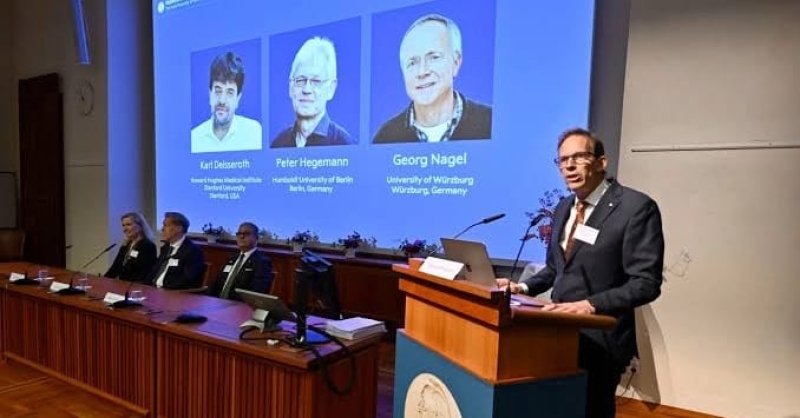
Photo: Karl Deisseroth, Peter Hegemann and Georg Nagel are displayed on a screen after being awarded the 2026 Nobel Prize in Physiology or Medicine during a press conference at the Nobel Forum at Karolinska Institutet in Stockholm, Sweden, Oct. 5, 2026.
The 2026 Nobel Prize in Physiology or Medicine was awarded on Monday to three scientists for their discoveries concerning light-gated ion channels and optogenetics, a technique that allows researchers to control the activity of individual nerve cells using light.
The laureates are Karl Deisseroth, 54, of Stanford University in the United States; Peter Hegemann, 71, of Humboldt University in Berlin; and Georg Nagel, 73, of the University of Würzburg in Germany.
The Nobel Assembly at Karolinska Institutet in Stockholm announced the award, opening this year’s Nobel Prize announcements.
The prize citation recognised discoveries that led to optogenetics, which makes it possible to switch individual nerve cells in a living brain on or off. The method is now widely used in neuroscience research to investigate how the brain works.
The three laureates will share a prize of 12 million Swedish kronor, or about $1.2 million.
The medicine prize traditionally opens Nobel week. The physics prize is due to be announced on Tuesday, followed by chemistry on Wednesday, literature on Thursday, peace on Friday and the economics prize on October 12.
Last year’s Nobel Prize in Physiology or Medicine was awarded to Mary Brunkow, Fred Ramsdell and Shimon Sakaguchi for discoveries concerning regulatory T cells and their role in immune tolerance.