

- Uncertainty over possible US-Iran talks as Trump extends ceasefire |
- Bangladesh eyes broader bilateral engagements with African nations |
- Trump Extends Iran Ceasefire, Seeks Time for Talks |
- SSC and Equivalent Exams Begin Nationwide |
- US, Iran Signal War Readiness as Talks Hang in Balance |
Parliament Passes July Uprising Immunity Law
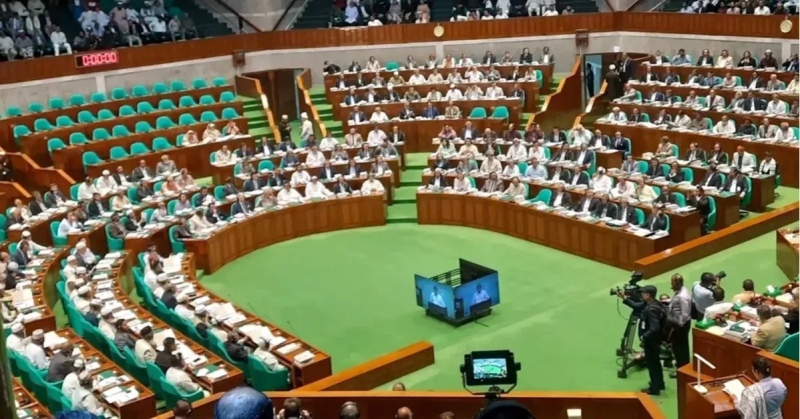
Parliament on Wednesday passed a law granting legal immunity to participants of the 2024 July mass uprising, despite strong objections from an opposition lawmaker over the role of the National Human Rights Commission (NHRC).
The House approved the July Mass Uprising (Protection and Liability Determination) Bill, 2026 by voice vote after it was placed by Home Minister Salahuddin Ahmed.
The law ratifies an ordinance issued by the immediate past interim government and provides legal protection to those who took part in the July uprising.
Under the new law, all civil and criminal cases, complaints and legal proceedings filed against uprising participants over their involvement in the movement will be withdrawn through prescribed legal procedures.
It also bars the filing of any fresh case or complaint against those recognised as participants in the uprising.
According to the law, public prosecutors or government-appointed lawyers will be able to seek dismissal of such cases in court based on official certification of participation. Once an application is submitted, the court will be required to halt proceedings and discharge or acquit the accused.
However, if any participant is accused of murder during the uprising, the case will be referred to the National Human Rights Commission for investigation.
If the commission determines that the act was committed as part of political resistance, it may recommend compensation for the victim’s family. But if it finds the incident to be a criminal act committed under cover of unrest, it will submit its findings to the court for trial proceedings.
Before the bill was passed, National Citizen Party MP Hasnat Abdullah raised a point of order and opposed its adoption until the proposed law relating to the National Human Rights Commission is finalised.
He alleged that key state institutions were being politicised and questioned whether the commission could act independently while remaining under the Ministry of Home Affairs.
Hasnat also criticised recent developments in sports and other sectors, alleging partisan influence in public institutions.
Responding to the criticism, Home Minister Salahuddin Ahmed defended the bill, saying it reflected a national demand and fulfilled commitments made under the July National Charter.
He said the law was intended to protect those who took part in a historic political movement and to prevent legal harassment against them.
On the issue of the NHRC, the minister said the government would soon bring a separate bill to establish an autonomous and internationally standard human rights commission aligned with existing laws on enforced disappearance and the International Crimes Tribunal.
He also said an investigation into irregularities in the Bangladesh Cricket Board had led to the dissolution of the previous board and the formation of an ad hoc committee headed by former national cricket captain Tamim Iqbal, which would hold elections within three months.
The passage of the law marks a significant political step, as it formally shields participants of the July uprising from legal action while leaving limited room for scrutiny in cases involving serious allegations.