

- SSC and Equivalent Exams Begin Nationwide |
- US, Iran Signal War Readiness as Talks Hang in Balance |
- Bangladesh, EU Push for FTA, Investment Pact Talks |
- Over 1.14cr workers sent to Middle East in 22 years |
- BNP finalizes 36 nominations for women’s seats in Parliament |
SAARC Media Leader Meets ECOSOC Chief at UN
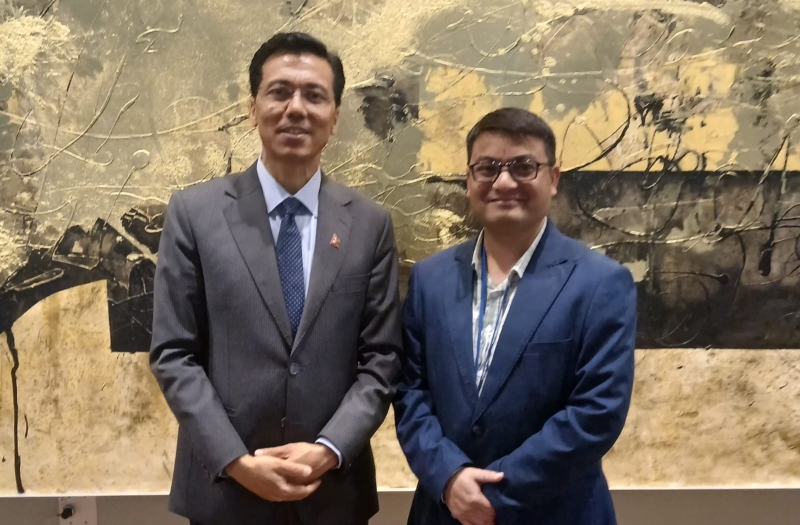
The President of the SAARC Journalist Forum held a high-level meeting with Lok Bahadur Thapa, President of the United Nations Economic and Social Council, at the United Nations Headquarters in New York, in a development that underscores growing engagement between regional media leadership and global multilateral institutions.
The meeting took place on the sidelines of a series of ECOSOC-related events, where policymakers, development experts, youth representatives and civil society actors have gathered to discuss pressing global challenges. These include sustainable development financing, climate resilience, and the role of young people in shaping inclusive growth.
During the discussion, both sides focused on the evolving role of journalism in advancing global dialogue, strengthening transparency, and fostering international cooperation. They acknowledged that credible, fact-based reporting is essential in bridging the gap between global decision-making forums and the public, particularly in developing regions where access to reliable information remains uneven.
President Thapa, who is leading ECOSOC for the 2025–2026 session, stressed the importance of inclusive communication in achieving the Sustainable Development Goals (SDGs). He noted that the media has a critical responsibility in amplifying underrepresented voices, especially from South Asia and other developing regions, and in ensuring that global policy discussions resonate at the grassroots level.
Highlighting the diversity and complexity of the South Asian region, he emphasised that journalists play a key role in translating global commitments into locally relevant narratives. “A well-informed public is central to sustainable development, and the media acts as a bridge between institutions and people,” he observed during the exchange.
The SAARC Journalist Forum President, in response, underlined the need for stronger institutional collaboration between international organisations and regional media platforms. He pointed out that journalists in South Asia often face structural challenges, including limited access to global policy spaces, and called for greater inclusion of media representatives in international forums.
He also stressed the importance of capacity building for journalists, particularly in covering complex issues such as climate finance, development economics, and multilateral negotiations. According to him, closer cooperation with bodies like ECOSOC would help enhance professional standards and ensure more accurate and impactful reporting on global issues.
The discussion further explored opportunities for knowledge sharing, training initiatives, and joint platforms that could connect journalists with policymakers and experts. Both sides agreed that such engagement could contribute to more informed public discourse and strengthen democratic accountability.
ECOSOC, one of the six principal organs of the United Nations, plays a central role in coordinating economic, social and development work across the UN system. It serves as a key platform for dialogue among governments, civil society, academia and the private sector, addressing issues ranging from poverty eradication to digital transformation.
Officials familiar with the meeting described it as a constructive step toward deepening ties between South Asian media networks and global governance institutions. They noted that in an era of rapid information flow and rising misinformation, collaboration between credible media organisations and multilateral bodies is increasingly important.
The interaction also highlighted the growing recognition of journalism as a partner in development. By ensuring transparency, promoting accountability and raising awareness, the media can contribute significantly to achieving global development targets.
Participants at the broader ECOSOC events echoed similar sentiments, pointing to the need for stronger engagement with regional stakeholders, including journalists, to make global processes more inclusive and effective.
The meeting concluded with a shared understanding of the need to maintain ongoing dialogue and explore practical avenues for cooperation. Observers see this engagement as part of a broader effort to integrate regional perspectives into global discussions, reinforcing the role of journalism in shaping international discourse.
As global challenges become more interconnected, such interactions are expected to play a vital role in aligning media narratives with development priorities, ultimately helping to build a more informed and engaged global community.