

- No Plan for Operation Clean Heart-Style Drive Now: Home Minister |
- Bangladesh Eyes $10b in UK Exports Through Diversification |
- 20 Bangladeshis Killed After Trafficking to Russia for War |
- Guterres proposes slimmer $3.3 billion UN budget for 2027 |
- President Proposes National Committee to Protect Minority Rights |
Early 2026 Spike In Migrant Deaths At Sea Is Alarming
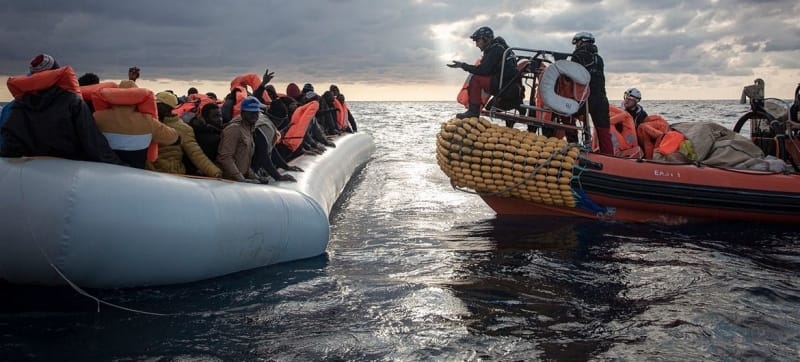
A rescue mission, saving 98 people from a dangerous journey in the central Mediterranean region in 2020. (file) © SOS Méditerranée-Anthony Jean
Asif Showkat Kallol
Bangladesh's economy depends heavily on migrant workers. Millions of Bangladeshis work abroad, and remittances provide one of the country's most important sources of foreign exchange. But the country's migration success story has another side that policymakers rarely place at the centre of economic discussions.
According to data from the Wage Earners' Welfare Board, more than 5,000 bodies of expatriate Bangladeshis returned home last year—an average of around 14 bodies every day. In the first two months of this year alone, nearly 900 bodies reportedly returned. Since 1993, records have been maintained on the return of deceased migrant workers, and more than 62,000 bodies have reportedly been brought back over the past three decades.
These are not merely numbers.
Behind each body is a family that borrowed money, sold land, mortgaged property or exhausted its savings to send someone abroad. Behind every coffin is a mother waiting for a son, a wife waiting for a husband, or children waiting for a father who will never return.
Three years ago, the average was reportedly around 10 bodies a day. Now it is around 14.
The government may boast about the growth of remittances, but what should concern policymakers is whether Bangladesh is also exporting an unacceptable level of human risk along with its labour.
The countries from which many bodies return include Saudi Arabia, Kuwait, Oman, Jordan, Libya and Malaysia. The reasons for death vary. Some die from workplace accidents. Others die from illness. Some suffer heart attacks or strokes. Others die in road accidents. Some become victims of violence or exploitation. And some disappear into the sea. The Mediterranean is becoming a graveyard
The latest tragedy in the Mediterranean once again exposes this uncomfortable reality. On August 3, a motorised boat carrying 42 migrants reportedly left the Libyan coast for Greece. Thirty-eight of the passengers were Bangladeshis. Soon after departure, severe weather swept away their food and water supplies. Then the engine failed. The passengers remained stranded at sea, gradually running out of food and drinking water. Eleven Bangladeshis died. Eighteen survivors were rescued and taken to a hospital in Egypt.
The figures from the International Organization for Migration should make governments across the migration corridor uncomfortable.
According to IOM data released on August 12 last, 821 people died or went missing on the Central Mediterranean route during the first four months of 2026, a 111 percent increase compared with the previous period. At the same time, arrivals on the route fell by 46 percent to 8,577.
That should destroy one dangerous assumption: fewer migrants do not necessarily mean safer migration. Quite the opposite can happen. When legal routes become harder, borders become more heavily controlled and legitimate opportunities remain inaccessible, desperate people do not necessarily stop moving. They simply move through more dangerous channels.
The result is a cruel market for traffickers. The more difficult the legal route turns, the more valuable the illegal route becomes. The more desperate the migrant, the more powerful the brokers. And somewhere between Bangladesh, the Middle East, North Africa and Europe, a vast human-trafficking economy flourish.
Whenever another migrant boat sinks, governments have a familiar solution - awareness campaigns.
People are told not to trust brokers. Young people are told not to take dangerous routes. Families are warned about human trafficking. Posters are printed. Seminars are organised. Officials make speeches.
And then everyone goes home. The next boat leaves. This is where the government's approach deserves a little satire. Perhaps the authorities believe that a sufficiently persuasive poster can defeat a trafficker who is offering a young unemployed man the possibility of earning several times his local income.
Awareness is necessary. But awareness without alternatives is not a policy. It is an alibi.
If the government tells a young man, “Do not take this dangerous boat,” the obvious next question is: “Then what should I do?” Where is the job? Where is the affordable legal migration route? Where is the verified foreign employer? Where is the transparent recruitment system? Where is the government mechanism that allows a rural worker to migrate without paying an extraordinary amount of money to an intermediary? These are much harder questions than arranging a seminar.
Former Bangladesh Head of IOM (International Organization for Migration) and Migration and Displacement Specialist Asif Munir has spoken to GreenWatch. Munir has warned that a highly organised transnational network is involved in human trafficking through the Mediterranean, and that countries along the route need coordinated action to prevent further deaths. Regarding the broader migration system, he has said that unethical immigration processes are behind the tragic situations faced by Bangladeshi workers abroad, while high migration costs leave families financially vulnerable when workers encounter problems overseas.
On job-seeking migrant workers, he has argued that Bangladesh should send fewer workers but ensure better salaries and security, provide training according to foreign labour-market demand, open new labour markets and ensure workers travel with valid visas. In relation to the Malaysia Libya, Saudi Arabia recruitment crisis, he has called for structural reforms, reintegration support for returning workers and a shift towards rights-based migration governance.
New government, old problem
The BNP government now has an opportunity to demonstrate that a change of government means more than a change of political slogans.
For years, successive governments have treated migrant workers primarily as a source of remittances. The BNP government risks making the same mistake if it measures success mainly through the monthly remittance figure.
There is an almost comic political temptation here. If remittances rise, the government can claim credit. If migrant workers die, the government can say the causes are complicated. If traffickers operate, officials can promise action. If bodies return, the government can arrange transportation. And if another boat disappears, another statement can be issued. It is an impressively efficient system—except for the inconvenient fact that people keep dying.
The BNP government cannot simply inherit the existing migration bureaucracy and continue operating it with a new political logo. If it wants to distinguish itself from the past, migrant welfare should be one of the areas where that distinction becomes visible. The government should ask a simple question: why does a Bangladeshi worker need a broker to access an overseas job? If the answer is that the recruitment system is complicated, expensive and opaque, then the system itself needs reform. If the answer is that foreign employers prefer intermediaries, then Bangladesh needs stronger government-to-government recruitment agreements.
If the answer is that workers lack information, then the state must provide reliable information directly. If the answer is that workers are willing to pay brokers because they desperately want to leave, then Bangladesh must confront the economic conditions producing that desperation. None of these problems can be solved by speeches.
The broker is not the whole story
It is convenient to blame traffickers. They deserve blame. Human trafficking networks must be dismantled, their financial channels investigated and their international connections exposed.
But the trafficker is only one part of the story. A trafficking network survives because there is a market for its services.
And there is a market because millions of people believe that their economic future is better abroad than at home. That belief cannot be criminalised away.
For many Bangladeshi families, migration is not a luxury. It is an economic strategy. A son goes to Saudi Arabia, Malaysia or Europe because there is no comparable income opportunity at home. A family borrows money to finance the journey because they believe the investment will be recovered through remittances. This is why the migration crisis is also an employment crisis.
If Bangladesh wants to stop dangerous migration, it cannot merely arrest brokers. It must reduce the economic desperation that makes brokers powerful.
A government cannot control the sea from Dhaka The state also needs to recognise the limits of domestic enforcement. A migrant journey from Bangladesh to Europe can involve several countries, multiple trafficking networks, forged documents, detention centres, deserts and finally the Mediterranean.
No single country can solve that alone. Bangladesh needs stronger cooperation with Libya, Egypt, Greece, Italy and other countries along the migration route. Law enforcement agencies need to exchange intelligence. Financial investigators need to track payments. Recruitment agencies involved in trafficking need to be investigated. Survivors need protection and legal assistance.
(The writer works as the Head of News at the German-based online news outlet Mirror Asia.)
From the August print edition.