

- Eliminate Wastes: Make Life Sustainable |
- Pay Scale Push Sans Funding Plan Alarms Economists |
- Early 2026 Spike In Migrant Deaths At Sea Is Alarming |
- Delhi spells out Mecca Pact has security implications for India |
- Trump Announces ‘Largest Oil Deal in World History’ With Venezuela |
History of Lalbagh Fort Is Written In Blood
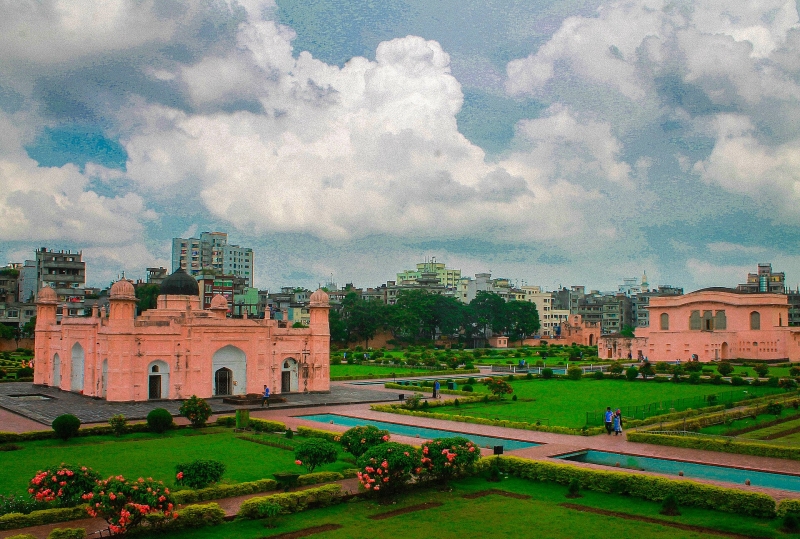
The Lalbagh Fort a monument dating back the time of Emperor Aurangjeb - Wikimedia Commons
Adnan Hadi
Standing proudly in the heart of Old Dhaka for more than three centuries, Lalbagh Fort remains one of Bangladesh's most treasured historical monuments. Built of red brick, marble and stone, the unfinished Mughal fortress has witnessed imperial ambition, royal tragedy, political change with the passage of time.
Every day, thousands of visitors stroll through its tranquil gardens, admire the elegant tomb of Pari Bibi and pause beside the serene pond within its walls. Yet, few realise that beneath this peaceful landscape lies a history written in blood.
Long before it became a popular tourist destination, Lalbagh Fort witnessed fierce resistance against colonial rule. Its gardens, pathways and pond bear silent testimony to the sacrifices of Bengali soldiers who defied the British during the Sepoy Revolt of 1857. Their courage, and the tragic events that unfolded here, remain one of the least discussed chapters in Dhaka's history.
Originally known as Aurangabad Fort, construction began in 1678 under Mughal Prince Muhammad Azam, the son of Emperor Aurangzeb and the then Subadar of Bengal. The ambitious project was intended to serve as the official residence and administrative headquarters of the Mughal governor in Dhaka.
Within a year, the Durbar Hall and the three-domed mosque had been completed. However, Azam Shah was urgently recalled to Delhi by Emperor Aurangzeb to suppress the Maratha rebellion, leaving the project unfinished.
In 1680, the responsibility for completing the fort fell to Subadar Shaista Khan. Construction continued until tragedy struck in 1684 with the death of his beloved daughter, Pari Bibi. Believing the fort to be inauspicious after her death, Shaista Khan abandoned the project permanently.
As a result, Lalbagh Fort remains one of the most remarkable unfinished Mughal forts in South Asia.
Historical records also suggest that the fort originally had four entrance gates. The southern gate served as the principal entrance, while another passage to the west was known locally as the "secret gate". According to popular folklore, this hidden route connected Lalbagh Fort with Sonakanda Fort or the Jinjira Palace across the Buriganga River. Although historians have never confirmed this story, the legend continues to fascinate visitors. Today, the mysterious passage remains sealed.
The earliest European account of Lalbagh Fort appears in the Dhaka Diary of the British Factory. An entry dated 9 July 1689 mentions that, besides serving as the Nawab's residence, the fort was also used to detain prisoners, including several Englishmen.
Nearly two centuries later, the British transformed the fort into a military installation. In 1844, local colonial authorities acquired the lease of Lalbagh Fort for an annual payment of 60 rupees.
By 1853, the military cantonment had been shifted from Purana Paltan to Lalbagh Fort, which served as the principal cantonment in Dhaka until the outbreak of the Sepoy Revolt in 1857.
Following the revolt, the British stationed the Police Reserve Force inside the fort. Before the Partition of 1947, it housed the Garhwali Police, and after Partition, the complex served as police lines and later as an Intelligence Branch office.
The Bloodshed of 1857
The most tragic chapter in Lalbagh Fort's history unfolded during the Sepoy Revolt of 1857.
Inspired by the uprising sweeping across the Indian subcontinent, Bengali soldiers of the 2nd Company of the 73rd Native Infantry refused British orders to surrender their weapons on 22 November 1857.
The confrontation quickly escalated into a fierce battle inside the fort.
British troops crushed the resistance with overwhelming force. Forty-one Bengali soldiers were killed during the fighting, while eleven others were later publicly hanged from a tree at Bahadur Shah Park as a warning against rebellion.
Local tradition also recounts that many bodies of the fallen rebels were thrown into the pond inside Lalbagh Fort, turning its peaceful waters into a silent witness to one of Dhaka's darkest days.
Lalbagh Fort witnessed bloodshed once again on 14 July 1948.
The East Pakistan Provincial Police, stationed within the fort, rose in protest against the policies of the Pakistani authorities. The rebellion was violently suppressed, adding yet another layer to the fort's long history of resistance and sacrifice.
One of the greatest mysteries surrounding Lalbagh Fort concerns the final resting places of the martyrs of 1857.
While many captured sepoys were publicly executed at Bahadur Shah Park, historical records remain uncertain about where their bodies were buried.
According to local oral accounts, numerous bodies were thrown into the fort's pond. Others were reportedly transported by a local boatman named Sona Mia, who carried them by boat to the Buriganga River.
Several of the martyrs are believed to have been buried in an area on present-day Bishnu Charan Das Street. The locality became known as Gore-e-Shahid—meaning "Graveyard of the Martyrs". Over time, local pronunciation gradually transformed the name into Ghore Shahid.
Today, a handful of old graves situated on the south-eastern side of the Salimullah Muslim Orphanage are widely believed to be the resting place of those brave sepoys who sacrificed their lives during the uprising.
The Untold Story of Lalbagh Fort's Southern Gate that Closed Forever
For more than three centuries, the southern gateway of Lalbagh Fort has silently witnessed the rise and fall of empires, the retreat of rivers, the fury of natural disasters and the relentless march of urbanisation. Once the principal entrance to one of the Mughal Empire's grandest projects in Bengal, the gate now survives as a forgotten monument—its original splendour buried beneath neglect and time.
The story of this remarkable gateway begins not in Dhaka, but in the imperial court of Emperor Aurangzeb Alamgir.
In 1673, Aurangzeb commissioned the magnificent Alamgiri Gate at Lahore Fort. Soon afterwards, he turned his attention to Bengal—the wealthiest and most prosperous province of the Mughal Empire.
His ambition was to build an imposing palace-fort in Dhaka, then the provincial capital. After approving the architectural design, Aurangzeb entrusted the project to his son, Prince Muhammad Azam (Shahzada Azam), who arrived in Dhaka in 1678 to oversee its construction.
The new fortress became known as Kella Aurangabad, today's Lalbagh Fort, and represented one of the final monumental architectural projects undertaken during Aurangzeb's reign.
Like other Mughal forts across the empire, Aurangabad possessed an impressive ceremonial entrance. Mughal gateways bore distinguished names such as Badshahi Darwaza, Delhi Darwaza, Lahori Darwaza, Roshnai Darwaza and Hathi Darwaza.
Architectural evidence strongly suggests that the southern gate served as the principal entrance to Aurangabad Fort. Designed with royal elegance, it reflected the refined aesthetics and military authority characteristic of Mughal architecture.
Its towering façade, ornamental floral finials, elegant arches, guard balconies and defensive galleries once announced the grandeur of Mughal Dhaka to every visitor approaching from the Buriganga River.
The Painting That Solved a Historical Mystery
One of the most fascinating chapters in the history of this gate emerged more than two centuries after its construction.
In October 2011, an oil painting depicting the entrance of an abandoned Mughal fort was exhibited in London. Visitors admired its architectural precision and artistic quality, yet nobody could identify the location portrayed.
The painting was later auctioned by Sotheby's in December 2011 after having twice failed to sell in New York. It was mistakenly attributed to another artist, Robert Home.
After acquiring the artwork, collector and researcher Greg undertook extensive research using historical documents and records from the British Library. His investigation revealed an extraordinary truth—the painting was not by Robert Home at all.
It was an authentic work by renowned artist Johann Zoffany, painted in 1787, depicting the southern entrance of Lalbagh Fort in Dhaka.
The rediscovery transformed the artwork into one of the most significant visual records of Bangladesh's architectural heritage.
In March 2012, Greg displayed the painting at the Royal Academy of Arts in London during the exhibition Johann Zoffany: Society Observed. There it was recognised as an important historical document of Bangladesh.
Today, the painting remains in Greg's private collection.
More importantly, it represents the earliest known pictorial record of Lalbagh Fort and is widely considered one of the oldest surviving artistic depictions of any architectural monument in present-day Bangladesh.
Zoffany's painting preserves details that no longer exist.
The massive floral finials crowning both sides of the gateway appear completely intact. Four domed watchtowers stand proudly around the entrance—two large front towers and two smaller rear ones. Today, only the rear pair survives.
Above the central arch once stood an elegant four-column guard balcony overlooking the entrance. Mughal soldiers guarded the fort from this elevated platform, while ceremonial musicians announced the arrival of distinguished guests before they entered the palace complex.
Wide galleries extended along both sides of the gateway, while lotus motifs—an enduring element of Mughal decorative architecture—adorned its walls.
Many of these features have long disappeared. Only fragments of the original grandeur remain visible.
(Adnan Hadi is a senior journalist mainly writing on archeological sites and sports. He could be reached at: adnangreenblack1987@gmail.com)
(From the August print edition)