

- UNGA President Warns Against Fading Attention to Rohingya |
- PM Proposes Five Urgent Steps to Resolve Rohingya Crisis |
- Govt Appoints Indonesian Firm to Operate Cox’s Bazar SPM |
- ADB lowers Bangladesh’s growth forecast to 4 % in FY2027 |
- El Niño Tests Global Readiness for a Changing Climate |
Guterres Urges Countries to Set Timelines to Quit Fossil Fuels
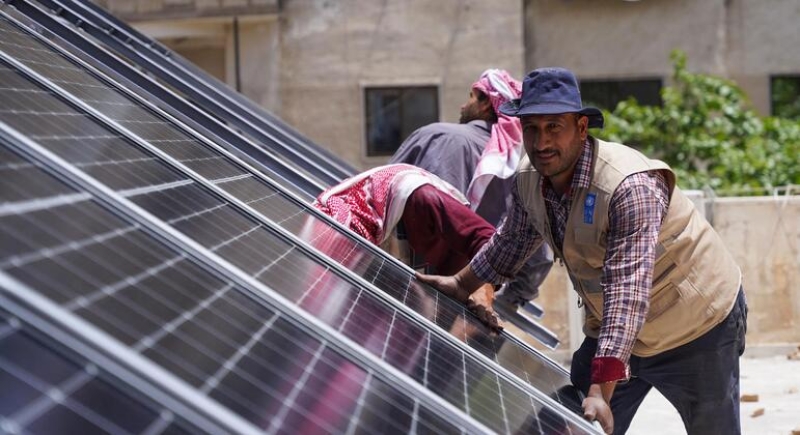
A UN worker helps to set up a solar system in Syria.
UN Secretary-General António Guterres has called on countries to develop credible roadmaps with clear timelines for transitioning away from fossil fuels, warning that greenhouse gas emissions continue to rise despite the urgent need for reductions.
“We are the first generation with the tools to end the fossil fuel age – and the last who can avert climate catastrophe,” Guterres said on Wednesday during the high-level climate discussions at UN Headquarters in New York.
He urged countries to respond to growing demands for climate justice through stronger action on emissions reduction, adaptation and climate finance.
Guterres said the Group of 20, which accounts for around 80 per cent of global emissions, must lead the transition. He also called for climate finance to reach $1.3 trillion annually by 2035, including at least $300 billion a year for developing countries.
Scientists expect the world to temporarily exceed the 1.5°C warming threshold set under the 2015 Paris Agreement. Guterres said the priority should be to make any overshoot as small and as short as possible.
Renewables and the fossil fuel transition
Guterres said renewable energy is increasingly becoming the cheapest and most secure source of new electricity in many parts of the world.
He called for renewable energy capacity to triple, energy efficiency to double, faster electrification, sharp reductions in methane emissions and an end to deforestation.
He also warned that rapidly increasing electricity demand, including from artificial intelligence, must be met through greater deployment of renewable energy, electricity grids and energy storage.
“I call on every country to develop a credible roadmap to transition away from fossil fuels – with clear timelines,” he said.
Guterres stressed that the transition must be fair, creating jobs, strengthening social protection and allowing developing countries to shape the process and benefit from it.
Calls for a financing revolution
Guterres called for at least $300 billion a year to be mobilised for developing countries, with developed countries taking the lead, and urged overall climate finance to reach $1.3 trillion annually by 2035.
He also called for polluters to pay, debt burdens to be eased when disasters strike and developing countries to have a stronger voice in the international financial system.
“Match the revolution in energy with a revolution in finance,” he said.
He stressed that greater financing is also needed to help countries cope with climate impacts that cannot be avoided, warning that droughts can become hunger crises, storms can trigger debt crises and heatwaves can become deadly.
Guterres said effective climate action depends on protecting science and truth, international law and cooperation. He noted that the International Court of Justice has confirmed that protecting the climate is an obligation.
Grids, minerals and early warnings
The climate summit also announced initiatives targeting practical barriers to faster climate action.
The Global Grids Accelerator will initially focus on Africa and Southeast Asia, where renewable energy is expanding faster than the electricity networks needed to transmit it. More than 2,500 gigawatts of renewable energy projects are currently awaiting grid connections worldwide.
The initiative will bring governments, financial institutions and technical partners together to help priority grid projects secure financing and move towards implementation.
A second initiative under the Task Force on Critical Energy Transition Minerals will begin work in Guinea, Indonesia, Madagascar, Nigeria, Zambia and Zimbabwe.
Demand for minerals such as copper, lithium, nickel and cobalt is expected to nearly triple by 2030. The initiative aims to help resource-rich developing countries create more value and jobs domestically while strengthening governance and environmental safeguards.
The Early Warnings for All initiative, launched in 2022, has also mobilised around $2 billion to help ensure that everyone worldwide is protected by an early warning system by the end of 2027. More than 160 countries are receiving direct support.