

- Lionel Messi scores 4 goals, helps Inter Miami to 7-1 win over Montreal |
- China sends tunnel experts for rescue operations in Nepal |
- Kaptai Dam gates opened to 1 foot as lake water rises |
- Nepal-China flood death toll rises to 691, more than 3,000 missing |
- International Day of the Disappeared Today: 250 Cases Probed |
Trump’s Venezuela oil deal faces questions over investment, US stake
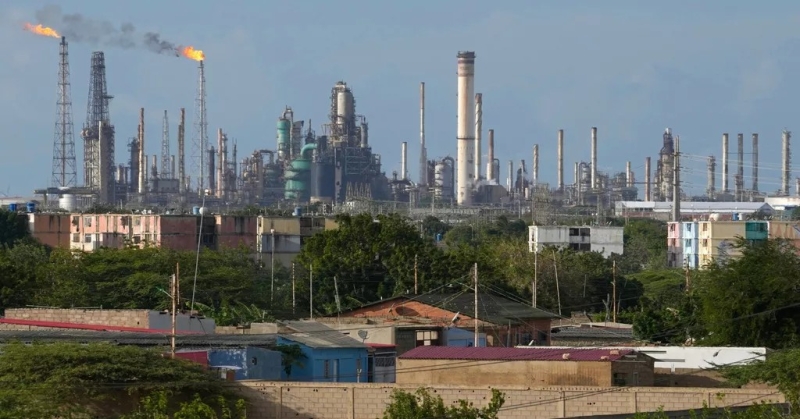
Flames rise from flare stacks at the Amuay refinery in Los Taques, Venezuela, Jan. 14, 2026. (AP Photo-Matias Delacroix, File)
US President Donald Trump has announced what he called the “biggest oil deal in world history” involving Venezuela’s vast crude reserves, but many details of the agreement, including investment plans and the identity of a private operator, remain unclear.
The White House has released little information beyond Trump’s social media announcement Friday night. No full text of the agreement has been made public.
Venezuela’s acting President Delcy Rodríguez described the deal as an important step toward reviving and modernising the country’s oil industry. She said it would help generate jobs, improve wages and expand access to essential public services.
According to Rodríguez, the agreement covers the development of 17 oil fields with a proven potential of about 65 billion barrels. It could attract roughly $100 billion in investment and generate more than $209 billion in tax revenue for Venezuela.
Under the arrangement, the US government and an unnamed private operator have established a new company with rights to develop previously untapped oil fields for 100 years.
A US official, speaking anonymously because the details have not been publicly released, said the United States would receive an effective 55% share of the company’s output through an ownership stake and rights to purchase oil at cost.
Some of the oil bought by the United States would be directed to the country’s strategic petroleum reserves and the military, the official said. The new company could become the second-largest corporate holder of proven oil reserves after Saudi Aramco.
Trump has said the deal will eventually help lower gasoline prices in the United States. However, energy experts cautioned that Venezuela’s ageing and damaged oil infrastructure would require years and billions of dollars in investment before production could rise significantly.
Amy Myers Jaffe, an energy expert at New York University, said the agreement could be beneficial in the long term but would not have an immediate impact on US gasoline prices.
The average US gasoline price was around $4.08 per gallon Saturday, compared with $3.20 a year earlier, according to AAA.
Kevin Book of ClearView Energy Partners said Venezuela has substantial scope to increase production, noting that its output had previously been more than 2.5 million barrels per day higher than current levels. But he said deploying the necessary capital and increasing production would take years.
The agreement has also sparked criticism inside Venezuela. Some citizens view it as a reversal of the longstanding position that the country’s natural resources should remain under Venezuelan control.
At a market in eastern Caracas, resident Douglas Borjas criticised the deal, saying Venezuela’s resources should benefit its people rather than political elites.
Harvard professor and former Venezuelan planning minister Ricardo Hausmann also denounced the agreement, questioning the legitimacy of Rodríguez’s government to make such a long-term commitment.
The deal has drawn mixed reactions in Washington. Trump allies praised it as a major economic and strategic achievement, while Democratic lawmakers accused the administration of pursuing Venezuelan oil at the expense of US national interests.
Sen. Tim Kaine called the agreement “corruption at epic scale,” while Sen. Chris Van Hollen accused Trump of putting US service members at risk to secure Venezuelan oil.
Several key questions remain unanswered, including who will finance the massive infrastructure investment, which private company will operate the new venture and exactly how the US 55% effective share will be divided between ownership and oil purchases.
Chevron, the only US oil company currently producing in Venezuela, declined to comment. Exxon Mobil also declined to comment.
Analysts also warned that political uncertainty, security concerns and Venezuela’s deteriorated oil infrastructure could make it difficult to attract major US energy companies, even if legal protections are provided.