

- PM Proposes Five Urgent Steps to Resolve Rohingya Crisis |
- Govt Appoints Indonesian Firm to Operate Cox’s Bazar SPM |
- ADB lowers Bangladesh’s growth forecast to 4 % in FY2027 |
- El Niño Tests Global Readiness for a Changing Climate |
- Dhaka's air quality recorded moderate on Wednesday morning |
PM Proposes Five Urgent Steps to Resolve Rohingya Crisis
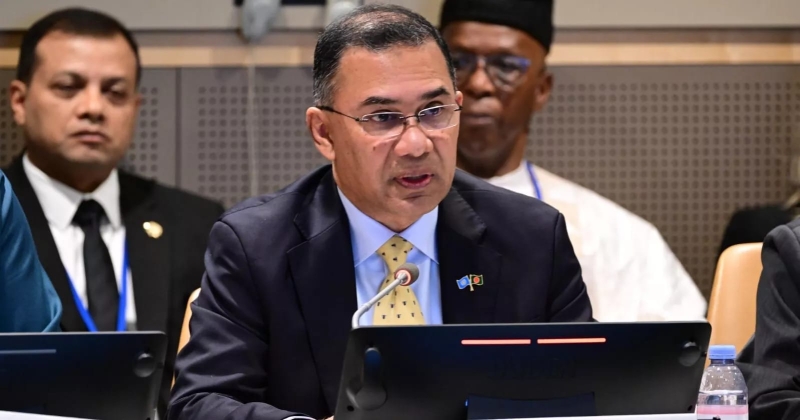
Prime Minister Tarique Rahman addresses a high-level side event titled “The Rohingya Crisis: A Renewed Call for a Durable Solution from Protracted Displacement, with Justice and Accountability” at the UN Headquarters in New York on Wednesday.
Prime Minister Tarique Rahman on Wednesday proposed five urgent measures to resolve the protracted Rohingya crisis, calling on the international community to move from empathy to addressing the root causes, from promises to action and from managing displacement to ending it.
“The time has come to move from empathy to a search for root causes and their solutions, from promises to action and from managing displacement to ending it,” he said.
The Prime Minister made the proposals while addressing a high-level side event titled “The Rohingya Crisis: A Renewed Call for a Durable Solution from Protracted Displacement, with Justice and Accountability” at the UN Headquarters in New York.
The five proposals are:
- Establishing a clear and credible roadmap for the early, safe, voluntary, dignified and sustainable repatriation of Rohingyas to Myanmar.
- Ending violence against civilians, including Rohingyas, and guaranteeing their fundamental rights and security.
- Ensuring adequate and predictable humanitarian support for Rohingyas and host communities in Bangladesh.
- Strengthening justice and accountability for grave crimes committed in Myanmar.
- Stepping up regional and international cooperation to combat the narco-economy, human trafficking, digital scams, illegal arms and other transboundary crimes.
Elaborating on the first proposal, Tarique Rahman called on international and regional stakeholders to establish a clear and credible roadmap for the early, safe, voluntary, dignified and sustainable repatriation of Rohingyas to Myanmar.
He said the international community and other states must support stabilisation efforts and use their leverage to create conditions inside Myanmar conducive to their return.
On the second proposal, the Prime Minister called for an end to violence against civilians, including Rohingyas, in Myanmar.
“The fundamental rights and security of the Rohingyas must be guaranteed in their homeland to regain their confidence to return,” he said.
Thirdly, Tarique Rahman urged the international community to ensure adequate and predictable humanitarian support for Rohingyas and host communities in Bangladesh.
“Their development aspirations should not be retarded by their generous act of hospitality,” he said.
As his fourth proposal, the Prime Minister stressed that justice and accountability are indispensable for sustainable repatriation.
He expressed appreciation for The Gambia’s efforts to pursue accountability before the International Court of Justice and recognised the role of the International Criminal Court in pursuing individual criminal accountability, alongside other international judicial and investigative mechanisms.
“International judicial and investigative mechanisms must receive sustained support. Those responsible for grave crimes must be held accountable,” he said.
In his fifth proposal, Tarique Rahman called for stronger regional and international cooperation to combat the narco-economy, human trafficking, digital scams, illegal arms and other transboundary crimes fuelling instability in the region.
He said the Rohingya crisis originated in Myanmar and that its solution also lies there.
“Sadly, the situation inside Rakhine State remains deeply concerning,” the Prime Minister said, noting that Rohingyas continue to face serious violations and abuses, including forced recruitment, arbitrary detention, restrictions on movement, forced labour and other forms of insecurity.
He said serious violations had been reported by both the Myanmar military and the Arakan Army.
“As such, the conditions for safe and dignified return remain challenged,” Tarique Rahman said.
Bangladesh has shouldered an enormous humanitarian responsibility for more than nine years and continues to host more than 1.2 million Rohingyas, he said.
“Regrettably, people continue to flee violence in Myanmar. Thousands of babies are born in the camps every year. They add another generation to this prolonged displacement,” the Prime Minister said.
He said Bangladesh opened its borders “because humanity demanded it” and continues to provide food and health services to the Rohingyas.
Rohingya children are receiving education based on the Myanmar curriculum through around 6,000 learning centres, while young people are receiving capacity-building and skills-development training to prepare them for eventual reintegration in Myanmar’s Rakhine State, he said.
However, the Prime Minister said the camps were not an ideal place for people to live for an extended period.
The cost of prolonged displacement is growing every day for both Rohingyas and host communities in Cox’s Bazar, while the social, economic, environmental and security pressures on Bangladesh are immense, he said.
Prolonged uncertainty and desperation are creating new challenges and security risks, including human trafficking, migrant smuggling, drug trafficking and other transnational crimes.
“Some people are leaving by boat to Malaysia, endangering their lives. A crisis left unresolved in one country can become a security challenge for an entire region,” Tarique Rahman said.
He also expressed concern over declining humanitarian funding for the Rohingya response.
The 2025 Joint Response Plan sought $934.5 million, while the 2026 appeal was scaled down to $710.5 million, covering only the most critical humanitarian needs, according to the UN and its partners.
“This trend cannot continue,” he said, expressing gratitude to international partners that continue to support Bangladesh.
“We need their support more than ever,” he added.
Tarique Rahman said humanitarian generosity could not become an excuse for political inaction, nor could Bangladesh be expected to shoulder the responsibility indefinitely.
“Bangladesh does not want the Rohingyas to remain displaced forever. We want them to return to their homes in Myanmar safely, voluntarily, with dignity and with their rights protected,” he said.
The Prime Minister said Bangladesh had carried its responsibility with humanity and called on the international community to carry its responsibility “with conviction”.
“If the necessary conditions are created, Bangladesh will be ready to facilitate their return,” he said.
“Together, let us ensure that the Rohingyas’ fate is not another story of persecution, expulsion and displacement. Let it be a story of justice, dignity and hope. And above all, let it begin now,” Tarique Rahman said.
Bangladesh and The Gambia co-convened the high-level side event, with other partners joining as co-sponsors.