

- Venezuela earthquakes kill 920, tens of thousands missing |
- Search Continues After Venezuela Quakes Kill 235 |
- Dhaka, Beijing sign 13 MoUs to deepen cooperation across key areas |
- China Eyes Teesta Project, Trade Boost With Bangladesh |
- PM Tarique, Li Qiang Hold Bilateral Talks in Beijing |
EU observer meets JS Speaker, discusses democracy, trade
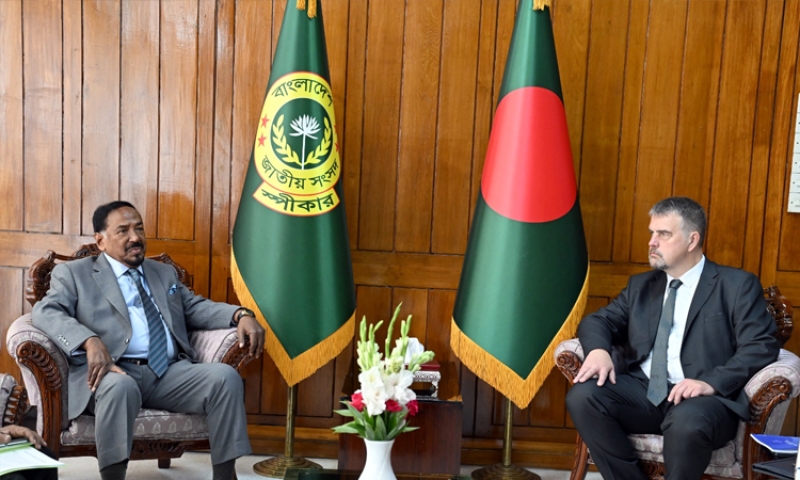
European Union Chief Election Observer Ivars Ijabs paid a courtesy call on Bangladesh Jatiya Sangsad Speaker Hafiz Uddin Ahmad, Bir Bikram, at his office in the Jatiya Sangsad Bhaban today.
During the meeting, the Speaker said the 13th Jatiya Sangsad election has opened a new horizon for democracy in Bangladesh. He expressed hope that the current Parliament would effectively fulfil the aspirations of the people.
He also noted that former Prime Minister Begum Khaleda Zia set a strong precedent in strengthening parliamentary democracy and promoting women’s participation in national policymaking, according to a press release.
Highlighting the spirit of cooperation, the Speaker said that despite ideological differences, political parties—both in government and opposition—often work together during national crises, which he described as a positive feature of parliamentary democracy.
The discussion also focused on Bangladesh’s transition from Least Developed Country (LDC) status to a middle-income economy. Both sides exchanged views on post-LDC trade challenges, including duty-free access to European markets and the potential for a free trade agreement with the European Union.
They further discussed women’s representation in Parliament and the proportional inclusion of ethnic minority communities in the national legislature.
The Speaker emphasised the importance of forming parliamentary friendship groups with EU member states and increasing exchange visits between parliamentary delegations to strengthen mutual understanding and cooperation.
The meeting was attended by the EU Ambassador to Bangladesh, members of the visiting delegation, and senior officials of the Jatiya Sangsad Secretariat.