

- Tarique Rahman Formally Named BNP Chairman |
- 136 new drugs in 195 essential drugs list, pricing guidelines |
- BSF halts overnight road building near border as BGB intervenes |
- U.S. Pullout From Global Bodies Sparks Widespread Alarm |
Global Voices Unite for Mother Language at Nalanda Meet
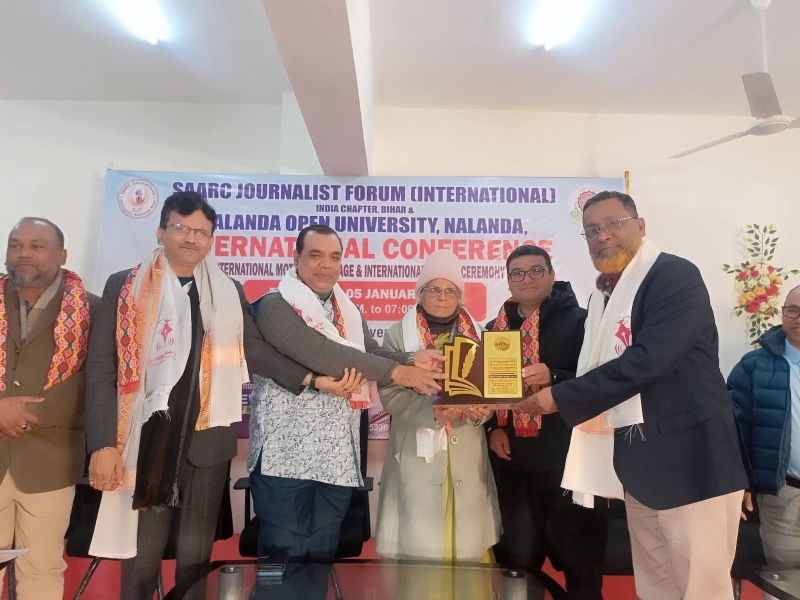
An international conference highlighting the global significance of mother languages, human rights, and press freedom was held in Nalanda, Bihar, bringing together voices from South Asia and beyond. The two-day event, titled “International Conference on International Mother Language & International Award–2026,” took place on January 4 and 5 at the International Conference Hall of Nalanda Open University in Rajgir, a historic and popular tourist destination.
The conference was jointly organised by Nalanda Open University and the SAARC Journalists Forum (SJF), drawing around 200 participants, including prominent journalists, academicians, human rights activists, writers, and cultural figures from India, Bangladesh, Nepal, Sri Lanka, Bhutan, Thailand, the United States, and Mauritius.
Former Governor of Sikkim Shri Ganga Prasad formally inaugurated the conference. Former Vice-Chancellor of Nalanda University Professor K. C. Sinha and eminent writer and cultural activist from Mauritius Dr. Sarita Budhu attended as chief guests. Among the special guests were Raju Lama, President of the Central Committee of SAARC Journalists Forum, and Md. Abdur Rahman, Secretary General of SJF. Senior SJF leaders from Nepal, including Nripendra Lal Shrestha, Rudra Subedi, Raju Napit, Dependra Prajapati, and Saddab Malik, were also present.
The conference featured a series of thematic sessions addressing contemporary global and regional challenges. The first session, titled “Journalism and Human Rights: A Global Challenge,” focused on the growing risks faced by journalists and the shrinking space for free expression worldwide. Sri Lankan journalist Rahul Samantha joined the discussion through video conference, sharing regional perspectives on press freedom.
The second session explored the educational and historical importance of Nalanda University, with renowned writer Professor Pratiyo Das and other speakers highlighting Nalanda’s legacy as a global centre of learning and its relevance in the modern education system.
In the third session, Professor K. C. Sinha, former Vice-Chancellor of Patna University and Nalanda University, spoke on “Culture and Mother Tongue of Bihar,” emphasising the role of native languages in preserving cultural identity and social cohesion.
Participants engaged in in-depth discussions on the importance of mother tongues, the protection of human rights, democratic practices, and freedom of the press in a rapidly changing global and geopolitical context.
The second session of the conference was presided over by Dr. Shashi Bhushan Kumar, President of the SAARC Journalists Forum Bihar Chapter. The event received special support from News Human Rights Media House.
A significant part of the discussions focused on South Asia’s geopolitical realities. Speakers underscored the role of SAARC in promoting peace, stability, and mutual cooperation among South Asian nations, noting that regional harmony has often been hampered by political tensions and bilateral disputes. Journalists at the conference stressed the need to build a strong foundation of harmony and brotherhood among the eight South Asian countries.
The conference also highlighted the enduring legacy of the 1952 Language Movement of Bangladesh, describing it as a universal symbol of the struggle to protect linguistic and cultural rights. Speakers noted that its recognition as International Mother Language Day serves as a reminder that safeguarding language and identity is a fundamental human right.
The challenging role of journalists in defending human rights and press freedom was another key theme. Participants called on South Asian governments to ensure journalists’ safety, remove barriers to free expression, and strengthen the media as the “fourth pillar” of democracy, even in adverse environments.
Following the formal sessions, a colourful cultural programme was held in the evening, featuring performances by artists from SAARC countries, celebrating linguistic diversity and shared cultural heritage.
The conference also honoured distinguished individuals for their outstanding contributions. Life Time Award 2025 was conferred on Dr. Sarita Budhu, Padma Shri Dr. J. K. Singh, Dr. Brajanandan Kumar Sinha, and Dr. Sushmita Pandey.
Under the Nalanda International Achievers Award, 21 eminent personalities, including four journalists from Bangladesh, were recognised. Additionally, the Bihar Gaurav Award was presented to 51 individuals, including renowned social figure Prem Singh, known as the “Gold Man of India.”
On the second day, delegates from SAARC countries visited the ancient ruins of Nalanda University, a thousand-year-old centre of learning and a symbol of Asia’s intellectual heritage.
Bangladesh was represented by five senior journalists, including Mustaq Ahmed Mubaraki, Editor of Dainik Bangabani and former Director of Bangladesh Sangbad Sangstha (BSS); Mohammad Moniruzzaman, Editor of Dainik Bank Bima Aurthaniti; and Kazi Habib Ullah, Chief Reporter of The Morning News, among others, marking Bangladesh’s strong presence at this significant international forum.