

- PM set to embark on maiden overseas tour with Malaysia visit Sunday |
- Food grain stocks in country exceed 20.6 lakh tons |
- Dhaka, Beijing Likely to Sign 15–17 Agreements |
- Govt Aims for Efficient Spending, More Revenue |
- PM Stresses Education, Health for Nation-Building |
Islamic banking windows at banks face tech-compliance divide
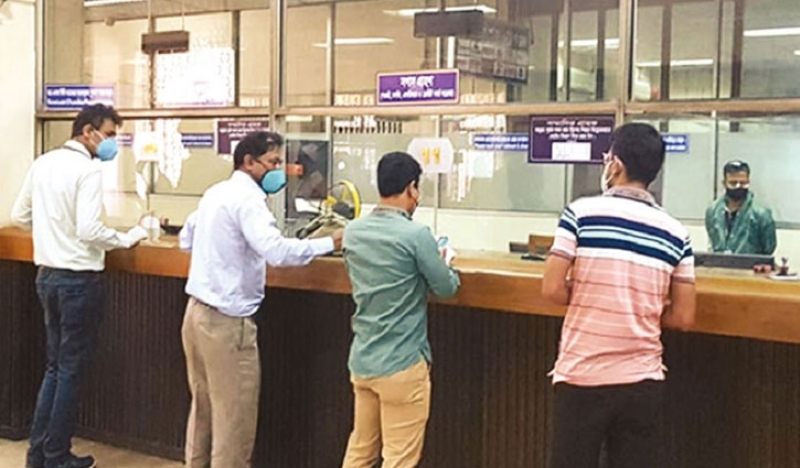
Bank clients waiting for transactions
Dhaka, April 23 — A newly published academic study has found that Islamic banking windows (IBWs) operating within conventional banks in Bangladesh face a persistent and structurally embedded tension between Shariah compliance and operational efficiency, one that is rooted not just in governance culture but in the very technology platforms that run their day-to-day operations.
The paper, published Wednesday in the Journal of Islamic Accounting and Business Research by Mezbah Uddin Ahmed, Research Fellow, The International Center for Education in Islamic Finance (INCEIF) University in Kuala Lumpur and co-author ATM Anisur Rabbani, Executive Director, Millennium Information Solution Ltd in Dhaka argue that the “engine room” of Islamic banking has been hiding in plain sight, largely ignored by regulators, scholars and even Shariah supervisory committees.
Bangladesh Bank currently authorises Islamic banking operations in 30 conventional banks alongside 6 full-fledged Islamic banks. These IBWs serve as the primary conduit through which millions of Bangladeshis access Shariah-compliant financial services from deposit accounts to trade finance and investment products.
Yet behind this sizeable market lies a striking institutional gap. When the researchers surveyed Islamic banking professionals on their system preferences, 83 percent said a dedicated standalone Islamic banking CBS known as an IB-CBS reduces the risk of Shariah non-compliance, and 84 percent said it enhances customer trust and market positioning. The numbers were unambiguous: practitioners overwhelmingly prefer the dedicated system.
The actual deployment picture, however, tells a different story. Of the 30 conventional banks offering Islamic services, only six have implemented a standalone IB-CBS. Eighteen rely instead on an Islamic banking module known as an IB-Module embedded within their conventional core banking platform. Six remained unidentified. Among five finance companies offering Islamic windows, only one has adopted a dedicated Islamic system.
The divergence, the authors argue, cannot be reduced to a simple compliance-versus-efficiency trade-off. It reflects a deeper set of institutional pressures: cost considerations, vendor dynamics, and a strategic ambivalence about whether Islamic banking is truly central to a conventional bank's priorities.
Two Systems, Two Sets of Problems
The study maps out the distinct strengths and vulnerabilities of each approach with granular precision, drawing on semi-structured interviews with four senior IBW executives each with experience leading Islamic windows across multiple banks.
A dedicated IB-CBS, designed from the ground up on Shariah principles, offers clean separation of Islamic and conventional funds, supports product innovation aligned with Islamic finance contracts such as Murabaha, Musharakah and Ijarah, and signals institutional seriousness about compliance.
According to the study, no full-fledged Islamic bank in Bangladesh operates on a module-based solution, the IB-CBS comes with painful operational headaches. Because the two systems, the Islamic CBS and the conventional CBS have fundamentally different architectures, integrating them is often done manually, with staff downloading data into Microsoft Excel spreadsheets and reconciling transactions by hand.
Customer identification codes differ between systems, meaning that a client holding both Islamic and conventional accounts at the same bank exists as two separate persons in two separate databases. When a solvency certificate is required, staff must manually pool data from both platforms and if an inexperienced employee uses only one account code, the certificate will be incomplete.
Staff are also required to maintain two separate logins, switching between systems throughout the day. If either login sits idle for a few minutes, the system automatically signs the user out, a seemingly minor feature that, in practice, causes repeated service disruptions and customer referrals to other branches.
The IB-Module addresses many of these friction points. A single integrated platform means unified customer data, streamlined account opening, consistent interfaces and shorter training cycles. For simpler products, basic deposits or straightforward financing arrangements, a well-configured module can meet core Shariah requirements.
The tradeoff, however, is compliance depth. IB-Module providers in Bangladesh are predominantly foreign firms specialising in conventional banking. Their understanding of Shariah nuance is, in the researchers' assessment, often insufficient.
Banks seeking customisation must submit formal change requests, a process that is both expensive and slow.
The study's most striking finding is that the risk of fund commingling, the mixing of Islamic and conventional money persists regardless of which system a bank uses.
IBWs frequently engage in cash and transfer transactions with their host conventional banks throughout the business day. Because maintaining separate vault facilities is expensive, most IBWs transfer funds from conventional accounts at the start of each day and return equivalent amounts by close of business, with differences recorded as receivables or payables. Achieving a zero balance at day's end is operationally difficult, meaning that a continuous receivable-payable relationship between the two operations is effectively unavoidable.
This structural reality is compounded by Bangladesh's automated clearing house (BACH) infrastructure. Because Bangladesh Bank does not assign separate BACH clearing numbers to IBWs and their conventional host banks, IBWs are compelled to route clearing transactions through conventional current accounts. Uncleared balances at end of day may, in effect, allow the conventional side of the bank to benefit from Islamic banking funds, a situation that, even if marginal, is objectionable under Shariah.
The Governance Gap
The study identifies a governance failure at the heart of the problem. Shariah supervisory committees, the expert bodies mandated to ensure compliance are largely absent from CBS development and change management processes. They rely instead on management assurances rather than direct review of system configurations. Internal Shariah auditors, meanwhile, tend to focus on documentation rather than system logic.
Bangladesh Bank conducts general IT audits of banks but does not extend these reviews to Shariah-specific assessments.
As a result, no CBS provider in Bangladesh is known to have established a formal Shariah governance framework, and responsibility for certifying a system as Shariah-compliant remains legally and institutionally unclear.
The shortage of professionals who combine expertise in Shariah, banking operations and information technology simultaneously is identified as a cross-cutting bottleneck.
In practice, the head of an IBW often becomes the sole bridge between vendor, IT department, Shariah committee and business leadership, a concentration of responsibility that creates both personal overload and institutional fragility.
Despite the structural challenges, the authors are cautiously optimistic about the direction of travel. Modern application programming interface (API) architectures and middleware solutions now make it technically feasible for banks to operate two fully independent banking systems while presenting customers with a unified digital experience across mobile, internet and agent banking channels.
A middleware API gateway can apply Shariah compliance checks and business logic validation to every transaction in real time. If a fund transfer is initiated from a conventional to an Islamic account, the middleware can validate prescribed limits, correctly classify the transaction and update both systems simultaneously without manual intervention.
Several banks in Bangladesh, the study notes, have already adopted standardised management information systems or data warehouses that aggregate data from multiple core platforms for unified regulatory reporting.
Cloud-native and Software-as-a-Service (SaaS) core banking solutions are also changing the economics of the choice. Cloud platforms now support both modular Islamic functionalities and fully standalone IB-CBS deployments, allowing banks to avoid heavy upfront infrastructure costs, scale operations dynamically and benefit from automated compliance updates.
Artificial intelligence, machine learning and robotic process automation tools embedded in modern core banking ecosystems can further automate Shariah-compliance validation, reconciliation and fund segregation monitoring, capabilities that earlier generations of core banking software could not deliver.
“The operational disadvantages historically associated with maintaining a standalone Islamic CBS have become far less significant,” the authors conclude. “Banks can now operate independent yet fully integrated dual-CBS environments, delivering seamless digital customer experiences, automating compliance and reconciliation processes and expanding Islamic product offerings more efficiently.” - UNB