

- Uncertainty over possible US-Iran talks as Trump extends ceasefire |
- Bangladesh eyes broader bilateral engagements with African nations |
- Trump Extends Iran Ceasefire, Seeks Time for Talks |
- SSC and Equivalent Exams Begin Nationwide |
- US, Iran Signal War Readiness as Talks Hang in Balance |
Tuvalu Fights Rising Seas to Protect Nation’s Future
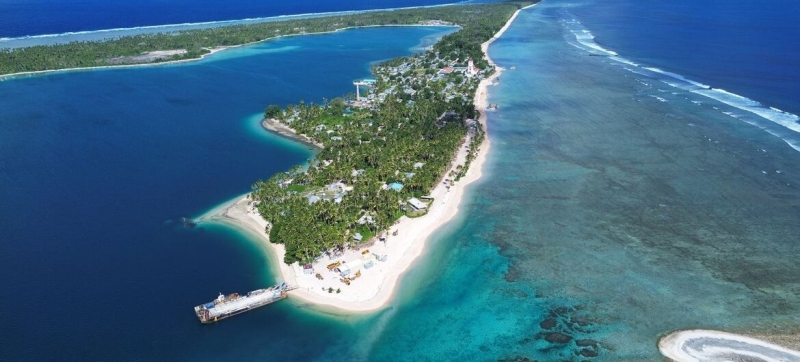
The Tuvalu archipelago is located in the west-central area of the Pacific Ocean.
As the Pacific island nation of Tuvalu faces rising sea levels that could submerge much of its land by the end of the century, its people are taking urgent steps to protect their future while preparing for the worst impacts of climate change.
In 2025, more than 90 per cent of Tuvaluans applied for a visa scheme offering residency or citizenship in Australia. Earlier, in 2022, the government launched the world’s first “digital nation” in the metaverse to preserve its identity and culture in case its physical territory disappears.
In these small and remote island communities, often home to only a few thousand residents, resources to combat the growing threat remain limited. Without external support, their ability to respond is severely constrained.
“A lot of times people say, ‘you’re just talking about a few thousand people’. But for us, those people are on the frontline of the climate crisis, and we owe it to them to safeguard their livelihoods,” said Tuya Altangerel of the United Nations Development Programme.
With UNDP support, the government is scaling up efforts to protect the country’s most populated islands.
Rising seas, growing risks
Sea-level rise, driven by global warming, is accelerating as oceans expand and ice sheets melt. The Pacific region is experiencing some of the fastest increases due to a combination of ocean currents, winds and climate change.
In Tuvalu, sea levels have risen by 21 centimetres over the past 30 years—nearly double the global average. At this pace, projections suggest that up to 95 per cent of the country could be underwater by 2100.
High tides pose daily threat
For local communities, the most immediate danger comes from increasingly frequent and intense high tides.
“Our islands are drowning,” Altangerel said.
With most of the country lying less than two metres above sea level, traditional coastal protection methods—such as seawalls or mangrove planting—are becoming ineffective against powerful tides.
Migration and uncertainty
Alongside adaptation efforts, migration is emerging as an option. Under the Falepili Union agreement signed in 2023, 280 Tuvaluans can relocate to Australia each year. In the first round, around 90 per cent of the population applied.
Similar migration pathways exist for citizens of other Pacific nations, including Kiribati and Vanuatu, raising concerns about the long-term impact on culture and heritage if communities relocate in large numbers.
Can a nation survive without land?
The threat goes beyond land loss to questions of identity and sovereignty.
“It’s not just about coastal areas disappearing; the very existence of these nations is at risk,” Altangerel said.
A 2025 ruling by the International Court of Justice clarified that a country does not lose its statehood or sovereignty even if its physical territory is submerged, allowing Tuvalu to retain rights and international recognition.
Building for survival
Since 2017, Tuvalu has been implementing a major coastal adaptation project with support from the UNDP and the Green Climate Fund. The initiative involves creating elevated land using dredged sand to withstand future sea levels.
The project has already added new land across key islands, including Funafuti, Nanumea and Nanumaga, and aims to expand further.
“These are drastic but necessary measures,” Altangerel said, noting that the project has cost nearly $55 million so far.
Additional support includes an insurance scheme to compensate households affected by tidal flooding, with initial payments planned for hundreds of families.
A global warning
For Tuvalu and other low-lying nations, these efforts may offer a model for survival. But the challenge remains immense.
“If we can safeguard Tuvalu, it could be replicated across other vulnerable island states,” Altangerel said.
As the world marks Earth Day, Tuvalu’s struggle reflects a broader question facing humanity: whether nations can preserve their land, identity and future in the face of rising seas.