

- 11-Year Run of Record Global Heat Continues: UN Agency |
- Gaza Ceasefire Not Enough as Children Continue to Die |
- Bangladesh Sets Guinness Record With 54 Flags Aloft |
- Gambia Tells UN Court Myanmar Turned Rohingya Lives Hell |
- U.S. Embassy Dhaka Welcomes Ambassador-Designate Brent T. Christensen |
After flood, Boro season unfolds in Sunamganj
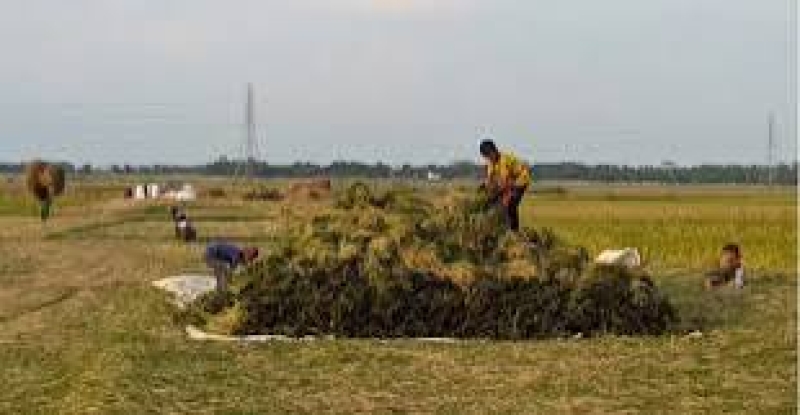
As the vast haor waters slowly recede, life in Sunamganj’s low-lying wetlands is once again defined by urgency, mud and relentless labour by farmers.
Across the district, farmers have plunged into the Boro cultivation season, racing against a narrow planting window that will determine their livelihoods for the year ahead.
From one upazila to another, the haor landscape has turned vibrant with activity. Knee-deep in muddy water, farmers and agricultural labourers work from dawn to dusk, transplanting paddy seedlings on freshly exposed land. Shantiganj, Tahirpur, Madhyanagar, Dharmapasha, Shalla and Jamalganj are among the upazilas where the seasonal rush is most visible.
According to the District Agriculture Department, seedlings have already been planted on 1.53 lakh hectares of land in Sunamganj.
With haor waters withdrawing gradually, farmers are making full use of every available day to ensure timely transplantation and a successful harvest.
Boro cultivation in the haor region typically begins after floodwaters recede, following the preparation of seedbeds in November and December.
This year, soil testing has been completed in advance, and required fertilisers, including urea, TSP, DAP, MOP and gypsum, have been applied as per recommendations.
Farmers are cultivating a mix of high-yielding and hybrid rice varieties, including BRRI dhan-28, BRRI dhan-29, BRRI dhan-89 and BRRI dhan-92. If weather conditions remain favourable, rice ears are expected to emerge in April-May, marking the crucial phase when grains mature ahead of harvest.
Yet the physical toll of the season is unmistakable. Despite the biting winter cold, labourers stand for hours in icy water, trampling mud to plant seedlings by hand. For many, agriculture is the only means of survival, leaving little room for rest.
“I work from 8am till evening for a daily wage of Tk 600 and one meal,” said Ibrahim Mia, a farmer from Khushdar Haor in Lalpur village. “Even in severe winters, we have to trample mud in water. We are poor people and survive through hard labour.”
Like many others, Ibrahim hopes that good yields and fair market prices will reward their effort. “If we get proper prices, farmers will be more motivated,” he said.
Officials say the Boro season is not only vital for food production but also creates seasonal employment in the haor belt.
Deputy Director of the Sunamganj District Agricultural Extension Department Mohammad Omar Faruk said Boro remains the district’s main cropping season.
“Workers from different districts have come to Sunamganj to take part in the planting activities,” he said, adding, “They are earning between Tk 600 and Tk 800 per day, which has created temporary employment opportunities in the haor areas.”
He said the Boro cultivation target for the current season has been set at 2,23,505 hectares, with planting already completed on about 1,53,000 hectares.
As farmers push forward against time, cold and uncertainty, the receding haor waters signal both hope and hardship, a familiar rhythm in Sunamganj, where the success of the Boro season shapes food security and livelihoods for thousands, reports UNB.