

- US to Pause Immigrant Visas for 75 Countries Including Bangladesh |
- 11-Year Run of Record Global Heat Continues: UN Agency |
- Gaza Ceasefire Not Enough as Children Continue to Die |
- Bangladesh Sets Guinness Record With 54 Flags Aloft |
- Gambia Tells UN Court Myanmar Turned Rohingya Lives Hell |
Draft Energy Plan May Lock Bangladesh into Costly Fuels
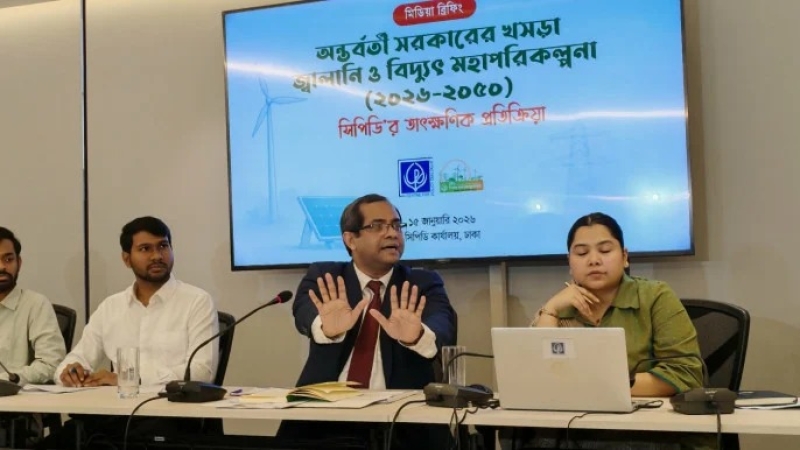
CPD Research Director Khondaker Golam Moazzem speaks during an event on 15 January 2026.
The Centre for Policy Dialogue (CPD) on Wednesday urged the interim government to immediately suspend the formulation of the Energy and Power Sector Master Plan (EPSMP), warning that the draft marks a backward shift in policy and prioritises bureaucratic control and vested interests over Bangladesh’s long-term energy and economic needs.
Speaking at a briefing in the capital, CPD Research Director Khondaker Golam Moazzem said the draft plan is fundamentally flawed, non-participatory and risks locking the country into expensive, carbon-intensive energy infrastructure for decades.
He questioned the mission and vision of the draft, noting that renewable energy has not been placed at the centre of planning, while domestic coal is being promoted under the guise of “resource optimisation”. Moazzem also raised concerns over the proposal to plan for nearly 60,000 megawatts of electricity capacity, asking who would realistically consume such a large volume of power.
According to CPD’s assessment, roughly half of the proposed capacity would be sufficient to meet demand by 2040, particularly as future industrial growth is expected to be more service-oriented, labour-intensive and less energy-intensive. Overestimating demand, he warned, would worsen excess capacity and deepen the financial strain already facing the power sector.
CPD argued that the entire EPSMP process should be halted and deferred until after national elections, allowing an elected government to initiate a fresh, inclusive and transparent planning exercise. The think tank said the draft appears to reflect pressure from foreign partners and entrenched domestic energy lobbies, especially in relation to the expansion of liquefied natural gas (LNG) infrastructure.
Referring to upcoming economic and trade engagements with Japan and the United States, Moazzem said there are indications that energy-related commitments linked to such partnerships may have influenced the draft master plan.
In the keynote presentation, CPD senior research associate Helen Mashiyat Preoty said the plan gives inadequate attention to grid upgradation. She noted that smart grid implementation has been pushed back to 2040, despite the fact that the existing grid cannot accommodate more than 20 percent variable renewable energy.
CPD also criticised the renewed emphasis on fossil fuels, particularly coal and LNG. The draft proposes expanding coal-based power generation from 6.8 gigawatts to 12.9 gigawatts and prioritises new LNG terminals and additional floating storage and regasification units—investments Preoty described as costly and detrimental to long-term energy security.
The organisation recommended scrapping all plans for new coal-fired power plants, initiating a time-bound phase-out of existing coal capacity, halting new LNG terminal projects and redirecting investment towards domestic gas exploration. It also called for redefining renewable energy to focus on proven sources such as solar and wind, prioritising high-potential regions including Chattogram, and integrating regional renewable energy trade, particularly cross-border imports from Nepal and Bhutan, which the draft largely overlooks.