

Tuesday, September 15, 2026
News update
- Bangladesh Has 1.584m Tonnes of Fertiliser in Surplus |
- July Uprising crimes: Obaidul Quader, six others get death penalty |
- School relocation row halts Gaibandha char children’s learning |
- REHAB president's post declared vacant over loan default |
- China criticises idea it is in 'malicious competition' over AI |
Bangladesh Has 1.584m Tonnes of Fertiliser in Surplus
Agriculture
2026-09-15, 1:54pm
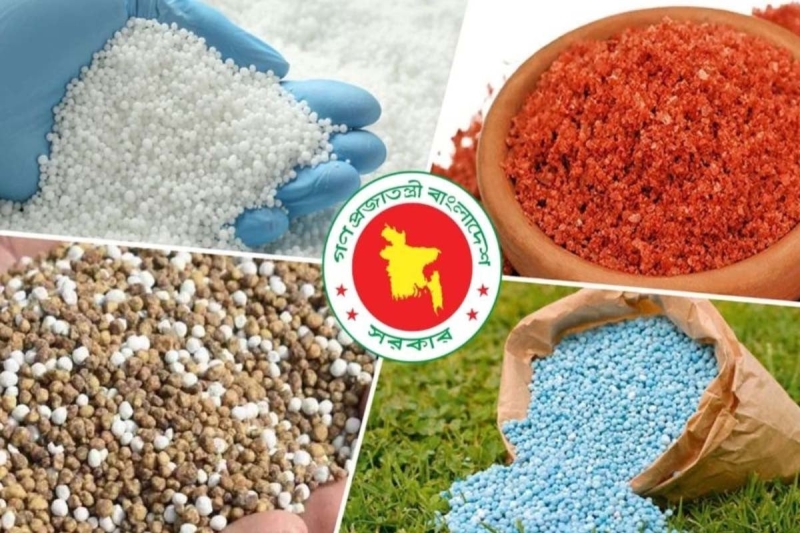
The government has prepared 5.171 million metric tonnes of fertiliser against a projected demand of 3.587 million tonnes for the upcoming Rabi and Boro seasons, leaving a surplus of 1.584 million tonnes.
At the same time, the government has taken steps to ensure that fertiliser is allocated to all 64 districts according to local demand and supplied to farmers on time.
According to government data, the projected demand for fertiliser is 3.587 million tonnes, compared with a prepared supply of 5.171 million tonnes. The figures indicate that supply preparations exceed projected demand by approximately 1.584 million tonnes.
In addition, allocations have been made to the relevant districts against the full projected demand for urea, triple superphosphate (TSP), diammonium phosphate (DAP) and muriate of potash (MOP) for October.
The information was disclosed in a letter issued by the Fertiliser Management and Monitoring Sub-Division of the Ministry of Agriculture on September 14, along with a district-wise allocation list. The document outlines allocations from various sources against the projected fertiliser demand for October 2026.
According to the allocation data, the total demand for TSP across the country’s 64 districts in October is 70,052 metric tonnes, and the full amount has been allocated through the Bangladesh Agricultural Development Corporation (BADC).
Similarly, the total demand for DAP is 150,910 metric tonnes. Of this, the Bangladesh Chemical Industries Corporation (BCIC) has allocated 1,000 tonnes, while BADC has allocated 149,910 tonnes. Thus, the entire projected demand has been covered.
The total October demand for MOP is 93,654 metric tonnes, and an equivalent amount has been allocated to the districts.
The combined district-wise demand for the three non-urea fertilisers—TSP, DAP and MOP—is approximately 314,616 tonnes, against which the government has arranged full allocations.
The Agriculture Ministry’s documents show that separate quantities have been allocated to each district based on its projected demand. Rather than relying on a single central allocation, the supply plan has been designed around agricultural needs at the field level.
Imports Continue to Support Supply
To ensure uninterrupted fertiliser supplies, the government has continued importing fertiliser alongside district-wise allocations.
On September 9, the Cabinet Committee on Government Purchase approved three proposals to import a total of 110,000 tonnes of MOP, DAP and urea to maintain agricultural production and ensure supplies for farmers.
The approved imports include 30,000 tonnes of MOP from Belarus, 40,000 tonnes of DAP from Morocco and 40,000 tonnes of urea from Saudi Arabia.
Earlier in August, the government approved proposals to import a total of 365,000 tonnes of fertiliser from various countries, including urea from Saudi Arabia and MOP from Russia.
As of September 9, the country had 418,000 tonnes of urea, 343,000 tonnes of TSP, 302,000 tonnes of DAP and 178,900 tonnes of MOP in stock.
In addition, 128,200 tonnes of TSP, 114,600 tonnes of DAP and 189,400 tonnes of MOP were in transit.
The government has also taken steps to improve fertiliser management by forming a national coordination and advisory committee and establishing fertiliser monitoring cells in all 64 districts.
Focus on Demand-Based Allocation and Monitoring
The government’s fertiliser management strategy focuses on demand assessment, district-wise allocation, advance imports, supplies in transit and field-level monitoring. The Integrated Fertiliser Dealer Appointment and Distribution Policy 2026 is also part of this management framework.
The Agriculture Ministry’s recent allocation document places particular emphasis on assessing the needs of all 64 districts for October. Officials believe that ensuring full allocations of TSP, DAP and MOP against projected demand will reduce the risk of shortages and improve farmers’ access to fertiliser when needed.
Fertiliser is one of the most important inputs for agricultural production. The government’s advance demand assessment, early allocation, imports and stockpiling are intended to prevent uncertainty and pressure on farmers during the production season.
Director General of the Department of Agricultural Extension Md Abdur Rahim said demand-based planning and advance preparation were among the government’s most important initiatives in fertiliser management.
“Besides importing and stockpiling fertiliser, we are considering how much fertiliser is needed in each area, when it is needed and how it will reach farmers,” he said. “Supply and distribution activities are also being closely monitored at the field level.”
He said the government would not allow any shortage of fertiliser to emerge, giving the highest priority to farmers’ interests. Agricultural officials are regularly monitoring the fertiliser situation, and any supply-related problem will be reported to the relevant authorities for immediate action.
Agriculture Secretary Md Salim Khan said the government had adopted an advance and coordinated plan from the outset to ensure fertiliser availability when farmers need it.
“Allocations are being made to districts after assessing actual demand at the field level,” he said. “Full allocations against the October demand for TSP, DAP and MOP have been ensured. Therefore, farmers should have no reason to be concerned about fertiliser during the current season.”
The secretary acknowledged that irregularities in distribution had caused some disruption in certain areas, but said the problems had been addressed quickly through government action and administrative measures.
He said the government’s main objective was to deliver fertiliser to farmers at the right time, in the right quantity and at fair prices. Imports, stockpiling, district-wise allocations, transportation and distribution are being monitored in an integrated manner, he added.
He further said fertiliser supplies had been given the highest priority to maintain agricultural production. Demand assessment and allocations are being completed before the production season so that farmers do not face additional pressure or uncertainty while collecting fertiliser at the last moment.
According to the secretary, these initiatives would increase farmers’ confidence and help maintain productivity through timely fertiliser application. He said the Agriculture Ministry was working with the highest level of commitment and vigilance to protect farmers’ interests.