

- UN calls for urgent action to protect children from online info risks |
- UN offers support to Colombia as 7.4 scale earthquake kills dozens |
- Former Syrian President Assad Sentenced to Death in Absentia |
- PM Welcomes Visa Investment in Bangladesh’s Digital Economy |
- PM Tarique inaugurates three pilot SDG villages |
Iranians Divided Over Mojtaba Khamenei’s Rise to Power
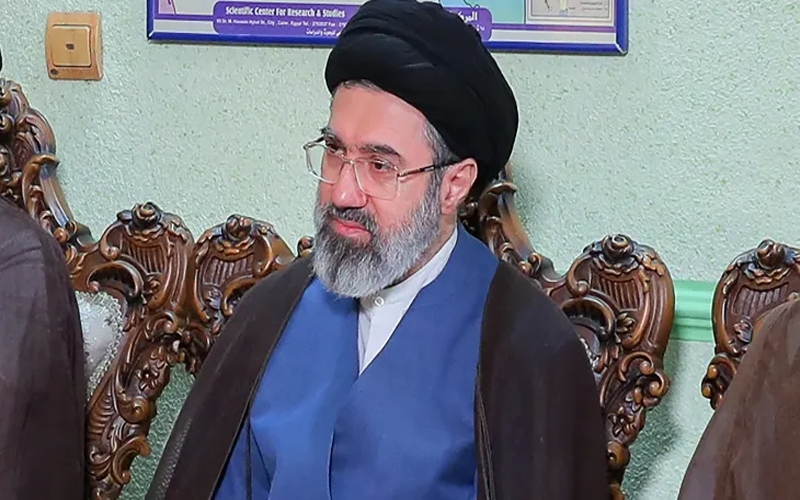
Mojtaba Khamenei
Iranians appear deeply divided after Mojtaba Khamenei was appointed the country’s new supreme leader following the killing of his father, Ali Khamenei, during the early days of the conflict between the United States and Iran.
While some supporters of the government have taken to the streets celebrating his rise, others say the leadership change offers little hope for political reform.
Mojtaba Khamenei, 56, was selected by the Assembly of Experts, the 88-member body responsible for appointing Iran’s supreme leader. Several residents in Tehran said the decision signals continuity rather than change in the country’s political direction.
“Even the smallest chance of reform within the system is gone,” said a man in his thirties in Tehran, arguing that the assembly could hardly have chosen anyone closer to the late leader.
“For supporters of the system, nothing will change. They won’t even need to change their slogans,” he added.
For years, Mojtaba Khamenei was widely believed to hold significant influence behind the scenes during his father’s rule. Analysts say he is likely to continue the hardline policies that defined the previous leadership.
Some Iranians fear the new leader could adopt an even tougher stance. A woman in her twenties in Tehran said she believed Mojtaba would be “more oppressive than his father,” while another resident suggested the war and his father’s death could harden his position.
“They killed his father and he won’t forget it,” said a man in his thirties. “If he cannot retaliate against the United States, ordinary people may end up paying the price.”
Despite criticism from some quarters, Iranian state television has shown large rallies supporting the new leader in cities such as Qom and Mashhad, Mojtaba’s birthplace. Footage broadcast by state-run channels showed crowds waving Iranian flags and holding posters of Mojtaba Khamenei alongside his father.
Supporters said the appointment would ensure continuity of leadership. “We are certain the path will continue under his leadership,” one supporter said at a gathering in Tehran’s Enghelab Square.
At the same time, videos circulating on social media showed small protests in some areas, with demonstrators chanting slogans against Mojtaba Khamenei while others voiced religious slogans backing the leadership.
Mojtaba Khamenei largely remained out of the public spotlight during his father’s tenure. However, leaked diplomatic cables published by WikiLeaks previously described him as an influential figure behind the scenes and a key gatekeeper to the late leader.
Critics have also accused him of playing a role in presidential elections and maintaining close ties with the powerful Islamic Revolutionary Guard Corps and the Basij paramilitary force.
His appointment comes as the United States and Israel continue military strikes inside Iran during the ongoing conflict.
US President Donald Trump has already criticised Mojtaba’s leadership, describing him as “unacceptable” and suggesting that any successor chosen without Washington’s approval “would not last long.”
Israeli officials have also warned they may continue targeting Iran’s leadership if tensions escalate further.
Analysts say Mojtaba Khamenei now faces one of the most difficult moments in Iran’s modern history, with the country confronting war, internal divisions and mounting international pressure.