

- RAB Officer Killed, Three Injured in Sitakunda Attack |
- Bangladesh Plans Padma Barrage, First Phase at Tk34,608cr |
- US Expands Trump’s Gaza Peace Board, Invites More States |
- Spain Train Collision Kills 21, Leaves Dozens Injured |
- NCP Announces 27 Candidates, Aims for Seats After Exit |
Spain Seeks Answers as Train Crash Death Toll Hits 40
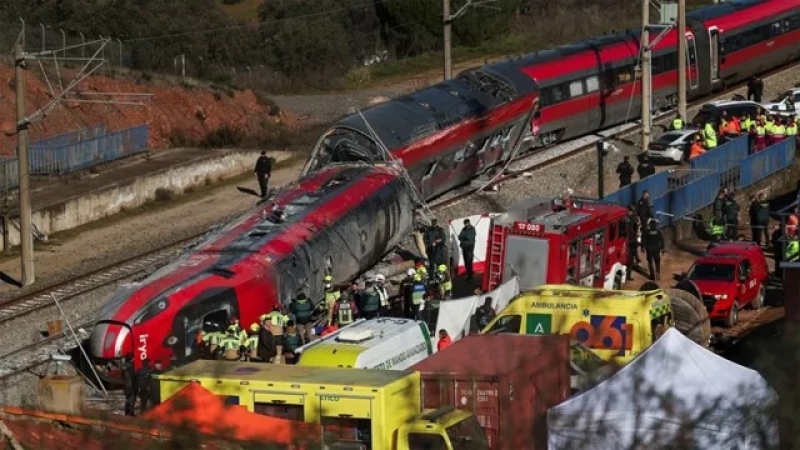
Spain launched a full investigation on Monday after the death toll from a high-speed train collision in the country’s south rose to 40, marking the deadliest rail disaster in more than a decade.
The crash occurred late on Sunday near the town of Adamuz in the Andalusia region when a high-speed train travelling from Malaga to Madrid derailed and crossed onto an adjacent track, colliding with an oncoming service. Both trains were thrown off the rails.
The regional government confirmed 40 fatalities, revising an earlier figure of 39, and warned that it could take 24 to 48 hours to determine the final number of victims as rescue teams continued their work. Heavy machinery was brought in to lift badly damaged carriages and reach trapped passengers.
More than 120 people were injured, with at least 41 still receiving treatment in hospitals in the nearby city of Córdoba. Families and friends of missing passengers turned to social media, sharing photographs and appeals for information.
Prime Minister Pedro Sánchez, who visited the crash site, described the incident as a national tragedy and declared three days of mourning. He pledged a transparent investigation to establish the cause of the disaster and ensure accountability.
Preliminary findings deepened the mystery surrounding the crash. Officials said the derailment occurred on a straight section of track and that both trains were travelling within the permitted speed limit, unlike Spain’s last major rail disaster in 2013, when a train derailed on a curve, killing 80 people.
The transport minister said the train that first derailed was nearly new and that the section of track had been recently renovated, calling the incident “extremely strange”. The operator of that service said the locomotive, built in 2022, had passed inspection just days before the accident and veered onto the adjacent track for reasons still unknown. About 300 passengers were on board.
The operator of the second train, which was travelling to the southern city of Huelva, said it was carrying 184 passengers. Rail officials said human error and speeding had largely been ruled out, noting that both trains were travelling at just over 200 kilometres per hour, below the 250-kilometre-per-hour limit for that stretch of track. Attention has instead turned to possible mechanical or infrastructure failures.
Spain has Europe’s largest high-speed rail network, spanning more than 3,000 kilometres and linking major cities including Madrid, Barcelona, Seville, Valencia and Malaga.
Survivors described scenes of chaos and terror inside the carriages, with shattered glass and injured passengers. In Adamuz, residents rushed to help, bringing water, blankets and supplies to emergency responders.
Condolences poured in from leaders around the world, including Pope Leo XIV and French President Emmanuel Macron, as Spain mourned one of the darkest days in its modern rail history.