

- Dhaka Ranks 7th Among World’s Most Polluted Cities on Wednesday |
- 4 killed in bus- auto-rickshaw collision at Mirpur |
- PM Pushes Plans for Second Padma, Jamuna Bridges, Barrage |
- Tap grants, local finance; shun loans for energy sovereignty |
- Govt eyes 3,000-4,000MW solar power addition to grid before next summer: PM |
Republican Byron Donalds elected Florida's first Black governor
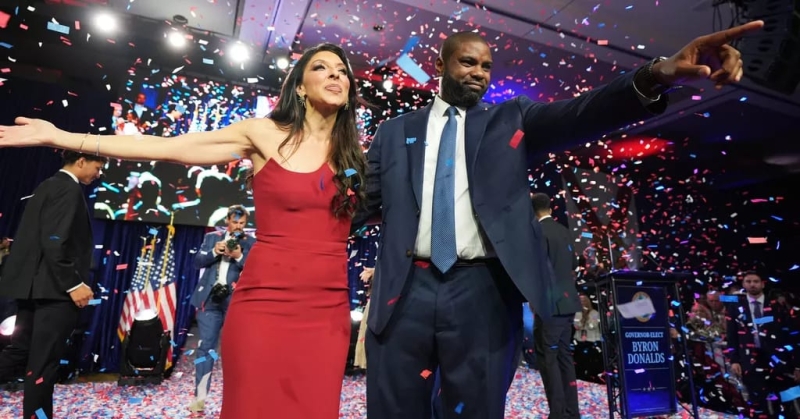
Republican gubernatorial candidate Rep. Byron Donalds, R-Fla., celebrates at an election night event with his wife Erika Donalds on Tuesday, Nov. 3, 2026, in Hollywood, Fla.
Republican US Representative Byron Donalds was elected Florida's first Black governor on Tuesday, defeating Democrat David Jolly in a surprisingly competitive race that tested the Republican Party's hold on President Donald Trump's adopted home state.
Donalds, a strong Trump ally, will succeed outgoing Republican Governor Ron DeSantis, who used his position to pursue presidential ambitions and move the country's third-most populous state further to the right.
Donalds will also become the first elected Black Republican governor in the United States. In his victory speech to supporters in South Florida, he thanked Trump for his backing.
"I want you to hear from Florida that we are still red," Donalds told the crowd. "Mr. President, I also want to tell you thank you for your support and thank you for being in my corner."
The contest tested whether Trump's declining popularity, which has weighed on Republicans across the country, would also affect his home state and threaten a governorship that Democrats have not won in more than three decades.
During the campaign, Donalds sought to portray Jolly as an out-of-touch liberal while reaching out to Black voters, who traditionally support Democrats.
Apart from the national political climate, the race focused on issues such as rising prices and the cost of homeowners' insurance, a particularly pressing concern in a state frequently battered by hurricanes.
For generations, Florida was one of the country's most closely contested political battlegrounds, where the interests of major cities, agricultural communities, newly arrived retirees and diverse Latino populations often shaped elections decided by narrow margins.
However, the state's reputation as a political battleground weakened under DeSantis. He won his first gubernatorial election in 2018 by less than half a percentage point but subsequently embraced cultural issues surrounding race and gender.
Among other measures, he signed legislation, commonly criticised as the "Don't Say Gay" law, prohibiting instruction on sexual orientation and gender identity in kindergarten through third grade.
By the time DeSantis sought reelection in 2022, he secured a landslide victory by nearly 20 percentage points, leaving Florida's Democrats in a weakened position.
Jolly faced significant challenges in his bid to revive the Democratic Party's fortunes in the state. Republicans enjoyed an advantage of around 1.5 million registered voters, while Donalds substantially outspent him in campaign fundraising.
To overcome those obstacles, Jolly campaigned in Democratic strongholds such as Broward County, as well as traditionally Republican areas of central Florida and the state's Panhandle.
Donalds maintained confidence throughout the campaign, balancing his support for Trump with efforts to maintain some distance from the president, including limiting references to him on his campaign website. -UNB