

- Women to Get Free Education Up to Honours Level: PM |
- PM releases fish fry into Brahmaputra in Kishoreganj |
- Miraz puts Bangladesh within sight of victory as Australia stutter |
- Scale 7.7 quake off Indonesia coast, kills at least 47, topples homes |
- PM for swift steps to restore energy supply, patience to resolve crisis |
Israel, Lebanon Sign Framework Peace Deal: US
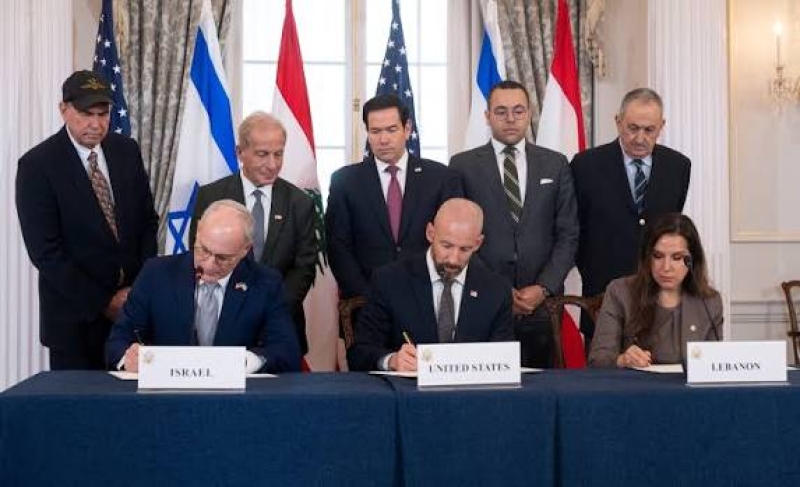
The United States on Friday announced a framework agreement between Israel and Lebanon, described as an initial step toward peace after months of conflict involving Israel and the Lebanese armed group Hezbollah.
US Secretary of State Marco Rubio joined the Israeli and Lebanese ambassadors to Washington in unveiling the deal, which the State Department said aims to create a pathway toward ending hostilities and addressing long-standing tensions along the border.
The agreement does not include Hezbollah, which has opposed the process. A senior Hezbollah figure in Lebanon warned that the deal could trigger internal conflict.
According to the State Department, the framework outlines steps toward dismantling Hezbollah’s military capability and enables Lebanon to regain territory taken by Israeli forces during the fighting. Washington will also establish a “Military Coordination Group for Lebanon” to support implementation and has pledged $100 million in humanitarian aid.
“For Lebanon, this framework provides a genuine pathway out of a long crisis,” the State Department said. “For Israel, it creates a verifiable path to removing the persistent threat on its northern border.”
The agreement was formally signed in Washington by Israeli Ambassador Yechiel Leiter and Lebanese Ambassador Nada Hamadeh Moawad in the presence of Rubio.
Leiter said the ultimate goal is lasting peace between the two countries, expressing hope for normalised relations in the future.
“We want to embrace Lebanon,” he said, adding that both sides should eventually be able to travel freely between Tel Aviv and Beirut. However, he stressed that progress depends on the disarmament and dismantling of Hezbollah, as well as support for the Lebanese army.
Moawad described the framework as an important initial step toward restoring Lebanon’s sovereignty and territorial integrity, ending hostilities permanently, and enabling displaced civilians to return home.
The latest conflict erupted after Hezbollah launched rockets into Israel following joint US-Israeli strikes on Iran on February 28. Israel later expanded its military operations into Lebanon, intensifying the conflict.
Since March, more than 4,000 people have been killed in Lebanon due to Israeli strikes, while at least 37 Israeli soldiers have died in fighting in Lebanon and northern Israel.
Lebanon has prioritised Israeli withdrawal from its southern territory in negotiations, while Israel has focused on disarming Hezbollah, which is backed by Iran.
The talks between Israel and Lebanon are separate from a US-Iran interim agreement reached last week aimed at ending fighting in Iran and addressing concerns over Tehran’s nuclear programme. That deal set a 60-day negotiation window on key issues.
Hezbollah, however, was not part of the Israel-Lebanon talks and has long rejected any plan requiring its full disarmament. The group insists previous agreements only require it to disarm south of the Litani River near the Israeli border.
Hezbollah official Hassan Fadlallah reiterated the group’s rejection of direct negotiations with Israel, saying it would not give up its weapons. He warned that enforcing the agreement could lead to civil conflict, and accused the process of undermining broader diplomatic efforts.
Lebanese Prime Minister Nawaf Salam said the framework seeks to secure Israeli withdrawal from all Lebanese territory, restore state authority, and enable citizens to return to their homes. President Joseph Aoun also noted discussions on “pilot zones” where Lebanese forces would assume control as Israeli troops withdraw, reports UNB.
An Israeli official, speaking anonymously, said negotiations also cover Israeli redeployment after southern Lebanon is cleared of Hezbollah infrastructure and the group is disarmed.
Israeli Prime Minister Benjamin Netanyahu called the agreement a “major achievement,” saying Israel would maintain a security zone in southern Lebanon until Hezbollah is disarmed and no longer poses a threat.
He added that Israel is coordinating with the Lebanese army to prepare for future control of areas being vacated, while maintaining strategic positions outside the range of anti-tank missiles.