

- Oil Prices Fall Despite Fears of Saudi Supply Disruptions |
- Trump Targets Somali, Haitian Immigrants at Ohio Rally |
- Why is Iran offering to mediate between Saudi Arabia and the Houthis? |
- Biman suspends Tuesday’s Dhaka-Dammam flight |
- First Phase of Union Parishad Polls Set for January 21 |
Uncertainty In ME Hits Bangladesh’s Manpower Export
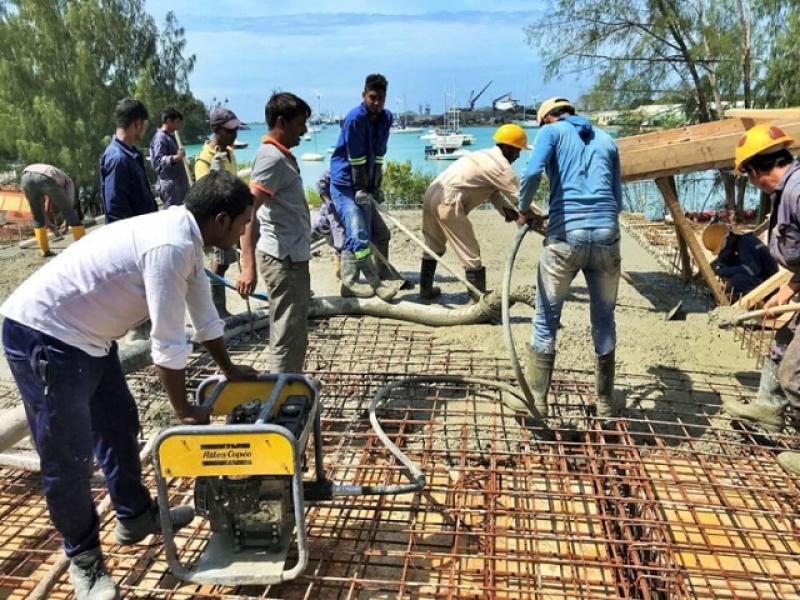
Migrant workers doing construction work, - Seychelles Nation via Wikimedia Commons.
By Imtiaz Ahmed and Samia Tabassum
The USA-Israel imposed war on Iran, global tension and high price of energy stand in the way of exporting manpower to overseas markets, said policy-makers and leaders of Bangladesh Association of International Recruiting Agencies (BAIRA).
Bangladesh exported a total of 479,067 workers to overseas markets during January 1, 2026 to August 21, 2026 periods compared to 704, 585 workers during the same period of the last calendar year showing 33 per cent drop during same period, according to the data of the of the Bureau of Manpower, Employment and Training (BMET).
Bangladesh exported a total of 266,660 workers to KSA, 49,405 workers to Singapore, 41,948 to Qatar, 20,234 to the Maldives, 17,184 to UAE, 11,462 to Jordan, 4808 to Iraq, 4694 to Portugal and 1133 to Malaysia during this year until August 21.
Remittance earned by migrant workers make the first of the two main pillars of the Bangladesh economy. The other pillar is readymade garment export which is also suffering due to the energy crisis created in the wake of the war on Iran.
The US-Israel war on Iran began on February 28, 2026 that resulted cancellation of several hundred international flights and job losses of Bangladeshi workers, said an official of the BMET
The global political tension particularly in the middle-east has a knock—on -effect on recruitment of workers in the global market, said a leader of the Bangladesh Association of International Recruiting Agencies (BAIRA).
Over 20 lakh youths are entering the job market in Bangladesh every year. However, the local economy and local industries can give jobs to a fraction of the youths and the rest youths eye getting jobs in the overseas markets, said an economist.
Meanwhile, Prime Minister's Information and Broadcasting Adviser Dr Zahed Ur Rahman this month said the Malaysian labour market will reopen for Bangladeshi workers in the last week of August following a bilateral understanding between the two countries.
"The opportunity for employment has been created for all Bangladeshi workers following a consensus reached between Bangladesh and Malaysia at a bilateral meeting," he said.
Dr Zahed said the government is committed to ensuring that workers are sent to Malaysia through a transparent and accountable process by addressing the irregularities, excessive costs and harassment that occurred in the past.
He noted that Prime Minister's Adviser and PMO Spokesperson Mahdi Amin had already announced the reopening of the Malaysian labour market in the last week of August.
"We want to inform everyone once again that an opportunity has been created for Bangladeshi workers to work in Malaysia based on the consensus reached between the two countries. This is very important news for us," he said.
Referring to overseas employment, Dr Zahed said many aspiring migrant workers had previously suffered due to irregularities, high migration costs and the involvement of a limited number of recruiting agencies.
However, sources in Malaysia said that the recruitment of Bangladeshi workers on a regular basis to Southeast Asian country is important in the context of high unemployment rate in Bangladesh.
Meanwhile, Bangladesh and Thailand have discussed the prospect of employment for around 10,000 Bangladeshi workers in Thailand following completion of necessary procedures, alongside expanding bilateral cooperation in trade, investment and tourism.
The issue was discussed during a bilateral meeting between Prime Minister's Foreign Affairs Adviser Humaiun Kobir and Thai Deputy Foreign Minister Vijavat Isarabhakdi in Bangkok recently
During the talks, the two sides reaffirmed their commitment to further strengthening the longstanding friendly relations between Bangladesh and Thailand and expanding cooperation in the areas of mutual interest.
They reviewed the overall state of bilateral relations and discussed ways to enhance cooperation in trade and investment, labour mobility, tourism and people-to-people contacts.
The two sides particularly exchanged views on the prospect of opening employment opportunities for around 10,000 Bangladeshi workers in Thailand once the necessary procedures are completed.
Meanwhile, a threat by US President Donald Trump to impose unprecedented economic warfare and isolation on Iran could have implications for countries that trade with it. Trump warned of economic consequences for any country that supports Iran, according to an AFP report.
China, the biggest buyer of Iranian oil, could face additional pressures from the US over its purchases if Trump follows through on his promise.
Over the past decade, China has created a ring-fenced system of refiners that process mainly Iranian oil and do not have much US exposure.
Over 80 per cent of Iran’s shipped oil has been destined for China, as Chinese independent refiners take advantage of discounted US-sanctioned oil.
Kpler estimates that China bought an average of 1.38m barrels per day of Iranian oil in 2025.
Meanwhile, the United Arab Emirates has historically been one of Iran’s most critical economic lifelines, and Dubai’s banks have long held substantial Iranian-linked deposits, much of them now immobilised under US sanctions.
The UAE was among Iran’s largest trade partners before the war, providing 30pc of its imports worth an overall $21bn in 2024, according to the World Trade Organisation’s latest figures. It also accounted for 13pc of Iran’s exports in the same year, the data showed.
Non-oil foreign trade between the two countries totaled $6.6 billion in 2024, according to UAE economy ministry data, with the vast majority of trade represented by re-exports.
The tension in the middle-east has increased energy prices and uncertainty that in turn will hot recruitment in overseas countries, said a BAIRA leader.
Bangladesh has become a victim of the middle-east crisis and even inside the country, several hundred local and export-oriented industries have to halt or cut production against shortage of gas. This in turn is also cutting the local job market, said an export-oriented readymade garment industry executive.
Recruiting agencies say that Malaysia is a more preferable destination for Bangladeshi workers than Middle Eastern countries because of its comparatively better salary structure and weather conditions that are almost similar to Bangladesh's.
Most of the foreign workers in the Middle Eastern countries are employed as construction workers, cleaners and housemaids. These countries also employ semi-skilled workers like drivers, electricians, and plumbers.