

- Food prices edged up in July amid heatwaves, costlier energy |
- Mother, daughter brutally tortured in Kalapara |
- Save Rivers, Save the People; Save Bangladesh |
- 46 maunds (1.65 tons) of hilsa caught in one net in Bay, sold for Tk48.5 lakh |
- Jamaat decides to take part in presidential election |
Save Rivers, Save the People; Save Bangladesh
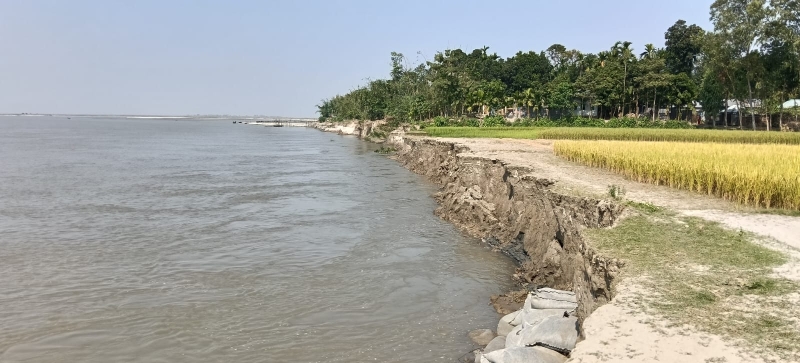
Teesta river-bank erosion cracks near a paddy field just before harvest time. UNB
Jasim Uddin Ahmed, Syed Tipu Sultan, Mostafa Kamal Majumder
The world's largest delta, Bangladesh is the creation of Rivers. Bangladesh is the drainage channel of the three major river systems—the Ganges, the Brahmaputra, and the Meghna—that flow from the Eastern Himalayas. Out of a total of 57 transboundary rivers, 54 enter Bangladesh through India. These rivers are the source of about 97 percent of the country's total water. But Bangladesh is now heading towards environmental and ecological disasters as upstream country India has built dams, barrages, or reservoirs on all 54 shared rivers.
For the past few decades, water has become a problem for Bangladesh in both the monsoon and dry seasons. Some regions of Bangladesh, including Comilla, Chandpur, Pabna, Bogra, Tangail, Narayanganj, and Munshiganj, do not receive normal monsoon floods due to the withdrawal or storage of water in India at upstream. The floodplains of these areas have remained dry for several decades. As a result, these lands are deprived of the generation of water lilies, other aquatic plants, algae, insects and small fish. Thus, these areas are losing biodiversity. The soil is no longer receiving the natural nutrients it once did.
On the other hand, severe floods occur every year in the greater Rangpur and greater Sylhet regions, which not only wash away crops but also houses and farms. The rivers dry up during the dry season. And in the southwestern region, the rivers do not flow to the sea. As a result, the salinity of the sea penetrates up to 200 kilometers into the land area, damaging the environment, biodiversity, agriculture, industry and the state of the biosphere.
While the neighboring country of India at upstream is ignoring the impact of the environmental disaster, the assigned authorities in our country are not making efforts with utmost seriousness to prevent this disaster. It is now urgent to raise voice from all quarters against this slow but certain environmental disaster — because it will intensify under the impact of climate change and will displace millions of people by the year 2050.
The Ganges Water Sharing Treaty is going to expire on December 11. For the remaining 53 rivers shared with India, Nepal, Bhutan and China there is no agreement at all. Therefore, Bangladesh needs to strengthen its water diplomacy. Water experts and environmentalists from all over the world say in one voice — all rivers must be alive and flowing from source to sea. The World Basin Conference held in Rio de Janeiro in June 2026 reiterated this. At the same time, it called for integrated water resource management through cooperation between upstream and downstream river communities. Because natural flows cannot be divided on their banks or the political borders of the countries through which they flow before they reach the sea.
If rivers are alive, all communities along the river will benefit from their services and the river will benefit from them. The condition of the Ganges has been so critical due to the construction of numerous dams and barrages that its flow, according to experts, has reduced to only 10 percent of its historical flow at the Farakka Barrage point in West Bengal, India.
Will India, the big upstream country, realise this serious mistake? Or how many years will it take them to realise this? No one knows. Unless there is a fundamental change in their thinking about water management. But as a downstream country, Bangladesh will continue to suffer at its own expense if it remains silent.
Finding no other option, Bangladesh is now planning to build a barrage on its own part of the Ganges, so that the coastal environment can be restored by reviving the Ganges distributaries in the southwestern region. These areas have been severely damaged by the long-standing lack of fresh water flow. But even if a barrage is built, an agreement needs to be signed to maintain the flow and revive the dead rivers. Or, it is urgently necessary to conclude a comprehensive and integrated agreement for the sustainable management of all 54 shared rivers.
The Ministry of Foreign Affairs and the Joint Rivers Commission, which are responsible for water diplomacy, should break the silence and secrecy on this issue and start a dialogue with environmentalists, ecologists, climate scientists, soil scientists, chemists, biologists, agricultural and fisheries experts and the affected people, so that a national strategy can be formulated to protect the rivers. This will enable them to effectively take the matter up with the other sides based on the latest concept of water management.
The issue has not been brought up for serious discussion from the Bangladesh side for almost 16 years. The sooner it is brought up again, the better. Because there is hardly any time left before all rivers in Bangladesh turn dead.
(Professor Jasim Uddin Ahmad, Chief Adviser, International Farakka Committee (IFC) Syed Tipu Sultan, Chairman, IFC, New York, Mostafa Kamal Majumder President, IFC Bangladesh.)
Dhaka, Friday 7 August 2026