

- COP31 Nations Push for Fossil Fuel Action, More Finance |
- WFP Seeks $12.1bn to Feed 91 Million People in 2027 |
- Bangladesh Crosses 300 LEED-Certified Green Factories |
- COP31 delivers deals for host Turkey as climate diplomacy stalls |
- UNGA President Urges Four Steps for Rohingya Justice |
Navigability Crisis in Coastal Rivers Puts Fishermen in Hardships
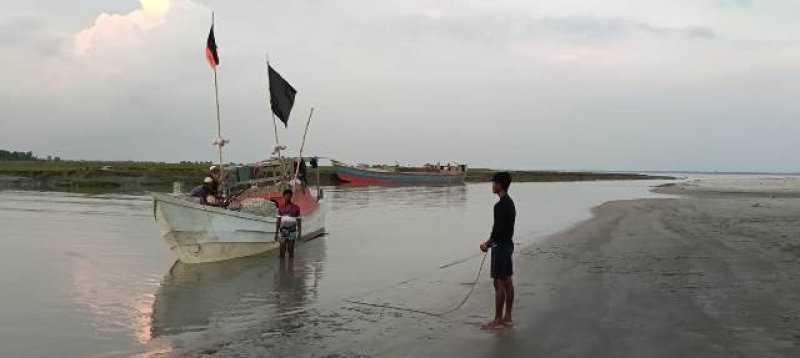
A small fishing boat has run aground in a coastal river in Kalapara
Patuakhali: Several rivers along the coast of Kalapara, Patuakhali—including the Andharmanik, Rabnabad, Shibbaria, Tiakhali, Don, and Dhulasar—have gradually silted up due to natural tidal processes. The construction of large bridges over some of these rivers, carried out without any environmental or ecological impact assessments, has exacerbated the situation. As these once-swift rivers become clogged with sediment, fishermen struggle to find safe harbor for their trawlers during disasters. Furthermore, many fishing trawlers frequently run aground on submerged sandbars while attempting to return from the deep sea to the fishing port.
During low tide, the lack of alternative routes means that fishermen are often unable to reach the port, causing large quantities of fish—worth lakhs of taka—to rot on board their vessels. Consequently, the livelihoods of hundreds of thousands of people who depend on these waterways are now under threat.
The Bablatala Fish Market, located in the Dhulasar Union of Kalapara Upazila, is a century-old traditional hub. Every day, countless fishermen from far and wide arrive here, and the market—along with its surrounding areas—bustles with the calls of fish wholesalers. The lives and livelihoods of hundreds of thousands are intrinsically linked to this market. Recently, however, fishermen returning from the sea have found it increasingly difficult to reach the port safely.
Due to the dire state of the Dhulasar River—the primary access route to the port—fishermen frequently find their trawlers stranded on sandbars, leading to the loss of their hard-earned catch. With vessels remaining stuck for hours or even days, the fish on board begin to decay. Unable to deliver their catch to the wholesale markets on time, the fishermen are forced to incur significant financial losses. Locals state that while the river—once a powerful, free-flowing waterway—can still be entered during high tide, the situation changes completely during low tide. Consequently, after toiling at sea, fishermen are often forced to carry their catch on their heads to reach the landing ghat.
Fishermen and fish-market traders warn that if access to or navigation through the river is completely blocked, the livelihoods of hundreds of thousands of people will be severely threatened. Dredging is, therefore, essential.
Local fisherman Sobhan Sikdar recalls a time when the river’s turbulent waves were truly formidable. Today, however, during low tide, many people can simply walk across the riverbed from one bank to the other. He explains that thousands of fishing trawlers enter the river daily from the sea estuary, but they frequently get stranded on sandbars, forced to wait for long periods. As a result, unable to reach the landing ghat on time, many fishermen are compelled to sell their catch at significantly lower prices.
Another fisherman notes that when the sea becomes rough—or during storms and floods—thousands of trawlers seek shelter in this river. Yet, due to submerged sandbars, they often struggle to enter, frequently leading to accidents.
Md. Rasel, a fish-market trader at Bablatala Bazar, points out that the state of this waterway now impacts the livelihoods of hundreds of thousands. During the winter season, the market handles fish trade worth millions of taka. However, the estuary has become so clogged with sand that navigating it has become nearly impossible for trawlers. While smaller vessels might manage to enter during high or low tide, larger ones frequently get stuck. He warns that unless the river is dredged urgently, many fishermen will be forced to abandon their profession.
Local businessman Haji Masud explains that this century-old market relies entirely on the river. It is difficult to fully articulate the extent of the negative impact caused by the current state of this waterway. Fishermen are increasingly reluctant to bring their catch to this ghat; meanwhile, reaching the alternative ghats at Mahipur or Alipur consumes significantly more fuel. As a result, many fishermen are left with no choice but to carry their catch on their heads for several kilometers to reach the landing point.
Upazila Senior Fisheries Officer Md. Zahirunnabi stated that although fishermen work hard to catch fish, they are often unable to reach the landing ghat on time due to the condition of the channel. The reduced navigability of the river and the presence of numerous submerged sandbars frequently obstruct the movement of trawlers. We have already informed the higher authorities about this issue so that steps can be taken for urgent dredging.
Mamun-ur Rashid, Executive Engineer of the Barishal Dredger Division, mentioned that the concerned minister has already initiated the process of dredging a channel for fishermen at the Khajura point, where sand is currently being removed using a dredger. If a formal request is submitted regarding this specific river as well, we will conduct an assessment and take the necessary measures. - Gofran Palash