

- Potential For Stronger Saudi Investment Considerable: Ambassador |
- Padma Barrage To Restore River Ecosystem In SW Bangladesh |
- The Urge To Contain Super AI, Today’s Frankenstein |
- Dhaka’s Invisible Inferno: 31 Risky Heat Days In Monsoon |
- Glacier Collapse, Himalayan Tsunami In Nepal: Climate Lesson |
Game-Changer for RMG: First US Cotton Warehouse In Ctg By Nov
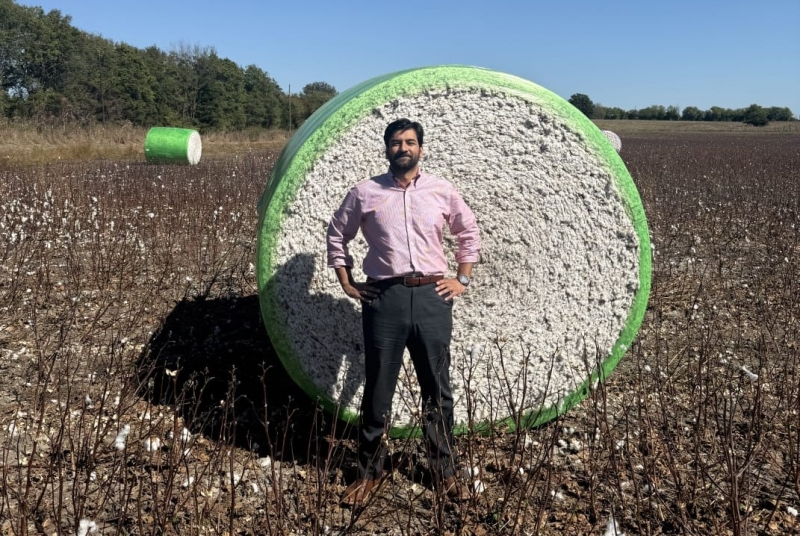
Aswar Rahman standing before a bale of cotton at a farm in USA.
GreenWatch Desk
A major private initiative is moving swiftly to make high-grade American cotton readily accessible to Bangladesh’s textile manufacturers and garment exporters.
AmeriBangla Corporation is setting up operations for what will be Bangladesh’s first privately operated warehouse for US cotton, situated in Anwara, Chattogram, near the government-designated Free Trade Zone. Operated jointly with a local Bangladeshi partner, the facility is scheduled for an official launch on November 18, 2026.
Aswar Rahman, 32-year-old Bangladeshi American entrepreneur, and CEO of the corporation explained his vision and activities started with the export of three shipments of cotton to Bangladesh textile and garment manufacturers to journalists at a posh hotel in Dhaka recently.
He unveiled an ambitious strategic roadmap aimed at drastically boosting trade between the United States and Bangladesh, projecting an increase from the current $10 billion to $100 billion by 2045.
Around 100 tonnes of cotton have already left a US port bound for Bangladesh to stock the facility initially. The local warehouse model is designed to solve one of the garment industry's most persistent bottlenecks: crippling supply-chain lead times.
Slashing Lead Times from Months to Days:
Spinning and textile mills rank among the largest consumers of raw cotton in Bangladesh. Sourcing raw cotton through standard overseas import channels currently requires nearly 90 days from order placement to port arrival. The local warehouse model compresses this waiting period significantly, providing instant access to stock and granting domestic spinners a crucial competitive advantage in lead times.
Showkat Aziz Russell, President of the Bangladesh Textile Mills Association (BTMA), welcomed the development as a positive turn for textile mill owners. “If there is a warehouse for US cotton in Bangladesh, everyone will buy from it because importing cotton after placing an order takes nearly 90 days,” Russell noted, adding that a physical stock facility in Bangladesh will also reduce price uncertainty.
Russell revealed that while the BTMA had written to the government regarding a stalled public-sector warehouse plan, the industry stands ready to support private ventures. “If someone now wants to establish such a warehouse under a private initiative, we will lobby the government on their behalf, if necessary,” he affirmed.
Mahmud Hasan Khan Babu, President of the Bangladesh Garment Manufacturers and Exporters Association (BGMEA), echoed this enthusiasm, stating that a privately operated cotton warehouse will deliver direct operational benefits to apparel manufacturers.
Bypassing Intermediaries: Lowering Procurement Costs:
Beyond logistics, the local warehouse promises tangible cost reductions for spinning mills and factories, particularly those operating with smaller capital capacities.
Because AmeriBangla purchases cotton directly from farmers and ginners in the United States, it eliminates multi-tiered intermediary markups. Under conventional import channels, US cotton costs approximately $0.85 per pound upon arrival at Chattogram Port. Through its direct-sourcing warehouse model, AmeriBangla expects to sell stock locally at around $0.10 less per pound than prevailing spot market rates.
Industry players have already taken notice. Ataur Rahman, a senior official at Envoy Textile—one of the country’s leading cotton importers—confirmed that his firm test-imported a small quantity of cotton from AmeriBangla. “Since AmeriBangla has the opportunity to source cotton directly from farmers and ginners, they may be able to supply it at prices lower than prevailing market rates,” he explained, noting that if the company can scale up volume while maintaining competitive pricing, it could become a major supplier.
Though US cotton carries a slight price premium compared to some alternative markets, textile leaders emphasize that its superior quality yields significantly lower wastage, reinforcing its long-term cost-effectiveness.
The Multi-Billion-Dollar Tariff Advantage
The operational rollout coincides with historic developments in US-Bangladesh trade relations. Under recent trade frameworks, apparel manufactured using certified American cotton is expected to receive tariff exemptions and duty benefits upon entering the US market.
In FY 2024–25, Bangladesh exported $8.69 billion worth of goods to the United States. During the same fiscal year, Bangladesh imported $346 million worth of US cotton—representing roughly 10 percent of its total cotton imports—up from $278 million in FY 2023–24.
With tariff-benefit mechanisms taking shape, apparel leaders project that Bangladeshi imports of US cotton could surge to $2 billion annually.
Aswar Rahman outlined the specific fiscal benefits awaiting end buyers: “The benefits to end buyers of cotton garments will be a 10–19% reduction in duties, and an 18% transferable tax credit on the value of all raw American cotton in their products.” Combined, US buyers could capture savings equivalent to at least 19% of total garment value, providing Bangladeshi exporters with a substantial indirect edge.
Aswar Rahman has navigated a career trajectory marked by creative ambition, political engagement, and multi-billion-dollar trade logistics. Today, as CEO of AmeriBangla Corporation, Rahman is driving a strategic vision to elevate US-Bangladesh trade to $100 billion by 2045.
Immigrating from Bangladesh to Minnesota with his family in 2001, Rahman grew up in South Minneapolis. Displaying early intellectual momentum, he entered college at age 16 and graduated with a bachelor’s degree from the University of Minnesota by 19.
Driven by a passion for visual storytelling, Rahman launched his career in filmmaking and media production. He founded Cineapolis—a Minnesota-based feature film collective—and Eloquent Design, a web development and user-experience firm. His work spanned award-winning short films, corporate campaigns for global brands, and appearances in American broadcast media.
Civic Leadership & Mayoral Campaign
Rahman’s commitment to community welfare led him into local governance and political activism. After working on youth policy under former Minneapolis Mayor R.T. Rybak, Rahman stepped into the national spotlight in 2017 when he launched a bid for Mayor of Minneapolis at age 23. Running on a platform focused on poverty alleviation, police reform, and fiscal responsibility, his campaign highlighted his commitment to civic progress.
Pivot to International Trade & Enterprise
Leveraging his background in strategy and digital media, Rahman shifted his focus to global trade infrastructure. Identifying strategic supply chain gaps between the US agricultural sector and Bangladesh’s textile industry, he spearheaded the establishment of AmeriBangla Corporation.
His present initiative represents a highly integrated push to bind US agricultural output directly with Bangladesh's robust garment manufacturing sector. By offering steep tax and tariff advantages alongside streamlined logistics, the framework seeks to create an aggressive growth corridor for bilateral trade over the next two decades, Aswar Rahman said.
AmeriBangla Corporation on Thursday August 27 officially launched "CottonPort," Bangladesh’s first digital raw cotton market, aimed at connecting local spinning mills directly with American farmers to ensure fair pricing, supply chain transparency, and stronger bilateral trade ties.
Operating with aligned promotional support from the American Embassy, the platform is designed to directly benefit US farmers. Following this, the company will debut the All-American Cotton™ Certification Program at an industry event in Manhattan on October 8. This program is positioned as the sole certification compliant with upcoming US Customs tariff exemptions and the pending Buy American Cotton Act.
Utilizing industrial reporting, third-party auditing, and state university isotropic testing, it offers end buyers of certified garments a 10-19% reduction in duties alongside an 18% transferable tax credit on raw US cotton content.
Further expanding its reach in October, the corporation will launch the AmeriBangla Cotton Lab in New York City. This incubator will select up to ten emerging New York fashion designers to manufacture their apparel lines in Bangladesh using certified US cotton, yarn, and fabric. To secure the logistics pipeline, the AmeriBangla US Cotton Warehouse will launch in Chittagong on November 18. Starting with an initial inventory of 80-100 metric tons (MT) at a leased location, the operation plans to transition into a permanent facility within the Anwara Free Trade Zone, targeting backing from multiple US federal entities including the USDA, US State Department, and the US EXIM Bank, he added.
(From the print edition GreenWatch. Please see greenwatchbd.com home page)