

- 'Lion fish' caught in fishing nets in Bay of Bengal |
- PM backs Army modernisation, expects higher global standing |
- Rare ‘Lynd Surgeonfish’ caught in fishing nets in Bay of Bengal |
- 51 dead in Flood, landslides; over 1,000 shelters open in 7 dists |
- JS recalls Jamiruddin Sircar's illustrious career, pays tribute |
Bangladesh Apparel Export Growth Slows to 0.89%
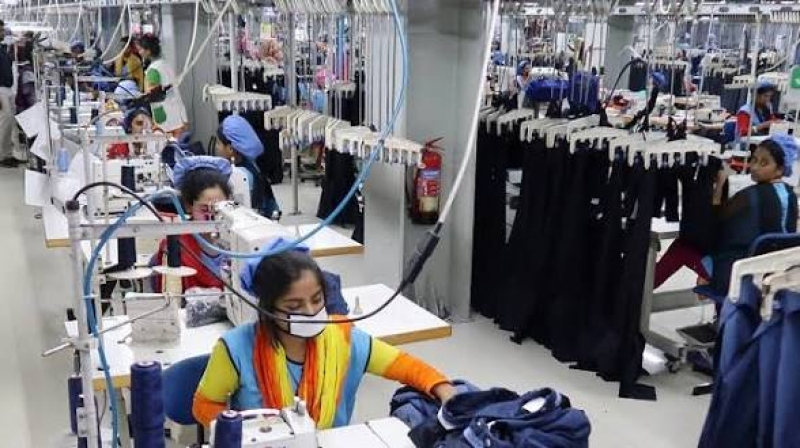
Bangladesh retained its position as the world's second-largest apparel exporter in 2025, but its export growth slowed sharply, lagging behind most of its major Asian competitors as rivals continued to gain ground in the global market.
According to recently released World Trade Organization (WTO) data, Bangladesh exported garments worth US$38.82 billion in 2025, a modest 0.89 percent increase from US$38.48 billion in 2024.
The growth was well below the global apparel market's expansion of 4.46 percent, indicating that Bangladesh's export momentum has weakened despite recovering international demand.
Among the world's leading apparel exporters, only China, Türkiye and the United States recorded declines in exports during the year.
Vietnam, Bangladesh's closest competitor, posted a strong 10.53 percent growth to US$37.51 billion, narrowing the gap with Bangladesh to just US$1.31 billion. Cambodia recorded the fastest growth at 16.88 percent, followed by Pakistan (6.83 percent), Indonesia (5.79 percent) and India (5.47 percent).
Despite the slowdown, Bangladesh accounted for 6.76 percent of global apparel exports, remaining second only to China, which held a 27.35 percent market share. However, Bangladesh's share fell from 7 percent in 2024, while Vietnam's increased from 6.17 percent to 6.53 percent, bringing it closer than ever to overtaking Bangladesh.
Industry leaders said Bangladesh is finding it increasingly difficult to attract new export orders as competing manufacturing hubs continue to expand capacity and improve competitiveness.
They cited persistent challenges, including energy shortages, gas supply constraints, high borrowing costs, political uncertainty, rising production costs and insufficient investment in manufacturing capacity, as key factors weakening the country's competitive position.
The WTO data also reflected a broader shift in global apparel sourcing. China's exports declined by 4.92 percent to US$157.11 billion, reducing its global market share from 31.71 percent in 2021 to 27.35 percent in 2025. Much of that market has shifted to other Asian producers, particularly Vietnam, Cambodia and Pakistan.
Bangladesh's export performance has also been volatile in recent years. After recording 27.64 percent growth in 2022, exports contracted by 21.49 percent in 2023 before rebounding by 7.23 percent in 2024. The slowdown to less than 1 percent growth in 2025 suggests that the recovery has lost momentum.
Exporters warned that maintaining Bangladesh's position as the world's second-largest apparel exporter will become increasingly difficult unless the country improves its competitiveness and regains stronger export growth, particularly as Vietnam continues to close the gap.