

- Once-in-a-generation solar eclipse dazzles UK and Europe |
- Govt Orders Shops, Markets to Close by 8pm |
- US Deal to Supply 117 LNG Cargoes Over 12 Years |
- Health impact of development plans should also be assessed: Shaikh Faridul |
- Dhaka Records ‘Moderate’ Air Quality Wednesday Morning |
Once-in-a-generation solar eclipse dazzles UK and Europe
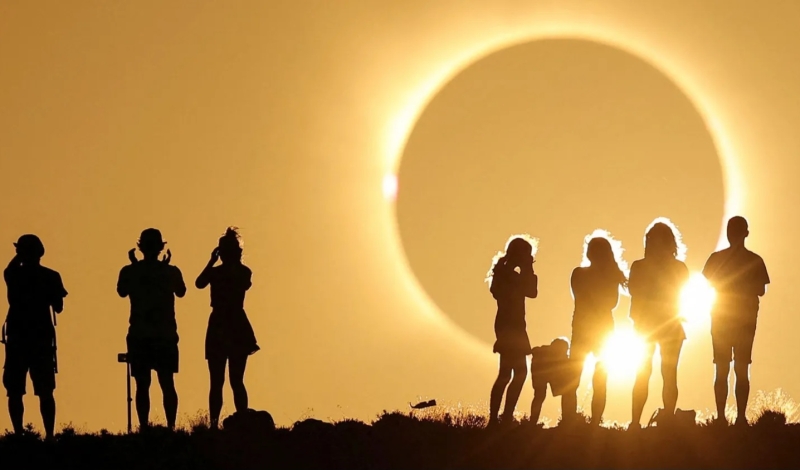
Millions of people across the UK and Europe have witnessed one of the most dramatic solar eclipses in decades, with parts of Spain, Iceland and Greenland experiencing total darkness.
The event was the most significant solar eclipse visible from the UK since 1999. Although the UK saw only a partial eclipse, the Moon covered more than 90% of the Sun across much of the country, creating an eerie twilight during the early evening.
The partial eclipse began at around 18:00 BST in northern Scotland and shortly before 18:20 on England’s south coast. It peaked shortly after 19:00, with coverage reaching about 95% in Cornwall.
Clear skies in much of central and southern England and Wales provided favourable viewing conditions, while cloudier conditions affected parts of northern England, Scotland and Northern Ireland. Large crowds gathered at landmarks and public viewing sites across the country.
Some enthusiasts struggled to obtain certified eclipse glasses, which were reportedly in short supply before the event. Others used safe projection methods involving household objects to observe the eclipse without looking directly at the Sun.
The path of totality began in the northern tip of Siberia before crossing the Arctic Ocean and reaching Iceland. It then moved towards Spain, where people were treated to the full spectacle.
At about 19:30 BST, the Sun, Moon and Earth aligned almost perfectly over parts of Spain, producing a total solar eclipse. The sky darkened dramatically as the Moon completely covered the Sun for less than two minutes.
In A Coruña, north-west Spain, Chilean scientist Yasmin Catricheo was among those who travelled thousands of miles to witness the event.
“At the totality, everyone was cheering and sharing the excitement of what we were seeing. No words could describe the feeling,” she said.
The total eclipse revealed the Sun’s corona, the outer atmosphere of superheated gas extending millions of kilometres into space. Some observers could also see prominences, loops of pinkish gas shaped by the Sun’s magnetic field.
A total solar eclipse occurs somewhere on Earth roughly every 18 months, but it is much rarer for any particular location, occurring on average only once every several hundred years.
The phenomenon is possible because the Sun is about 400 times farther from Earth than the Moon, while its diameter is also roughly 400 times greater. As a result, the two bodies appear almost exactly the same size in the sky.
The eclipse comes at the beginning of what astronomers describe as a particularly exciting period for eclipse enthusiasts, with three total solar eclipses occurring between 2026 and 2028.
However, none of those total eclipses will be visible from the UK. The country’s next notable partial eclipse will occur in 2027, when some areas could see about 45% of the Sun obscured.
A more dramatic eclipse is not expected in the UK until 2081, when up to 99% of the Sun could be covered. The next total solar eclipse visible from the UK is expected in 2090.
For millions who watched the Moon slowly consume the Sun before revealing it again, however, the brief spectacle offered a rare reminder of the scale and wonder of the universe.