

- Climate change cuts hilsa catch, raising long-term risks |
- Jamaat Ameer calls meeting with Tarique 'an important moment |
- BNP govt to take office with economy at a crossroads |
- Pahela Falgun brings colour, music as spring begins |
Inside-Out Planetary System Baffles Astronomers
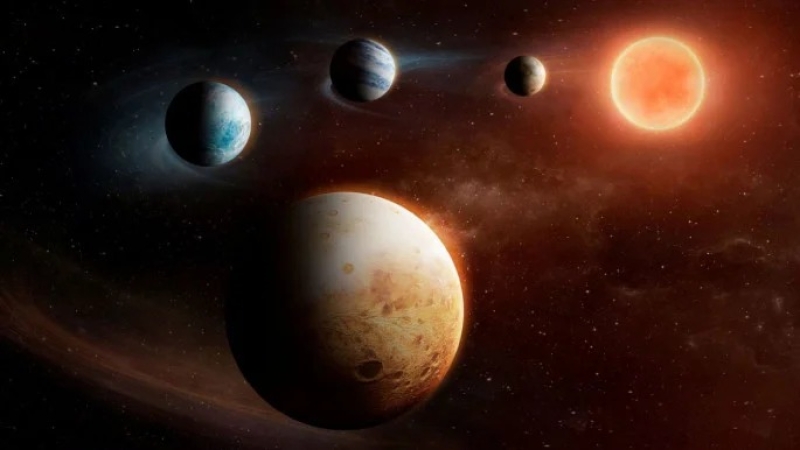
Astronomers have identified a strange planetary system that appears to have formed in reverse order, challenging long-standing ideas about how planets are born.
Using the European Space Agency’s Cheops space telescope, scientists observed four planets orbiting a faint red dwarf star about 117 light-years from Earth. The system includes two rocky worlds and two gas-rich planets, but their arrangement defies expectations.
Normally, planets closest to a star are small and rocky, while those farther away are gas-rich because cooler outer regions allow gas and ice to accumulate. In this system, however, a rocky planet sits beyond two gaseous neighbours, suggesting an unusual formation history.
“The standard model predicts rocky planets inside and gas giants outside,” said lead author Thomas Wilson of the University of Warwick. “Here we see a rocky world where a gas planet should be. It looks like the system was built from the inside out.”
The findings, published in the journal Science, describe a compact system where all four planets orbit much closer to their star than Mercury does to the Sun.
The two inner rocky planets are classified as super-Earths, meaning they are several times more massive than Earth. The two gaseous worlds are mini-Neptunes, smaller than Neptune but still dominated by thick atmospheres.
Researchers suspect the planets may have formed one after another rather than simultaneously. By the time the outer rocky planet began forming, much of the available gas had already been consumed by its siblings, leaving it with little material to build a thick atmosphere.
Wilson described this world as a “late bloomer,” likely forming in a gas-poor environment.
Another theory suggests the planet once had a substantial atmosphere that was later stripped away by a massive collision. Co-author Andrew Cameron of the University of St Andrews noted that Earth’s own Moon is thought to have formed after such a catastrophic impact.
The outer rocky planet is particularly intriguing because it may be capable of supporting life. With a mass nearly six times that of Earth and an estimated surface temperature of about 60°C, conditions could fall within the range where liquid water might exist under the right circumstances.
Future observations, including those by NASA’s powerful space telescopes, are expected to examine the planet’s atmosphere and surface conditions more closely, potentially revealing whether this unusual world could indeed be habitable.