

- Fuel Queues Ease As Supply Rises, Demand Falls |
- PM says govt working to reopen closed factories |
- 7-year Sukuk worth Tk 5,900cr planned for rural bridge project |
- Unplanned bundhs worsen flooding, crop losses in Sunamganj haors |
- Trump admin says its war in Iran ‘terminated’ before 60-day deadline |
Artemis II Astronauts Highlight Unity at UN Visit
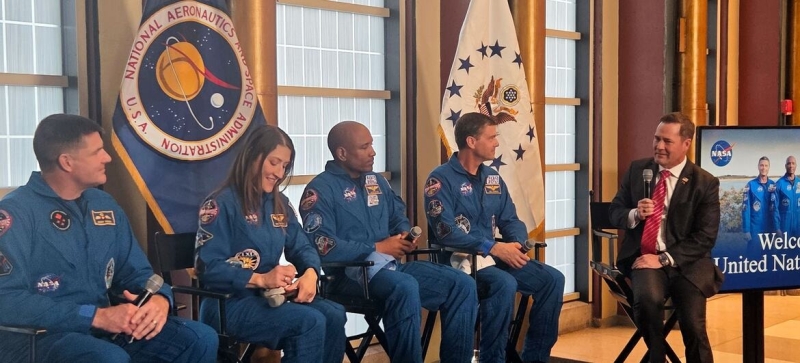
US Ambassador to the United Nations, Mike Waltz, talks to the Artemis II mission astronauts at UN headquarters in New York.
A month after completing their historic flyby of the Moon, astronauts from NASA’s Artemis II mission visited UN Headquarters in New York this week with a clear message: humanity can achieve extraordinary things when it works together.
Their visit on Thursday followed a long-standing tradition. Cosmonauts and astronauts have been coming to the United Nations for decades to speak about peace, international cooperation, and a shared global future.
The four-member crew carried out the farthest human spaceflight in history, travelling beyond the far side of the Moon and safely returning to Earth after 10 intense and demanding days. During that time, they “captured the imagination of billions” and renewed a sense of global participation in space exploration.
Tradition and continuity
The UN General Assembly building has long welcomed pioneers of the space age, beginning with Yuri Gagarin and Valentina Tereshkova. Their visit in October 1963 symbolised not only technological progress but also the idea that space can unite humanity.
Since then, representatives from many nations have addressed the international community, highlighting that space exploration depends on cooperation and shared responsibility.
Artemis II continues that legacy. The mission represents not just a technological milestone but also international collaboration, involving multiple countries and institutions, including the European Space Agency.
Earth from deep space
For the astronauts, the most powerful experience was seeing Earth from deep space. From hundreds of thousands of miles away, the planet appeared small and fragile against the vast darkness, underscoring its uniqueness and the rarity of life.
“I always felt urged to be grateful for what we were seeing and for what we were going back to,” said pilot Victor Glover.
Astronaut Christina Koch described a new awareness of humanity’s place in the universe, noting that Earth is both shared and shaped by human choices.
Life on board
Life inside the spacecraft was demanding. The crew balanced experiments, navigation, system monitoring, and constant adaptation to microgravity.
Canadian astronaut Jeremy Hansen recalled a lighter moment when floating food drifted across the cabin, highlighting both the challenges and the human side of space travel.
A return to the Moon
Artemis II is part of a broader effort to return humans to the Moon and establish a sustained presence there, including plans for future lunar infrastructure. These efforts are guided by international agreements such as the Artemis Accords.
Speaking at the UN, the astronauts encouraged young people to stay curious, ask questions, and seek answers.
They stressed that the mission’s importance goes beyond distance or technology. Space offers a perspective that shows Earth as unique, shared, and in need of care.
Commander Reid Wiseman said that while many ask what Earth looks like from space, the answer remains simple: it is a small but extraordinary place.
Reaching for the stars
The event also highlighted inspiring journeys on Earth. Alinda Mashiku, a NASA aerospace engineer who grew up in Tanzania dreaming of space, now helps manage satellite safety and supports missions like Artemis II.
Her story reflects the broader message of the visit: that ambition, cooperation, and persistence can turn even distant dreams into reality.