

- Support to coastal security, early completion of MRT lines, Airport Terminal III, business promotion assured |
- Tarique Seeks Japanese Support for Energy, Tech and Infrastructure |
- Japan eyes 1 trillion yen investment in Bangladesh over 5 years |
- Dhaka Among World’s 11 Most Polluted Cities on Tuesday |
- Tide Rising, Time Running Out For Coastal People, Wildlife |
Dhaka Turns To Solar As Fuel Crisis Turns Power Plants Idle
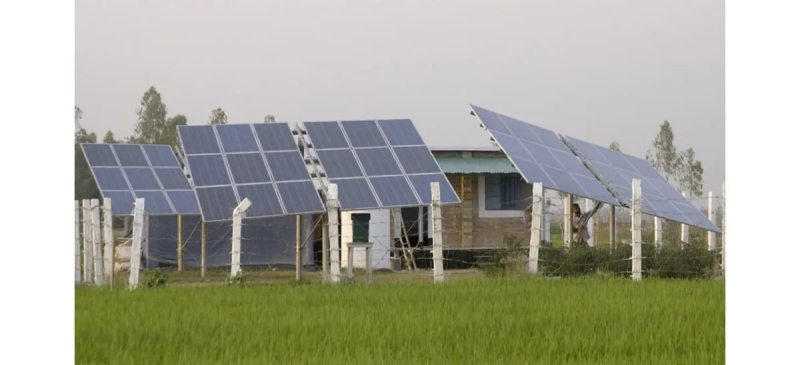
A solar energy system in Bangladesh.
Asif Showkat Kallol
Bangladesh has accelerated its push for renewable energy. However, despite policy support for solar power, businesses want more supportive measures.
Bangladesh has enough installed power-generation capacity to meet much of its electricity demand, but fuel shortages leave thousands of megawatts idle, while costly LNG imports amid the Middle East crisis further strain the power sector.
The country has nearly 29,600MW of installed generation capacity, yet peak output has remained at just over 17,000MW, or about 59% of total capacity. Load-shedding reached a record 3,757MW at one point this year, highlighting the widening gap between capacity on paper and electricity actually reaching consumers. In this circumstance, the government has tried to pursue the Pakistani model to solar power. Pakistan’s massive surge to 10,000MW of solar power has been primarily driven by consumer and market-led adoption, supported by government tax exemptions and high grid tariffs. The solar boom helped Pakistan to avoid over USD 12 billion in fossil fuel and LNG imports over two years.
For Bangladesh the main constraint is fuel. About 41% of Bangladesh’s 137 power plants rely on gas. Fifty gas-fired plants have a combined capacity of 12,154MW, but inadequate gas supplies prevent many from operating at full capacity, raising generation costs and increasing the risk of further power cuts.
Furnace-oil plants account for another 5,641MW of capacity across 54 plants, representing about 19% of the national total. Coal-fired plants contribute roughly a quarter of installed capacity, while diesel and solar plants each account for about 3%. The government targets 20% solar power by 2030 and 30% by 2040..
As part of the initiative to increase of power -generation, State Minister Anindya Islam Amit recently announced that Titas Well No. 28 was adding 12.5 million cubic feet of gas daily to the national grid, easing energy crisis. He noted that 27 of 30 ongoing wells have been drilled, part of a plan to drill 150 wells by 2030.
Prime Minister Tarique Rahman on 3 August in parliament ordered the phased installation of solar panels on major government buildings, support for local solar inverter manufacturing and the development of a financial model to make solar power more affordable. Under Prime Minister Tarique Rahman’s leadership, the government has taken several groundbreaking and practical steps to expand solar and renewable energy and tackle the country’s energy crisis.
On October 3, State Minister for Local Government, Rural Development and Cooperatives Mir Shahe Alam said Prime Minister Tarique Rahman had installed solar panels on the rooftop of his Gulshan residence. Rahman uses 1,000 units of solar power from the rooftop system and sends 1,200 units to the national grid a day, Shahe Alam added.
He said the prime minister had set an example by generating and using solar power. Shahe Alam also urged people to view electricity generation as a business opportunity.
Key Initiatives and Targets
Work has begun to install solar panels at Banga Bhaban, the National Parliament building, the Prime Minister’s Office, and the offices of all Deputy Commissioners (DCs) and divisional commissioners across the country.
The government has launched an initiative to install solar power systems at around 46,000 schools and hospitals, potentially adding about 1,454MW of electricity to the national grid. It also plans to generate 5,500MW from ground-mounted solar projects by 2030.
Financial Incentives and Support
Consumers can feed surplus electricity generated by rooftop solar systems into the national grid. The government has set the purchase price at Tk10.50 per unit, with the rate applicable for three years and potentially offering entrepreneurs returns of up to 45%.
Tax Exemptions and Financial Support
The government has directed authorities to support the import of raw materials required for domestic solar-inverter manufacturing and encourage local industry.
Experts have urged the government to focus on payment guarantees, attracting foreign investment and developing skilled manpower to meet the sector’s targets.
Net Metering and Tariff Reduction
On 15 September, the Finance Ministry decided to cut import duties and taxes on solar-sector equipment. The decision reduced the overall duty and tax burden from 17% to 1% for the next six months. Businesses welcomed the decision but called for a longer extension.
Mustafa Al Mahmud President, Sustainable and Renewable Energy Association said, “The measure will provide a boost, but some loopholes still remain. The question is whether people will enter this business when the 1% tariff facility lasts only six months.
“The government has set a target of 10,000MW over the next four to four-and-a-half years. That would require an investment of almost $6–7 billion. The key question concerns the duration of the 1% tariff facility.
“The scheme allowing solar systems to enter under a 1% tariff needs a much longer timeframe. At least initially, we proposed extending the facility until December 2027.”
Shahriar Ahmed Chowdhury, a renewable energy specialist said, “The policies provide support, and the fiscal incentives also help. But the government must pay close attention to where the investment will come from.
The required investment could reach Tk60,000 crore, which represents a huge amount of money. The government must ensure that financing reaches the sector. Otherwise, achieving these targets will prove very difficult.”
Energy specialist Professor Dr Ejaz Hossain told GreenWatch the Bangladesh had spent years discussing the removal of oil-fired plants but now had little choice but to rely on them because of the wider fuel crisis. He urged the authorities to ensure uninterrupted coal supplies so coal-fired plants could operate at full capacity while keeping necessary oil-based generation available.
Mazedul Haque, chairman of the Power and Energy Research Centre, told GreenWatch Bangladesh could also explore faster gas imports from Myanmar and increase electricity imports from Nepal and Bhutan to ease immediate shortages. But experts argue that the longer-term solution lies in reducing dependence on imported fossil fuels and expanding solar power.
Of 30 power projects currently under construction as per government plans, 19 involve renewable sources, mainly solar and wind, with a combined capacity of 1,042MW. Haque said solar could also help farmers struggling to run irrigation systems where grid electricity remains unreliable. He called for faster imports of solar equipment and raw materials, including through government-to-government arrangements.
The private sector is responding. Walton and PRAN-RFL, two major Bangladeshi industrial groups, are expanding their involvement in solar power and related technologies. Walton already produces about 25MW of solar electricity for its own operations. It has completed a lithium-ion battery manufacturing plant that it expects to bring into operation soon. The company has also begun establishing a solar-inverter plant at Chandra in Gazipur. Solar inverters convert the direct current generated by solar panels into alternating current that can power conventional electrical appliances and industrial equipment.
Battery storage can then allow electricity generated during daylight hours to be used after sunset. Walton currently imports some inverters from China under an original equipment manufacturing arrangement but plans to manufacture them locally. The company also intends to support private-sector investment in solar plants. PRAN-RFL is pursuing a similar strategy. It already generates solar power for its own facilities and is investing $1m in a solar-inverter manufacturing plant at Palash in Narsingdi. It plans to invest a further $4m in inverter production in Habiganj.
Both companies are also considering a capital-expenditure, or CAPEX, model for solar projects. Under the arrangement, customers would pay for equipment and installation while the companies install, operate and maintain the systems under contract.
For Bangladesh, the challenge is increasingly clear: making existing power plants run when fuel is available while rapidly building a renewable system that can reduce the country's exposure to costly and unreliable imported energy.