

- Dhaka records moderate air quality Wednesday morning |
- Bidisha Siddique Arrested in Fraud Case |
- As wars spread, the global food system unravels |
- Holy Eid-e-Miladunnabi Wednesday |
- EU sees Bangladesh as partner of growing strategic importance: Miller |
Rohingyas face atrocity crimes, displacement and humanitarian crisis: UN
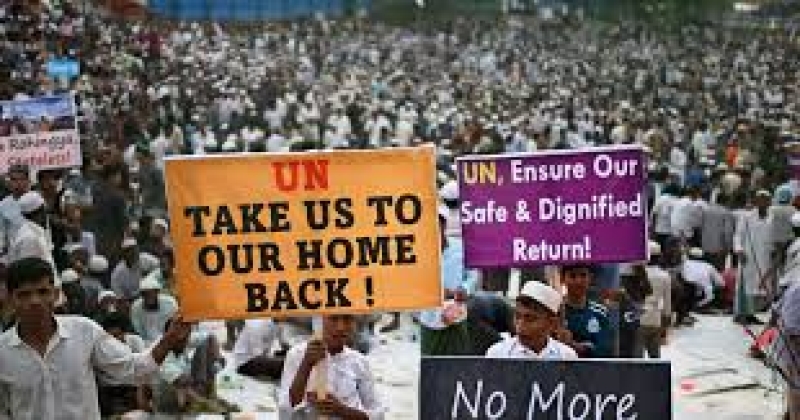
Nine years after brutal military attacks in Myanmar that triggered the mass displacement of the Rohingya, they continue to face grave human rights violations and a dire humanitarian situation in Myanmar and across the region, UN experts warned on Tuesday.
For Rohingya refugees, the ongoing conflict, persecution and denial of citizenship undermine any prospects for safe, voluntary and sustainable return, while driving further refugee movements across the region, they said.
“We are alarmed that Rohingya continue to live under constant threat of violence and persecution in Myanmar, where ongoing conflict and entrenched discrimination have exposed them to mass displacement and atrocity crimes committed by both the military and the Arakan Army, in flagrant violation of international law,” the experts said in a statement.
They warned that the humanitarian situation is worsening amid funding cuts, with the Rohingya population suffering from poverty, acute food insecurity, preventable diseases and inadequate living conditions.
Reports indicate that more than 1.6 million Rohingya refugees remained outside Myanmar at the end of 2025, with the vast majority living in Bangladesh and others in India, Thailand, Malaysia and Indonesia.
“While conditions vary across host countries, the Rohingya continue to face the risk of forced return, prolonged arbitrary detention, racist hate speech, and severe barriers to education, healthcare and livelihoods,” the experts said. “The situation is especially alarming in Bangladesh, where critical funding shortfalls have resulted in major reductions in humanitarian assistance, including health care in the last years, deepening vulnerability and hardship.”
They were concerned that deteriorating conditions are leaving Rohingya refugees, particularly women and girls, increasingly vulnerable to trafficking, exploitation and gender-based violence, and forcing many to undertake perilous journeys across the Andaman Sea and the Bay of Bengal, which put their lives at grave risk.
“The international community cannot allow the Rohingya to become a forgotten people. Nine years after these atrocities, many remain without citizenship, protection or meaningful prospects for a dignified future,” the experts said. “The international community must step up support for humanitarian assistance, protection measures, and international accountability processes.”
The experts called for urgent action by all parties to the conflict in Myanmar to protect the Rohingya from ongoing violence, forced recruitment, displacement and other serious human rights violations, in accordance with international humanitarian and human rights law; and to facilitate unhindered humanitarian access, and create conditions conducive to the safe and voluntary return of displaced Rohingya to their places of origin.
They urged host countries to refrain from forcibly deporting and returning Rohingya refugees to Myanmar, where they would risk being subjected to serious human rights violations and abuses.
“States must ensure that all Rohingya are treated in accordance with international human rights standards and granted access to essential services without discrimination,” the experts said.
The experts include Nicolas Levrat, Special Rapporteur on minority issues;
George Katrougalos, independent expert on the promotion of a democratic and equitable international order; Ashwini KP, Special Rapporteur on contemporary forms of racism, racial discrimination, xenophobia and related intolerance; Elena Carolina Díaz Galán, Special Rapporteur on extreme poverty and human rights;
Nazila Ghanea, Special Rapporteur on freedom of religion or belief, Gehad Madi, Special Rapporteur on the human rights of migrants; Mariângela Batista Galvão Simão, Special Rapporteur on the right of everyone to the enjoyment of the highest attainable standard of physical and mental health; Reem Alsalem, Special Rapporteur on violence against women and girls, its causes and consequences; Matthew Gillett (Chair-Rapporteur); Ganna Yudkivska (Vice-Chair on Communications); Ethan Hee-Seok Shin (Vice-Chair on Follow-Up), Miriam Estrada-Castillo and Mumba Malila, Working Group on Arbitrary Detention;
Claudia Flores (Chair); Ivana Krstić (Vice-Chair); Dorothy Estrada-Tanck, Haina Lu, and Laura Nyirinkindi, Working Group on discrimination against women and girls; and Paula Gaviria, Special Rapporteur on the human rights of internally displaced persons, reports UNB.