

- President undergoes stent implantation for heart block in UK |
- Delhi says closely follows all devs around world, on FM’s China trip |
- 3 to die, 6 on life in prison for Rajbari village doctor murder |
- July Museum to Inspire Fight for Democracy: Speaker |
- Trump Says Mideast Ceasefire Near Collapse |
Call for ensuring financial inclusion for Rohingyas
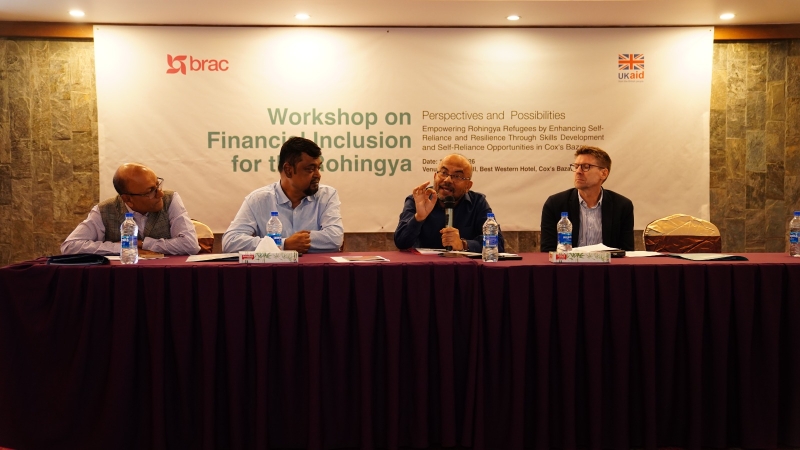
Workshop titled Financial Inclusion for the Rohingya - Perspectives and Possibilities organised by the humanitarian and crisis management programme of BRAC on Tuesday.
Dhaka, May 12 - Practitioners and humanitarian leaders at a workshop in Cox’s Bazar have stressed the importance of financial inclusion for the Rohingya community alongside skills development initiatives to improve livelihoods and strengthen resilience.
The workshop titled “Financial Inclusion for the Rohingya: Perspectives and Possibilities,” was organised by BRAC’s Humanitarian Crisis Management Programme (HCMP) with support from UK Aid on Tuesday at a local hotel.
Speakers highlighted several potential initiatives to enhance financial inclusion among Forcibly Displaced Myanmar Nationals (FDMNs), including pilot programmes on digital cash and Mobile Financial Services (MFS), partnerships with banks and MFS providers, literacy and women-focused inclusion programmes, youth engagement in digital income-generation activities, and integrating financial services with livelihoods and skills development interventions.
Refugee Relief and Repatriation Commissioner (RRRC) Mohammed Mizanur Rahman, who attended the event as the chief guest, said BRAC’s initiative reflects the practical realities on the ground and deserves appreciation.
He noted that nearly 52 percent of the Rohingya population are under 18 years of age. “Without productive engagement, many young people may become vulnerable to human trafficking and other criminal activities. The priority now is to involve them in constructive and meaningful work,” he said.
The event began with the welcome address by Rezaul Karim, Associate Director and Office-in-Charge (OIC) of BRAC HCMP. Ashik Kabir, Sector Coordinator of the Livelihoods and Skills and Development Sector (LSDS), delivered a presentation on the “Resilience and Adaptation Fund.”
Subrata Kumar Chakrabarty, Adviser to BRAC HCMP, presented on Financial Inclusion: BRAC’s Learning from the pilot project. The session was moderated by Kaniz Zinath, Programme Manager of the BRAC HCMP’s Food Security, Skills and Livelihoods (FSSL) Sector.
KAM Morshed, Senior Director (Advocacy, Communications and Engagement) at BRAC, said the organisation continues to prioritise innovative pilots. Successful implementation and scaling will require collaboration and commitment.
Other speakers included David Budgen, Head of the Refugee Coordination Platform (RCP); Camp-in-Charge Md Shariful Islam (Camp 1 East and 1 West); Suraya Akter Swety (Camp 4 and 4 Extension); and Md Arafatul Alam (Camp 9 and Camp 10). Mohammad Abdur Rouf. (Camp 3 & 5).
According to information shared at the workshop, the FCDO-funded pilot project was launched in October 2025 and will continue through May 2026. The programme is currently being implemented across Camps 2 West, 3, 4 Extension, 9, 14, 15 and 16 in Cox’s Bazar.
Since the pilot project began, 160 Rohingya refugees have received formal skills development training, while 400 individuals have been trained for informal-sector employment opportunities.
In addition, 398 women have received cash assistance and 123 participants have been supported through entrepreneurship development initiatives. With support from the RRRC, mobile SIM cards have also been distributed to 297 participants.
More than 80 representatives from international development agencies, humanitarian organisations and NGOs attended the workshop, according to a press release. -UNB