

- Stocks end week sharply lower as DSE, CSE indices tumble |
- 'Not all collections in the road transport sector is extortion': Sk Rabiul |
- Zubaida, Zaima take iftar with orphan students |
- Dhaka ranks second among world’s most polluted cities Friday |
- Dhaka to maintain ties with all countries with dignity |
BNP Forms 50-Member Cabinet Mixing Veterans, New Faces
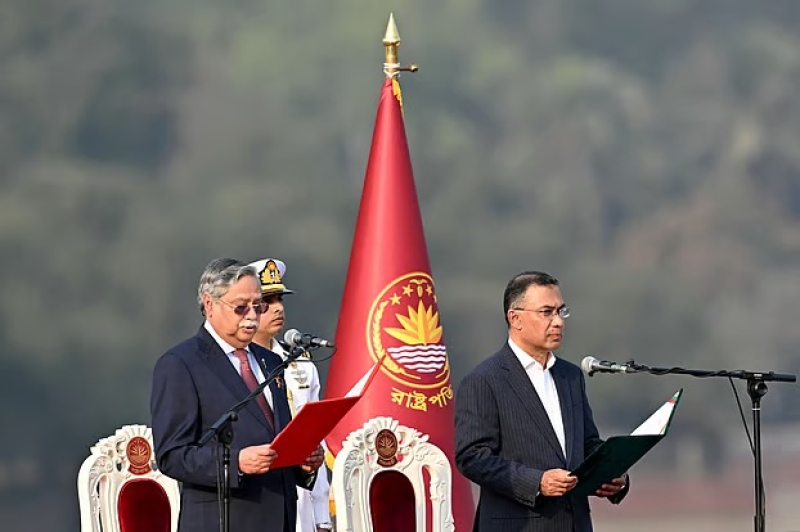
Bangladesh Nationalist Party (BNP) chairman Tarique Rahman (R) takes oath as prime minister during a swearing-in ceremony at the National Parliament building in Dhaka on 17 February 2026.
After two decades out of power, the Bangladesh Nationalist Party (BNP) has returned to government, marking a major shift in the country’s political landscape.
Party chairman Tarique Rahman was sworn in as prime minister and unveiled a 50-member cabinet that blends senior leaders with a large number of younger and mid-level figures.
The oath-taking ceremony was held at the South Plaza of the Jatiya Sangsad Bhaban, where President Mohammed Shahabuddin administered the oath of office and secrecy, formally launching the new administration.
Blend of experience and newcomers
The cabinet reflects a deliberate mix of three generations of leadership. Many ministers and state ministers assumed executive office immediately after being elected to parliament for the first time, with newcomers outnumbering experienced figures.
Several younger leaders have been assigned major portfolios despite limited administrative experience, while some selections have drawn mixed reactions within political circles.
Senior BNP figures sworn in include Secretary General Mirza Fakhrul Islam Alamgir and Standing Committee members Amir Khasru Mahmud Chowdhury, Salahuddin Ahmed, Iqbal Hasan Mahmud (Tuku) and Major (retd.) Hafiz Uddin Ahmed.
Notably absent from the cabinet are senior leaders Khandaker Mosharraf Hossain and Abdul Moyeen Khan. Political observers suggest they may be considered for other constitutional posts, including the presidency and the speakership of parliament.
Advisers with ministerial rank
Ten individuals have been appointed as advisers with the rank of minister or state minister. Among those granted ministerial status are senior joint secretary general Ruhul Kabir Rizvi, former bureaucrat Md Ismail Zabihullah, economist Rashed Al Mahmud Titumir, Mirza Abbas and Nazrul Islam Khan.
Advisers with state minister rank include Humayun Kabir, Brigadier General (retd.) Shamsul Islam, Zahed ur Rahman, Mahdi Amin and Rehan Asif Asad.
High-profile technocrat appointment
One of the most discussed appointments is Khalilur Rahman, who previously served as national security adviser in the interim administration led by Muhammad Yunus. He has been inducted as a technocrat minister and assigned the foreign affairs portfolio — a notable development given earlier opposition to his role.
Composition of the cabinet
The cabinet includes 25 full ministers and 24 state ministers. Nine of the full ministers previously held ministerial posts, while nine others became ministers immediately after their first election to parliament. The remaining seven had parliamentary experience but no prior cabinet role.
All state ministers are first-time office holders, most of whom entered government directly after their initial electoral victory.
Influx of new faces
Tarique Rahman himself has become prime minister after contesting a national election for the first time.
Several newly appointed ministers come from diverse political backgrounds, including former party reformists and technocrats. Some appointments are seen as recognition of organisational contributions or efforts during the opposition years.
Sheikh Rabiul Alam, elected from Dhaka-10, has been entrusted with multiple key infrastructure ministries — road transport and bridges, railways and shipping — drawing particular attention due to the concentration of responsibilities.
Political families and allies represented
Among the state ministers are figures from established political families as well as leaders from allied parties involved in the broader opposition movement, including representatives of Ganosamhati Andolon, Gono Odhikar Parishad and National Democratic Movement.
Former national football team captain Aminul Haque has also been appointed as a technocrat state minister despite not winning his parliamentary race.
Public expectations
The BNP last governed from 2001 to 2006. Following its victory in the 13th parliamentary election, the party has returned to power with a cabinet notable for the large number of first-time lawmakers elevated directly to executive roles.
The open-air swearing-in ceremony drew large crowds, reflecting strong public interest in the political transition.
Analysts say the success of the new government will depend less on symbolism and more on effective governance, policy direction and implementation. Whether the combination of seasoned leaders and newcomers can deliver on expectations remains an open question.