

- Relatives hold cremations without bodies for Nepal’s missing flood victims |
- Dhaka ranks 13th among cities with worst air quality on Sunday |
- Dhaka South now worst dengue-hit municipality with 39 deaths |
- Putin renew talks with US envoys at the Kremlin to end Ukraine war |
- US strikes 3 Iranian oil tankers saying warships were targeted |
Govt's 180 days good start; Oppositoon Road March unhelpful
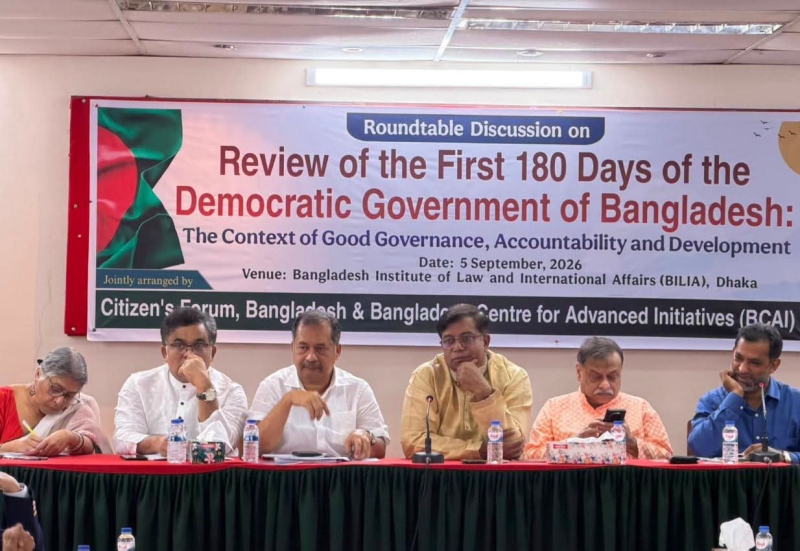
The roundtable on 180 days of the government was held at the BILIA auditorium in Dhanmondi on Saturday.
The first 180 days of the government has been termed as a good beginning in the backdrop of a devastated economy and stolen banks, but the opposition long march viewed as counterproductive as vested quarters might use it against the interests of Bangladesh.
This view was reflected at a roundtable organised by the Citizen's Forum Bangladesh and the Bangladesh Centre for Advanced Initiatives at the BILIA auditorium on Saturday.
Speakers, mostly University teachers, retired or serving bureaucrats, noted the initiatives of Prime Minister Tarique Rahman as good and the relationship between the government and the opposition in Parliament cordial but corruption, toll collection, bureaucracy and government's detachment from the party as hurdles.
The event was presided over by University Grants Commission (UGC) Chairman Prof. Mamun Ahmed, with the Prime Minister's Political Adviser Zahiruddin Swapan in attendance.
The participants—comprising university teachers, retired and serving bureaucrats, and civil society leaders—lauded the initiatives of Prime Minister Tarique Rahman. They highlighted a remarkably cordial relationship between the treasury and opposition benches in Parliament, with former State Minister Abul Hasan Chowdhury describing the mutual understanding in the house as a "quantum leap" for the country's democratic culture.
However, the speakers pointed out significant hurdles still blocking the government's path, including systemic corruption, grassroots extortion, a sluggish bureaucracy, high fuel prices driven by Middle East conflicts, and the government's growing detachment from its own party grassroots.
Several experts focussed heavily on the economic crisis left behind by the previous Awami League regime. Prof. Dr. Abdul Hannan Chowdhury (North South University) and Prof. Abu Ahmed noted that the government inherited a plundered banking sector and an economy in deep decline. Prof. Ahmed warned of the dangers of a high money supply paired with stagnant domestic production.
Zahiruddin Swapan, Political Adviser to the PM, stated that the previous government intentionally left behind an import-dependent economy and a devastated energy sector due to a "long-term conspiracy". He emphasized that the current administration is pushing policies to revive production, explore maritime gas, and reduce imports.
Md Mazharul Huq (former NSI CEO) suggested that the government could drastically reduce fiscal pressure by expediting court cases to recover Tk 200,000 crore currently stuck in legal disputes, and urged using reserve dollars as an Export Development Fund (EDF) loan.
Civil society members and academics expressed concern over the slow pace of state and administrative reforms.
Shirin Huq, Trustee of Gonoshasthya, called for patience but stressed that grassroots extortion, price hikes, and child theft must be tackled urgently. She demanded the removal of police officers involved in past killings and disappearances, a new recruitment drive, and an anti-discrimination law.
Retired Secretary Abdur Rashid noted that parts of the police force remain unsupportive of the current administration. He also recommended promoting solar energy on a rebate basis to counter high fuel costs.
Abul Kashem Haider (former Director, FBCCI) urged the government to remove Awami League cadres from the administration, establish a permanent education commission, and enforce zero tolerance against toll collection.
Dr. Md Ziaur Rahman Munna warned that past leaderships became autocratic by relying too heavily on bureaucrats and the military, urging the PM not to lose touch with the political party that brought him to power.
The roundtable highlighted the government's foreign policy maneuvers as a major success. National University's Prof. Amanullah stated that the restoration of national sovereignty remains the government's primary achievement.
Former State Minister Abul Hasan Chowdhury advised the government to seriously consider China’s corridor proposal through Myanmar and swiftly implement the Teesta Masterplan, provided national sovereignty is not compromised.
John Hardy of the International Republican Institute (IRI) shared research indicating that Bangladeshi citizens highly desire to cooperate with the government as it navigates global challenges and job creation.
Concluding the session, UGC Chairman Prof. Mamun Ahmed observed that because the government is democratic, public expectations are exceptionally high. He advised the administration to be highly responsive to public grievances to maintain stability and transition the country smoothly towards a stable welfare economy. - GreenWatch Desk