

- Govt Earns Public Trust in First Six Months: Mahdi Amin |
- Myanmar Recognises 309,000 Rohingyas as Former Rakhine Residents |
- Bangladesh Unaware of Hasina’s Status in India: Chief Prosecutor |
- Rooppur to Supply 300MW to National Grid in September |
- Iran Announces $30,000 Reward for Capturing US Troops |
Govt Earns Public Trust in First Six Months: Mahdi Amin
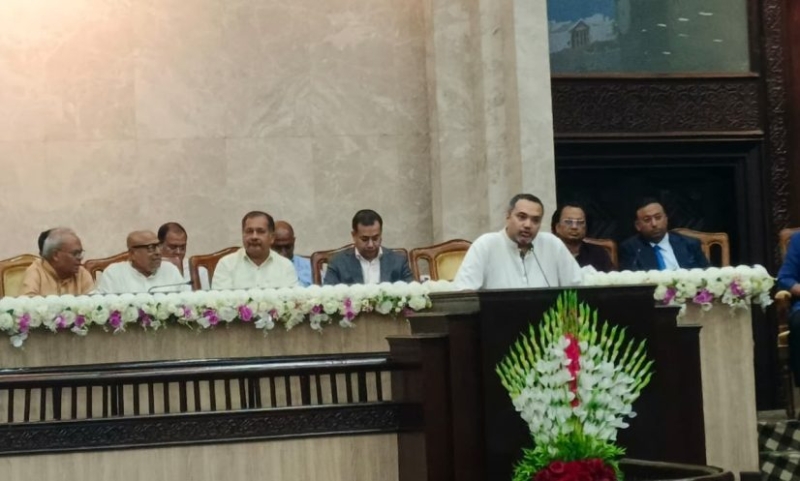
Prime Minister’s Office spokesperson and adviser Mahdi Amin speaks at a press conference marking 180 days of the Tarique Rahman-led government at the PMO in Tejgaon, Dhaka.
The current elected government has become a symbol of public trust
within its first six months in office, Prime Minister’s Office
spokesperson and adviser Mahdi Amin said on Monday.
Speaking at a
press conference at the Prime Minister’s Office in Tejgaon, Dhaka, he
said the government had inherited what he described as the consequences
of 16 years of “fascist rule” and had taken steps to address the
country’s political, economic and institutional challenges.
The
press conference was held to mark 180 days of the government led by
Prime Minister Tarique Rahman. Mahdi Amin outlined the government’s
achievements, reform initiatives and future plans during its first six
months.
He claimed that there had been no political harassment
during the period and that the government had ensured a high level of
freedom of expression.
On democracy and political reforms, Mahdi
Amin said people had been able to exercise their voting rights in the
recently held 13th parliamentary election after what he described as
disputed elections in 2014, 2018 and 2024.
He said more than 100
ordinances were converted into laws during the first session of
parliament. An amended Anti-Terrorism Ordinance had also been used to
legally ban what he described as a “terrorist political organisation”
that had established fascist rule.
Economy and energy
On
the economy, Mahdi Amin said the cabinet waived farmers’ loans of up to
Tk 10,000, including interest, at its first meeting after taking office,
benefiting about 1.3 million farming families.
The government has also introduced Farmer Cards, Family Cards for women and Expatriate Cards for migrant workers, he said.
He said VAT and taxes had been reduced on more than 60 products to help control commodity prices during Ramadan.
Regarding
the energy crisis, Mahdi Amin said the government had taken several
initiatives to address gas and electricity shortages inherited from the
previous government.
He said the government had held discussions
with major companies from the United States, China and Malaysia and
claimed that significant progress had been made in addressing the gas
shortage through Petronas following talks between Tarique Rahman and
Malaysian Prime Minister Anwar Ibrahim.
Health and education
On healthcare, Mahdi Amin said work had begun to upgrade every upazila health complex to 151 beds.
The
government also plans to recruit 100,000 health workers and provide Tk
100,000 in assistance to people suffering from serious diseases, he
said.
He said major reforms were planned in education, including
the introduction of new subjects in Classes Four and Six from next year.
Free
Wi-Fi, school uniforms and bags have also begun to be provided at
educational institutions, while tuition-free education for girls up to
the undergraduate level has been ensured under the prime minister’s
direction, he said.
Law and foreign policy
Mahdi Amin
claimed that law and order had improved, with steps taken to establish a
service-oriented police force and administration free from political
influence.
He also cited progress in investigations and trials into the murders of Sohagi Jahan Tonu and Shaheed Osman Hadi.
He said an accused in the murder of Shaheed President Ziaur Rahman had also been arrested after many years.
Regarding
former prime minister Sheikh Hasina, Mahdi Amin said Bangladesh had
formally requested her extradition from the neighbouring country and
that the legal process was continuing.
On foreign policy, he said
the government had moved away from what he described as a “subservient
foreign policy” and adopted the principle of “Bangladesh First.”
He said Bangladesh was seeking to maintain relations with all countries based on equality, fairness and dignity.
He
also highlighted Bangladesh’s election as president of the United
Nations General Assembly, describing it as a source of pride for the
country internationally.
Describing Tarique Rahman’s lifestyle as
simple, Mahdi Amin said the prime minister had moved away from VIP
culture and sought to remain connected with ordinary people.
He said the prime minister had repeatedly visited grassroots areas and even participated in canal excavation work.
The
press conference also highlighted government measures to move away from
corruption-prone mega projects towards environmentally friendly and
cost-effective initiatives, reopen abandoned factories, keep previously
closed ports operational around the clock and increase remittance
inflows from Bangladeshis working abroad.